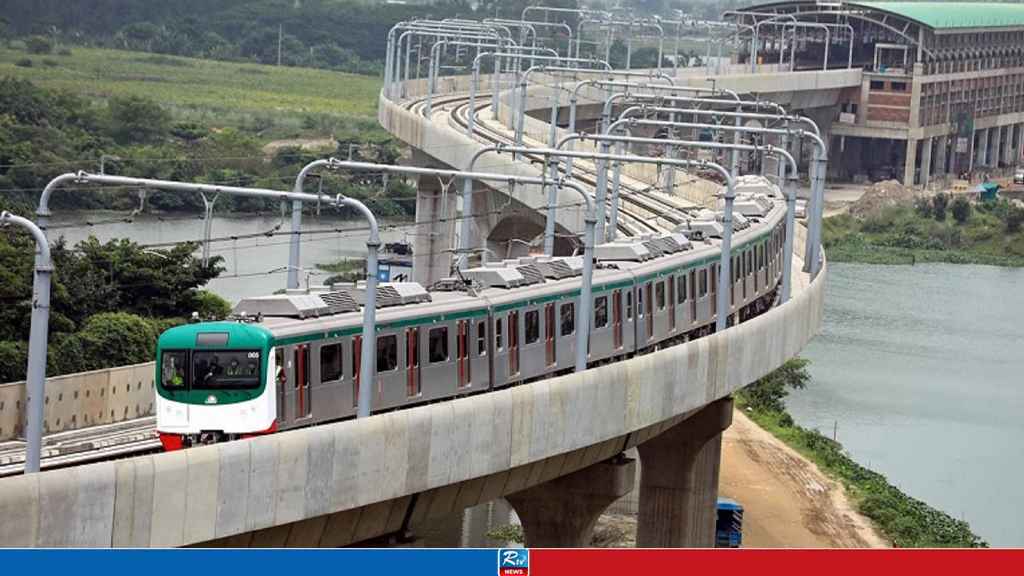
The Ministry of Road Transport and Bridges has launched a deep investigation following the tragic death of a pedestrian in the Farmgate area of the capital, caused by a bearing pad falling from a Metro Rail pillar.
A five-member committee has already been formed.
This is the second such incident, as another bearing pad from a pillar fell in the same area on September 28 of last year. Although no casualties occurred then, train service between Agargaon and Motijheel was suspended for 11 hours.
Operations Center Under Scrutiny
Serious allegations have now been raised against the Metro Rail's Operation Control Center (OCC).
It is alleged that even after being alerted about the pad falling, the OCC failed to act on the cautionary information and instead allowed two more trains to pass over the high-risk section.
First Train Report: A responsible source from MRT Line-6 indicated that three trains were near the location at the time. The operator of the leading train informed the OCC that the train "jumped" while entering the Farmgate station.
Second Train Ignored: No warning was issued for the second train. As it entered the Farmgate 'down' platform, it "dipped down and jumped up again." This train also immediately reported the issue to the OCC, causing panic among passengers.
Third Train Passed: Despite the reports, the OCC did not halt services. A third train proceeded from Farmgate towards Bijoy Sarani on the 'up' line. This operator also reported that the train was "tilting" and passengers were afraid. Only then did the OCC issue a "platform hold" instruction to all trains.
Maintenance Failure Suspected
Another responsible source suggests that the fallen bearing pad was observed to have undergone a slow, gradual degradation over a long period, becoming thinner on one side and thicker on the other.
This indicates a progressive decay over time. As the train's load fell on the thinner section, it came loose. The source speculates that the Maintenance Team failed to notice this for an extended period, suggesting a lapse in maintenance.
Experts Demand Design Review
Communication experts have expressed grave concern over the fall of the nearly 150 kg bearing pad. They argue that design flaws in the Metro Rail section near Khamarbari are causing a recurrence of accidents.
They state that the curved sections are not suitable for high-speed operation and that the bearing pad's guiding mechanism may be weak or absent.
Experts are advising an urgent review of the entire design, suggesting that the pads be secured with screw-locks or protective frames, and that a comprehensive project audit be conducted by an impartial panel of experts.
DMTCL Managing Director's Statement
Faruk Ahmed, Managing Director of DMTCL, spoke to the media at the site, stating, "The probability is that [when] the train was jerking there, it might have fallen. It might have slipped to this side. Then the bearing pad fell to the ground.
"He acknowledged the previous incident, saying, "This exists in all countries of the world, it is this way... I am looking into the investigation of the contractors—Tai-ken and Tekken Avinco Abdul Monem. A similar incident happened before. At that time, we took steps, and the steps were effective. Now we have to see why this incident happened even after those steps were implemented.
"He added that they are arranging to bring in external experts to analyze the incident and asserted that the Metro Rail authorities never want any loss of life.
Design Flaw as Root Cause
Experts believe such an incident is extremely rare and point to potential design or installation flaws. Officials from DMTCL have also not ruled out this possibility in their initial observations.
It is worth noting that a joint venture of Japanese consulting firms, NKDM Association, was responsible for the design and supervision of the entire Metro Rail structure, including the line, spans, and bearing pads.
Dr. Md. Hadiuzzaman, a communication expert and professor at Bangladesh University of Engineering and Technology (BUET), stated that the falling of the bearing pad is likely a result of a design flaw.
Despite the Dhaka Metro Rail being declared a 'high-speed corridor,' the design limitations in the curve sections require trains to slow down to $30-35 ext{ km/h}$, undermining the project's high-speed standard and increasing safety risks.
He stressed that the elastomeric rubber pads used between the viaduct and the pillars lack a proper 'guiding mechanism'. This allows them to become displaced over time, creating a risk of accidents. He believes that while the design is Japanese, it may not have adequately accounted for Dhaka's complex geographical structure and the curved sections.
He concluded that an impartial expert committee must audit the entire corridor and review the design immediately.
Dr. Hadiuzzaman also advised verifying the safety of the straight sections, not just the curves. He suggested installing protective railings or screw-fixing mechanisms around every bearing pad if necessary.
He warned that failure to correct the design shortcomings could lead to further accidents, questioning both the project's safety and public trust.








 Live TV
 RTV Plus