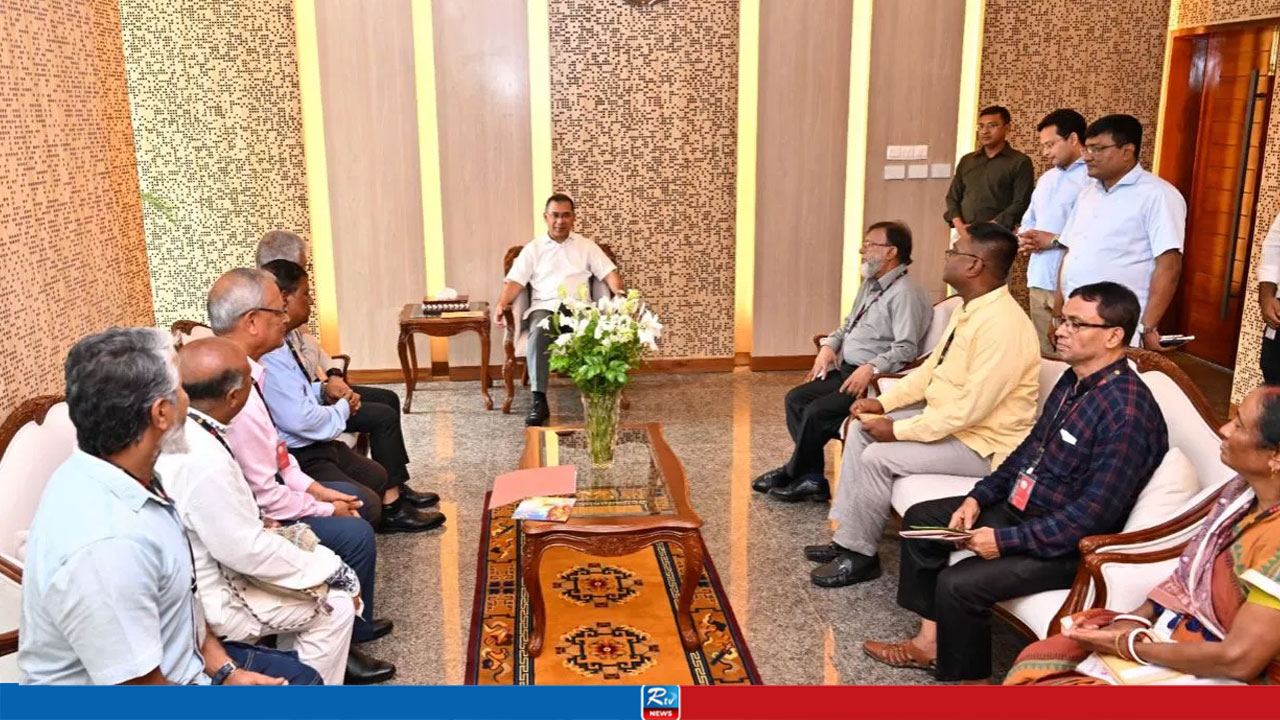
Prime Minister Tarique Rahman on Tuesday welcomed the interest expressed by the Netherlands government in conducting a feasibility study for the Teesta project alongside providing technical assistance and expert guidance for its execution.
He extended the welcome during a meeting with a visiting delegation headed by Dutch Minister for Foreign Trade and Development Cooperation Sjoerd Sjoerdsma at the Prime Minister's Office in the Secretariat, according to PM's Deputy Press Secretary Shahadat Shadhin.
The high-level discussions centered on bolstering bilateral trade relations, exploring a potential free trade agreement with the European Union (EU), water resources management, renewable energy, agricultural cooperation, human rights, and the ongoing Rohingya humanitarian crisis.
Highlighting shared geographical realities during the meeting, Tarique Rahman observed that Bangladesh and the Netherlands, as deltaic nations, possess significant potential to collaborate by tackling mutual challenges and sharing technical expertise.
He conveyed specific interest in adapting the Netherlands' advanced models and expertise in land reclamation.
Sjoerdsma underscored the necessity of expanding knowledge sharing, exchanging practical experiences, and deepening bilateral collaboration in water resources management, land reclamation, char development, and climate-resilient river governance.
The Dutch minister remarked that the current period presents an opportune moment to further solidify bilateral ties through increased investment and expanded cooperation, particularly across water management, trans-boundary river systems, democratic governance, and economic growth.
The agenda also covered free trade dynamics and Bangladesh's broader commercial relationship with the EU block.
While Sjoerdsma voiced interest in fostering free trade initiatives, Bangladesh requested Dutch support in examining the prospect of concluding a free trade agreement with the EU.
The Dutch minister inquired about state measures implemented to mitigate Bangladesh's prevailing energy crunch and commended the administration's strategic plans regarding renewable energy adoption.
Addressing the Rohingya crisis, Bangladesh reaffirmed that the origin of the displacement remains rooted in Myanmar and that any sustainable resolution must ultimately be achieved there, emphasizing Dhaka's commitment to ensuring the safe, voluntary, and dignified repatriation of the Rohingya population.
The meeting highlighted the urgency of reinforcing diplomatic engagements across bilateral and multilateral platforms to address the crisis effectively.
Drawing upon its agricultural heritage and technical capabilities, the Netherlands expressed intent to broaden sectoral cooperation with Bangladesh in agriculture.
Deliberations additionally focused on consolidating democratic practices and safeguarding human rights across Bangladesh.
The Prime Minister stated that the BNP, as a political entity, had historically endured human rights abuses, affirming that his administration remains dedicated to defending and fortifying human rights nationwide based on that experience.
At the conclusion of the session, Sjoerdsma extended an official invitation to the Prime Minister to visit the Netherlands.
The meeting was attended by Commerce Minister Khandakar Abdul Muktadir, Water Resources Minister Shahiduddin Chowdhury Anee, State Minister for Foreign Affairs Humaiun Kobir, Prime Minister's Adviser on Education, Expatriates' Welfare and Overseas Employment Mahdi Amin, Dutch Ambassador to Bangladesh Joris van Bommel, alongside senior government officials.




 Live TV
 RTV Plus