
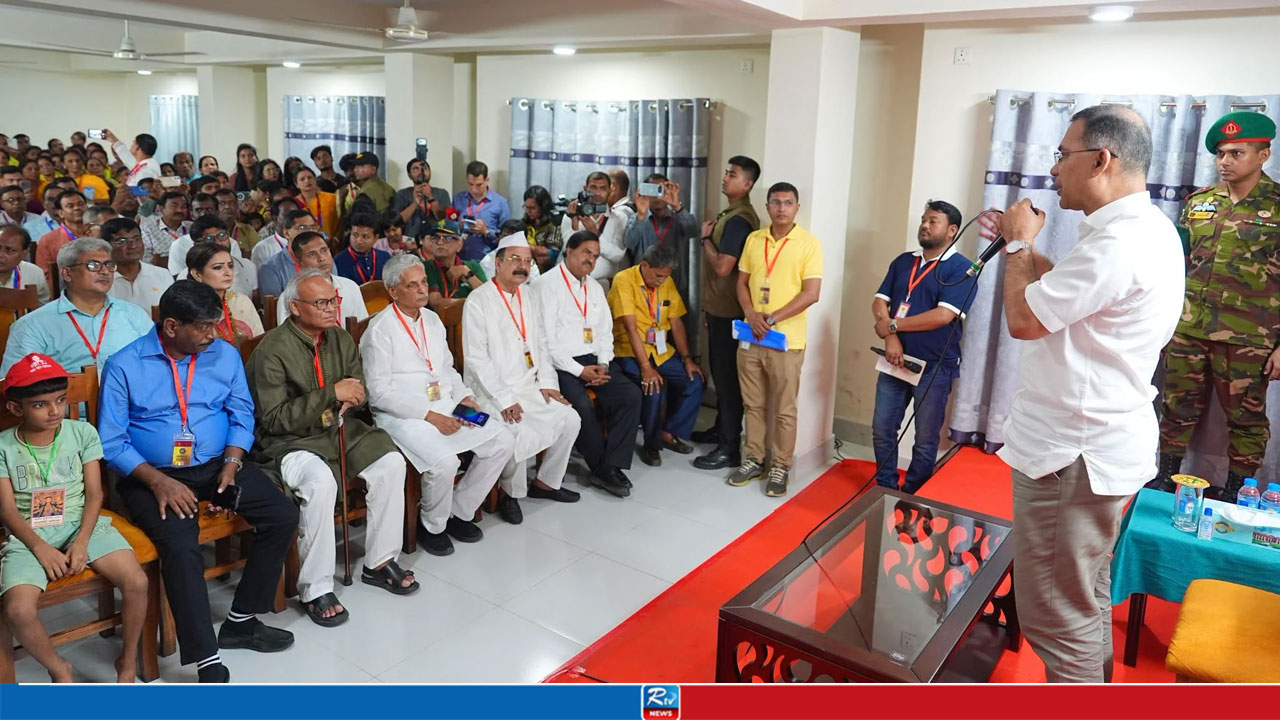
Prime Minister Tarique Rahman has asserted that all citizens share a single identity as Bangladeshis, transcending distinctions of minority or majority.
He made the remarks on Tuesday (October 20) while visiting a Puja Mandap in Chattogram.
Recalling the July–August mass uprising of 2024, the Prime Minister noted that people from all walks of life, professions, and age groups participated in the movement.
Hundreds of thousands of individuals—including mothers, sisters, children, and youth—took to the streets across every district of the country, ultimately forcing the authoritarian regime to relinquish power through their united efforts.
"It was not long ago—just over two years ago, in July and August 2024—that the people and students of this country ousted an autocrat," he said.
"Hundreds of thousands of people took to the streets across Bangladesh. Mothers, sisters, people of all ages, children, and youth came forward. None of us asked whether the person struck by a bullet was Muslim, Hindu, Buddhist, or Christian. The autocrat fired and wanted to cling to power. My brother was martyred; my brother was injured. Others rushed them to the hospital, some passing away along the way, while others survived with various injuries."
Emphasizing national unity, the Prime Minister stated,
"We are all Bangladeshis. There is nothing like minority or majority. Just as people from all communities plunged into the Liberation War of 1971 regardless of religion to snatch victory, the people of this country overthrew autocracy through the movement of '24."
Recalling the sacrifices of the Liberation War, Tarique Rahman remarked, "On the battlefield that day, hundreds of thousands of people fought, and hundreds of thousands were martyred. Those who fought and those who gave their lives—we did not look at whether they were Muslim, Hindu, Buddhist, or Christian. We saw only that they were fighting for the Liberation War. They wanted to liberate the country, and they did."
Highlighting subsequent struggles to protect democracy following independence, the Prime Minister said that whenever the nation's democracy faced threats, students, the general public, and political activists took to the streets to campaign for people's rights, freedom of speech, and voting rights, without ever considering anyone's religious identity.
"Even then, we did not check the religion of the activist standing beside us, in front of us, or behind us,"
he added.
Pointing out that religious identity played no role in the treatment of the injured, the Prime Minister stated that doctors at hospitals did not inquire about patients' religions, and treatment was never distributed on religious grounds. This profound display of mutual cooperation and humanity among the citizens proves that everyone's identity and rights as citizens are equal.




 Live TV
 RTV Plus
