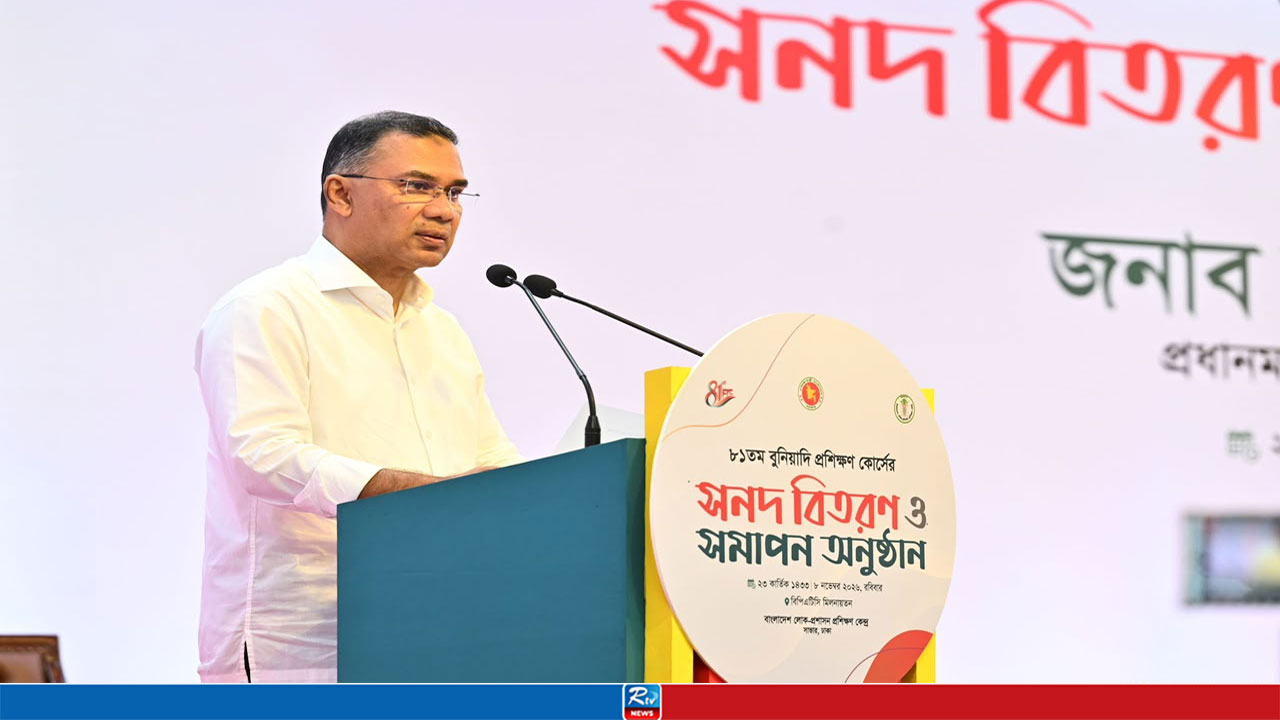
Show any political support in the ballot box, not in government offices—Prime Minister Tarique Rahman made this remark, addressing civil service officials.
He stated that he does not personally consider it a fault for administration officials to have support for a political party. However, that support should not be reflected in government work.
The Prime Minister said this while addressing newly commissioned BCS officers at the closing ceremony of the 81st Basic Training Course at the auditorium of the Bangladesh Public Administration Training Centre (BPATC) in Savar on Sunday (November 8) evening.
Tarique Rahman said, "As a government official, I do not believe there is scope for me to give a long speech on what you should or should not do in your professional life. Because I believe you certainly know best what to do and what not to do. Rather, having the sincere intent to implement known principles in the workplace is what is vital."
Highlighting his expectations from the young officers as the head of government, Tariq Rahman urged them to ensure that citizens of any age visiting public offices for assistance do not face any form of harassment.
Reminding them of a "Golden Rule" in this context, he said, "Treat others how you want to be treated." In other words, treat others the way you expect to be treated yourself.
The Prime Minister noted that everyone needs help from others at some point in life. When seeking assistance, the kind of behavior one expects from others must also be extended when someone approaches them for help.
Emphasizing the importance of humane behavior alongside carrying out duties in accordance with laws and regulations, the Prime Minister stated that an officer must complete actions within the framework of prescribed rules.
There is no scope to go beyond the law. However, whether humane treatment was accorded to the person concerned while handling the matter is extremely important in a modern state and administration.
Giving an example, he said that if a citizen brings an application with errors, asking them to correct those errors is neither illegal nor unfair. However, pointing out the specific error and advising where and to whom they should go to fix it reflects humanity and sincerity.
The people of the country expect humanity from officials, not just orders and directions.
Regarding postings and promotions, he noted that the public administration of a country has thousands of posts and designations.
Every position in the administration is necessary and important for the state and the government.
However, sometimes individuals compromise their professional skills and integrity to secure a preferred posting or promotion. Being mentally prepared to serve in any position, anywhere in the country, at any time is the true mark of professionalism.
Everyone must remember that just as a government is not permanent, no position in public administration is permanent for anyone.
Addressing the new officers, the Prime Minister noted that the Bangladesh Civil Service currently comprises 26 cadres in total. Upon completing training, officers will join various branches including administration, foreign affairs, agriculture, taxation, education, or information.
While the nature of work and workplaces may vary and administrative cadres differ, their primary and main identity is that they are public administration officers.
In this context, he emphasized, "You are there to serve the people."
Regarding the role of public administration in implementing the government's political programs, Tariq Rahman stated that the current government is executing its political agenda through the civil administration.
However, the difference is that the public voted this government into power specifically to implement these agendas.
The Prime Minister added that prior to the national election, representatives of the political party presented an electoral manifesto to the public. The people voted in favor of that manifesto. Consequently, the electoral manifesto is now the manifesto of the nation's people—a public document.
Implementing that manifesto is the responsibility of the present government, and he expects officials to work sincerely to fulfill that mandate through administrative work.
Stressing the need to make government services simpler and citizen-friendly, the Prime Minister remarked that a positive mindset among officers and employees is more effective than administrative initiatives in reducing red tape and streamlining services. He expressed hope that the new officers would play a key role in this regard.
The Prime Minister also drew the new officers' attention to environmental protection and cleanliness. He stated that greater focus is needed on protecting the environment, ecology, and maintaining cleanliness. Keeping homes, offices, and surrounding areas clean will make it possible to build a clean environment and nation for future generations.
At the beginning of his speech, the Prime Minister congratulated the young officers as they embark on a new chapter in life. He noted that after acquiring academic knowledge, they have learned techniques to apply that knowledge in practical life.
Now, as responsibilities are assigned within the government administration, officers must apply their knowledge to discharge those duties properly.
He mentioned that most of the officers officially beginning their careers are likely receiving their first postings. They are now part of the state's public administration. The more efficient the government administration is, the more successful the government's operations will be.
Therefore, an administration equipped with efficiency, integrity, and humane values is essential for the overall success of the government. These qualities enrich not only an individual officer but also the state and the government.
The Prime Minister wished the new officers happiness, peace, comfort, and success in their future professional lives.
Prime Minister Tarique Rahman attended the event as the chief guest at 6:00 PM on Sunday. He presented certificates to the top 10 officers participating in the four-month-long 81st Basic Training Course, followed by a directional speech to the newly appointed officers.




 Live TV
 RTV Plus