Dhaka 26 September, 2026

'BNP destroyed the democracy'

RTV News

Publish : 30 Dec 2022, 05:00 PM

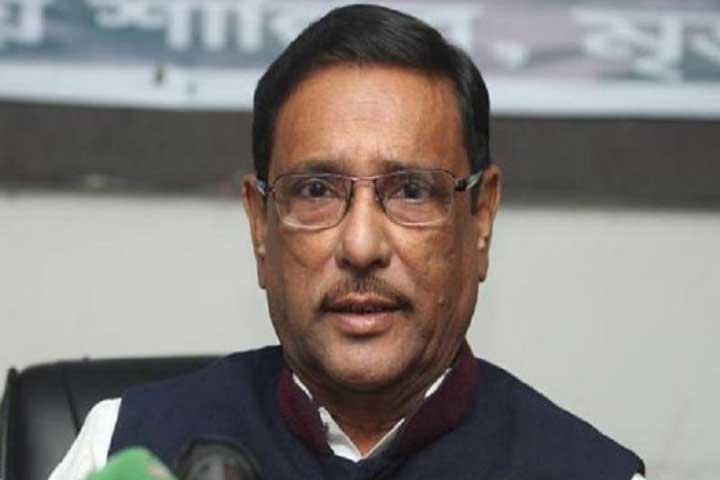
Obaidul Quader, General Secretary of Awami League stated that democracy of this state killed by the BNP.

On Friday, December 30 in the afternoon, Mr. Quader commented this at a peace rally organized by Awami League to protest against 'BNP-Jamaat's anti-national conspiracy and anarchy' at Shyamoli Square premises in the capital.

Quader said that BNP destroyed the state and killed the democracy. They do not bring the positivity in politics, they do bad politics. And those who do bad politics, they cannot build the state, they only can demolish the state.

Follow google news channel to get RTV news Google News
3 dead after being hit by train
At Gopalpur railway gate in Natore's Lalpur 3 people, including a woman, died after being hit by a train. On Saturday, December 31 at around 12:45 pm, the accident happened.  However, specification of deceased identity not been found so far. Lalpur Police Station Officer-in-Charge (OC) Monowaruzzaman verified the incident and said that the accident occurred when a Rajshahi-bound Tungipara Express train hit 3 people and they died. The police reached the spot after hearing the information. The matter has been reported to Ishwardi Railway Police.
3 dead after being hit by train
Dhaka gets first Mass-Transit Rail: Bloomberg report
Bangladesh’s capital now has its first metro rail, a Japanese-funded project that aims to ease commuting in one of the most congested cities in the world.  A section of the over 20-kilometer (12.427 miles) urban rail project, known as Line 6, was inaugurated by Prime Minister Sheikh Hasina Wednesday. The line connects the northern zone of Dhaka to a hub of government offices and hospitals in the middle for now. Eventually it will cut through the city to the financial district of Motijheel in the south.  While the project is likely to bring significant changes to how people travel in Dhaka, its inauguration will also give some much-needed political mileage to Hasina’s government. With elections expected in January 2024, the leader and her party are under pressure as the South Asian nation’s foreign currency reserves dwindle and it battles inflation and energy crises.  The metro rail “added another feather” to Bangladesh’s cap and is “another milestone in development,” Hasina said at the opening ceremony. She was the first passenger to ride the train amid tight security. The service will open to the public Thursday. In Dhaka, with 10.3 million people packed in 305 square kilometers (117.76 square miles), the average driving speeds have dropped to less than 7 kilometers (4.3496 miles) an hour right now from 21 kilometers an hour 10 years ago. Given the current trends, a World Bank report has estimated it could drop as low as 4 kilometers an hour, slower than walking.  “It’s an extremely important development for a city like Dhaka,” Martín Rama, a consultant with the World Bank’s presidency and former regional chief economist for South Asia, said in an interview. “If you look at the case of India in many cities, it has changed a lot the way people go to work. It’s a safe means of transportation, for instance, for women, which in South Asia is not trivial.” At the same time, Rama said it would be “naive to think that congestion problems will go away” immediately because every time a country builds public transport infrastructure and adds more capacity, 90-95% of the freed up road space is taken up by additional traffic.  Traffic congestion wastes about 3.2 million working hours each day and costs Bangladesh’s economy billions of dollars every year. Dhaka is the seventh least livable in a list of 172 cities in the world on the Economist Intelligence Unit’s Global Livability Index for 2022. “The bigger your city is, the more time you spend typically commuting,” said Rama. “So it’s a congestion cost that detracts from what the city has to offer.” Bangladesh approved 219.85 billion taka ($2.1 billion) fund for the Line 6 project in 2012, with Japan providing 165.95 billion taka at the time. The cost later escalated to 334.72 billion taka as the authorities added a new section linking the metro rail to Kamalapur, the central railway station that connects Dhaka and the rest of the country.  Japan is also funding two other urban railway lines in Dhaka. When completed, three metro lines are projected to carry two million passengers daily, according to Japan International Cooperation Agency’s website.   The Dhaka metro rail follows six months after Hasina inaugurated the country’s longest river bridge, spanning over 6 kilometers over the Padma River. That is expected to connect 80 million people — half the country’s population — linking the southwest to the northeast. 
Dhaka gets first Mass-Transit Rail: Bloomberg report
'I am not a perfect leader'
Among the political parties in the country, Awami League, led by Sheikh Hasina, is the only one that practices internal democracy, General Secretary of the party and Minister of Road Transport and Bridges Obaidul Quader made the statement on Friday. He said, 'The Awami League is the only one political party in Bangladesh that practices internal democracy. It do not know whether there is any other party holding regular conferences in accordance with the constitution of the party. Obaidul Quader remarks this at a press conference organized at the Awami League's central office on Bangabandhu Avenue today. This press conference was organized by the party on the occasion of the 22nd National Conference of Bangladesh Awami League. The minister said, ''Through the national conference, we want to give a spontaneous message to the people of the country that we stand by the people and will stand by them. Awami League wants to build a 'Smart Bangladesh' by learning from the past mistakes with the advice of the people in the next election as well." In response to a question from journalists, Obaidul Quader said, "I am not a perfect leader. There may be mistakes in the performance of duties. Such a large political party like Awami League there will be some successes as well as failures."
'I am not a perfect leader'
Fifty Years On: Why Are Pakistani Generals Not Held Accountable For Events Of 1971?
December 16 marks 50 years since Pakistan lost to Dhaka. Even today, the Bengali liberation effort confuses many Pakistanis – over losing a part of the country to Indian forces or no longer having to deal with the Bengali identity crisis prior to the liberation of Bangladesh. After independence in 1947, Pakistani governments and military did not consider Bengalis a worthy member of their circles. They glossed over the Bengali Liberation War. But, now, will they recognise the mass massacre they sponsored 50 years ago? East Bengal was never considered equal to West Pakistan. Pakistan’s declaration of independence in 1947 supported Urdu as the official language. The demand of East Pakistan to make Bangla one of the main languages was resisted. Public rallies or meetings to discuss the idea of Bangla as a language were outlawed. On February 21, 1952, students of the University of Dhaka protested and called for the recognition of Bangla as the main language in East Pakistan. They met severe resistance from police, killing four students. In response to the tragic events of 1952, the UN recognises February 21 as International Mother Language Day every year. In 1956, the Iskander Mirza government finally gave in to the Bengali cause, and recognised Bangla as an official language under the newly-formed Islamic Republic’s constitution. Regardless, protests against highhandedness by West Pakistan become a regular occurrence in East Pakistan. The Pakistani government approved ‘Operation Searchlight’ — a mission to subside the Bengali calls for independence. It had specifically called for the removal of Sheikh Mujib, the leader of Awami League. Mujib had won a decisive majority in East Pakistan, yet Pakistanis were unwilling to transfer power to him and his party. This, however, proved to be least of problems for Bengalis. Over a nine month period, West Pakistan, led by General Tikka Khan and General Khan Niazi, was responsible for deaths of over three million Bengalis, and rape of some 400,000 women across the region. Major Khadim Hussain Raja, in his book A Stranger in My Own Country, discussed the unholy tactics employed by Niazi throughout the genocide — “in the presence of Bengali officers, Niazi was often found to say ‘I will change the race of the Bengalis.’” The Hamoodur Rahman Commission of 1971 received many witness statements which confirmed Niazi’s sentiment for genocidal rape. One witness statement read, “stationed troops used to say that when the Commander himself was a rapist, how could they be stopped?” The genocide which had ensued in 1971 was entirely destructive to Pakistan’s reputation in the world. Pakistan continues to hold a pick-and-choose sentiment when it comes to events that took place 50 years ago. Still many of us look back at 1971 with great justification, using straw-man arguments to back up the cause for the genocide — much to do with a select number of Bengalis targeting Biharis for their allegiance to West Pakistan. Genocide, however, in any form, is intolerable. To simply hold a ‘forgive and forget’ attitude, as Pakistan much does, is unacceptable. Why are Pakistani generals not held accountable for crimes against humanity? Once a symbol for universal poverty, Bangladesh has long dismissed the chains of impoverishment it once spearheaded. The Bengali Taka’s buying power is now double that of Pakistani rupee. The republic of Bangladesh has long forgotten its relation in adversity, choosing instead to thrive. Source: The Friday Times  The Article is written by Abdullah Raza, A student of law and politics at the National University of Ireland.
Fifty Years On: Why Are Pakistani Generals Not Held Accountable For Events Of 1971?
Bangladesh Muktijuddha Mancha requests Pakistan to apologise for 1971 war crimes
Bangladesh Muktijuddha Mancha (BMM) wrote a memorandum to Pakistan’s Prime Minister Shehbaz Sharif and requested an unconditional apology for the attack and atrocities during the 1971 liberation war. In the memorandum, BMM writes, “Request the government of Pakistan in general and Pakistani Army in particular, to offer an unconditional apology to our Prime Minister and leader Sheikh Hasina and to the people of Bangladesh for the brutalities in Bangabandhu killing, 21st grenade attack and the atrocities of 1971 liberation struggle.” The memorandum also demanded Pakistan to desist, overtly or covertly, from engaging with those forces that stood against our freedom struggle and also the trial of the Pakistani army involved in killings and Genocide during the Liberation War of Bangladesh in 1971. In the memorandum, Bangladesh Muktijuddha Mancha reminded about the 1971 Liberation struggle of Bangladesh and said thirty Lakhs people were killed and Pakistani militaries raped two lakhs of women, during the war. The party also said that Pakistan ISI was directly involved in Bangabandhu Sheikh Mujibur Rahman killing. “To take revenge for surrender in the Liberation War, Pakistan started conspiring against Bangabandhu’s government. With the help of Zia-Mostaque, Pakistan killed Bangabandhu and his family members which was the most brutal political killing in the world,” the memorandum reads. Pakistan also patronised and supplied grenades to BNP-Jamaat-Huji to kill Bangabandhu’s daughter Shiekh Hasina on August 21, 2004. Some Awami League leaders created human protection to save the life of Sheikh Hasina. Finally, Sheikh Hasina was saved but 24 Awami League leaders were killed due to grenades attack,” it added. Bangladesh Muktijuddha Mancha also said that Pakistan cannot avoid responsibility for these killings. Party threatened Pakistan and said that if the country continues sponsoring terrorism in Bangladesh, they will make that their government would be bound to cut all diplomatic relations with Pakistan. “We demand to United Nations to bring the Pakistan militaries under the trial of the International War Crimes Court for their involvement in genocide and intellectuals killings in 1971,” the party concluded the sentence. The latest good news for Bangladesh is that Pakistan’s “genocide” against Bengalis, and Hindus in the 1971 war has been finally recognized as the US House condemns Islamabad’s actions and called on President Joe Biden to recognise the atrocities. The legislation brought by Congressmen Ro Khanna, and Steve Chabot, recognise Pakistan’s atrocities against ethnic groups constitute crimes against humanity, war crimes, and genocide. “…condemns the atrocities committed by the Armed Forces of Pakistan against the people of Bangladesh from March 1971 to December 1971; recognizes that such atrocities against ethnic Bengalis and Hindus constitute crimes against humanity, war crimes, and genocide; calls on the President of the United States to recognize the atrocities committed against ethnic Bengalis and Hindus by the Armed Forces of Pakitan during 1971 as crimes against humanity war crimes, and genocide,” the legislation read. Source: ANI
Bangladesh Muktijuddha Mancha requests Pakistan to apologise for 1971 war crimes
Read More
Peace or BNP-Jamat alliance’s mischief, Hasina asks Bangladesh to choose
India is world's largest democracy, home to great diversity of faiths: US
How does BNP’s Political Culture impact in Bangladesh?
Khaleda, Tarique disqualified for polls as per laws: Quader