Dhaka 05 October, 2026

Why Swami Vivekananda’s Call for Religious Harmony Still Matters 133 Years after Chicago

Probir Chandra Das

Publish : 13 Sep 2026, 02:29 PM
Swami Vivekananda seated on stage at the Art Institute during the World’s Parliament of Religions conference 1893 in Chicago. -Collected Photo

On 11 September 1893, a young monk from India stood before nearly seven thousand people at the World’s Parliament of Religions in Chicago and began with four words that still reverberate: “Sisters and Brothers of America.”

The hall rose in a standing ovation lasting more than two minutes. In that instant Swami Vivekananda did not simply introduce Hinduism to the West; he issued a challenge that remains unfinished 133 years later — the choice between harmony and fanaticism.
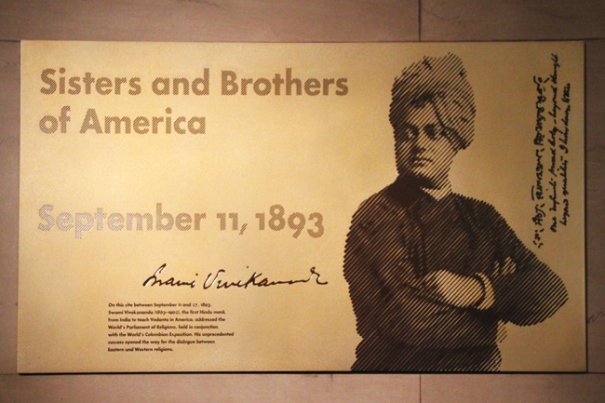
A plaque placed outside Fullerton Hall, commemorating the location of Swami Vivekananda’s famous speeches calling for an end to religious bigotry, hatred and intolerance. -Collected Photo

As we mark the 133rd anniversary in 2026, the question feels sharper than ever. In an age of artificial intelligence, climate anxiety, religious polarisation and digital tribalism, why does a speech delivered under gaslight still matter? Because its central insight has not been answered: the deepest truth of religion is the oneness of humanity, and genuine spirituality must liberate rather than divide.

Narendranath Datta, who became Swami Vivekananda, reached Chicago almost by accident — with little money, no formal invitation and only a letter of introduction.

On 11 September he was thirty, clad in the ochre robes of a sannyasi, carrying the spiritual weight of an ancient civilisation into a hall that expected the East to appear as a curiosity. He refused that role.

In his opening address and the talks that followed — especially “Why We Disagree” — he rejected both aggressive proselytisation and defensive apologetics. He presented the Vedantic vision that all religions are paths leading to the same summit.

Quoting the Bhagavad Gita he declared: “Whosoever comes to Me, through whatsoever form, I reach him; all men are struggling through paths which in the end lead to Me.”

He condemned sectarianism, bigotry and fanaticism as the true enemies of religion. The test of a living faith, he insisted, is not the number of converts it claims but the character it produces and the compassion it inspires.

To drive the point home he told the parable of the frog in the well. A frog who had lived its whole life in a small well met another from the ocean. When the ocean frog described the vastness of the sea, the well frog could only measure it against the walls of its own narrow home and dismissed the larger reality as impossible.
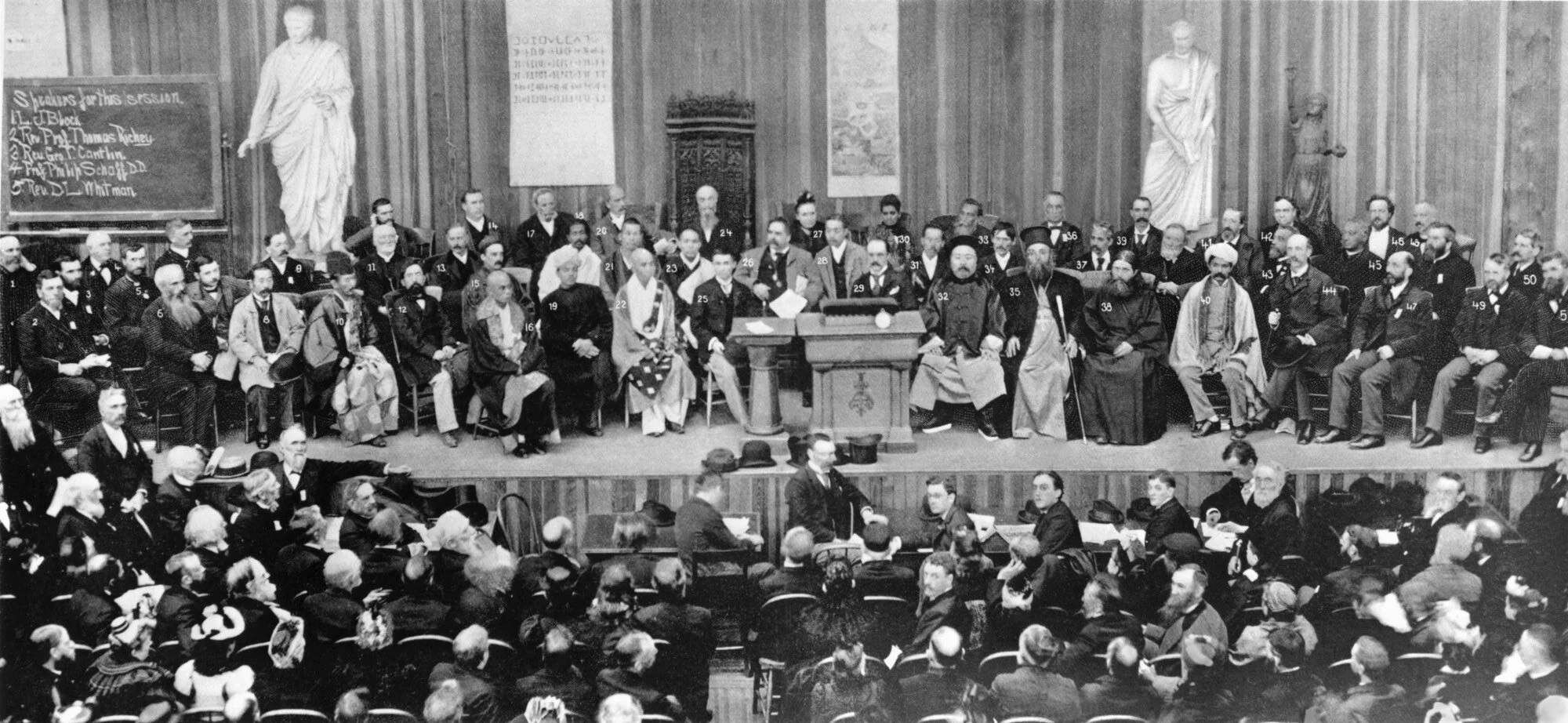
Religious leaders and representatives at the World’s Parliament of Religions conference 1893 in Chicago. -Collected Photo

Vivekananda used the story to expose the mental prison of sectarianism: each tradition, trapped in its own well, mistakes its limited view for the whole of truth. The Parliament, he hoped, would help humanity climb out of those wells.

The speech was radical for its time. Colonial powers still spoke of a “civilising mission.” Many missionaries regarded other faiths as darkness awaiting the Gospel. Vivekananda asserted the dignity of every sincere spiritual tradition. He did not dilute Hinduism; he elevated the entire conversation.

The immediate impact was electric. American newspapers reported on the “Hindu monk” who had captivated the Parliament. Over the next few years Vivekananda lectured across the United States and Europe, founded the Vedanta Society, and planted seeds that later grew into a worldwide interest in yoga, meditation and Indian philosophy. When he returned to India in 1897 he was received as a national hero.

His message had reversed the colonial gaze: India was no longer merely a land to be saved; it had something essential to offer the world. The Chicago addresses became a founding document of modern interfaith dialogue. “We believe not only in universal toleration,” he said, “but we accept all religions as true.”

One hundred and thirty-three years later the problems Vivekananda diagnosed have only changed costume. Religious conflict continues to scar societies. Faith is still too often weaponised. Digital platforms have become the new wells: algorithms amplify the loudest voices, turning complex traditions into caricatures and locking users inside echo chambers that feel complete and absolute.

In this climate, Vivekananda’s insistence that every sincere seeker is equally worthy of respect is a radical act of courage. He never claimed that every doctrine is equally accurate. He claimed that the human being seeking the divine deserves dignity, regardless of the path chosen. Equally relevant is his critique of hollow religiosity.

“The poor, the illiterate, the ignorant, the afflicted — let these be your God,” he said. Climate refugees, economic migrants and those left behind by technological change stand as living tests of whether our faith traditions retain any moral force.

Vivekananda was a fierce patriot who wanted India to awaken to its spiritual strength, yet he never confused pride with chauvinism. He urged his countrymen to honour their heritage while remaining open to the best in other civilisations. That balance — rooted confidence without arrogance — is what many societies struggle to find today.

For the young the speech carries special power. Vivekananda placed his deepest faith in the younger generation. “My faith is in the younger generation, the modern generation,” he declared. “Out of them will come my workers. They will work out the whole problem, like lions.”

He saw youth not as a passive stage but as the most potent force for transformation — provided it was trained rightly.

That training, he insisted, must be education in the true sense. “Education is the manifestation of the perfection already in man,” he said. He rejected an education that merely filled the mind with information.

“We want that education by which character is formed, strength of mind is increased, the intellect is expanded, and by which one can stand on one’s own feet.” The end of all education, he argued, should be man-making — the building of fearless, compassionate, self-reliant human beings capable of serving others.

In a time of anxiety and digital distraction, these words cut with fresh force. Character, self-mastery and service remain the surest antidotes to both consumerism and nihilism.

Writer: Probir Chandra Das

The real test of the Chicago addresses is whether their spirit can still shape institutions and individual lives. Universities can teach comparative religion as a search for shared human questions and form character rather than merely transmit data.

Religious leaders can model the humility Vivekananda displayed. Policymakers can remember that social harmony is not produced by uniformity but by the capacity to hold difference without fear.

Ordinary citizens can practise the simple discipline of listening before judging — of climbing, however briefly, out of their own wells. Honouring the Chicago speech means offering a vision of unity that does not erase diversity.

At the final session Vivekananda expressed the hope that the Parliament would mark the death-knell of all fanaticism, of all persecution with the sword or the pen, and of all uncharitable feelings between persons journeying toward the same goal. That hope has not yet been fully realised. Wars continue to be fought in the name of God. Digital wells grow deeper every day.

Yet the fact that we return, generation after generation, to those words suggests that something in them remains unfinished and necessary. One hundred and thirty-three years on, the young monk’s voice still asks: Can we recognise the divine in those who pray differently? Can we build societies that honour both freedom of conscience and the bonds of common humanity? Can we make spirituality a force for liberation rather than control?

The answers will not come from repeating the speech. They will come from living it — imperfectly, persistently, and with the same courage that once made a hall in Chicago rise to its feet. In a world still hungry for meaning and still wounded by division, Swami Vivekananda’s message has not grown old. It has simply been waiting for us to climb out of our wells and catch up.

Writer: Senior Assistant Director, University Grants Commission of Bangladesh (UGC)

Follow google news channel to get RTV news Google News
Social Structure, Class and Access to Higher Education in Bangladesh
Education is supposed to promote the well-being of society. Ideally, it should unify citizens while fostering peace and solidarity, as well as sustainable socio-economic development. However, the situation is often the reverse. Education tends to reproduce social relations as well as the class structure in which it exists. 
Social Structure, Class and Access to Higher Education in Bangladesh
Achilles or Hector, that Is the Question!
Homer's Iliad is not simply a story about the Trojan War. It is a story about human nature. Behind the battles, blood and glory, Homer presents two very different kinds of heroes, Achilles and Hector. Both are great warriors. Both are brave. Both know that death is waiting for them. Yet they choose to live their lives in very different ways. 
Achilles or Hector, that Is the Question!
Janmashtami: Lord Krishna's Timeless Call to a Better World
In a world weary with conflict, greed, and division, the teachings of Lord Krishna, the eighth avatar of Lord Vishnu, feel less like ancient scripture and more like an urgent prescription for our times. 
Janmashtami: Lord Krishna's Timeless Call to a Better World
85th Death Anniv of Bishwakabi Rabindranath Tagore Observed Today
Nobel Laureate Rabindranath Tagore shared a profound spiritual connection with the monsoon clouds, the melody of rain, and the boundless beauty of nature. On a rainy day—a season he immortalized in countless poems, songs, and literary works—the universal poet bid farewell to this world.  Today, August 6 (corresponding to 22nd Shravan), marks the 85th death anniversary of this greatest luminary of Bengali literature. Rabindranath Tagore breathed his last on the 22nd of Shravan, 1348 BS (August 7, 1941) at the Jorasanko Thakur Bari in Kolkata. However, even more than eight decades after his passing, his literature, philosophy, music, and humanistic consciousness continue to brilliantly illuminate Bengali-speaking people and global culture alike. Tagore began his writing journey at the tender age of eight. Over a long and illustrious literary career, he enriched the Bengali language with an invaluable treasure trove of poetry, novels, short stories, dramas, essays, travelogues, letters, children's literature, and songs. By composing over two thousand songs, he created a unique musical genre—Rabindra Sangeet—which remains an integral part of Bengali life, culture, and emotion to this day. Beyond literature, Tagore was a pioneer in educational thought, social reform, and human welfare. Driven by the vision of integrating education with nature and humanism, he established Shantiniketan, which later evolved into Visva-Bharati University. For the improvement of rural economies and the livelihoods of farmers, he introduced agricultural credit systems and various rural development initiatives, which were remarkably visionary steps for that era. In 1913, Tagore won the Nobel Prize in Literature for the English translation of his poetry collection, Gitanjali. He was the first Asian Nobel laureate in literature, and through this achievement, Bengali literature attained a new stature on the world stage. Tagore never compromised on the issues of humanity and justice. In 1919, in protest against the Jallianwala Bagh massacre, he renounced the 'Knight' title conferred upon him by the British government, setting a unique precedent of humanitarian protest for the world. Born into the renowned Tagore family of Jorasanko, Kolkata, on the 25th of Boishakh, 1268 BS (May 7, 1861), Rabindranath Tagore was the 14th of the 15 children of Maharshi Debendranath Tagore and Sarada Sundari Devi. Growing up in a rich environment of literature, music, philosophy, and culture, Tagore later experienced the nature of Bengal and the lives of its people deeply through boat journeys along the Padma, Meghna, and Jamuna rivers. The imprints of those experiences remain immortalized in his countless literary works. During Bangladesh's struggle for independence, Tagore's songs served as a source of courage, hope, and inspiration. His composition "Amar Sonar Bangla" is the national anthem of Bangladesh, while India's national anthem, "Jana Gana Mana," is also his creation. In world history, Tagore holds the unique distinction of being the author of the national anthems of two countries. Marking his death anniversary, various cultural, literary, and educational institutions across the country have organized discussions, commemorative events, poetry recitations, musical programs, and other activities. As part of these observances, Chhayanaut will stage the musical drama Shyama this evening (August 6) at 7:00 PM at the Chhayanaut Auditorium in Dhaka. The event is open to all. Rabindranath Tagore is not merely a poet; he is an eternal symbol of Bengali self-identity, culture, humanity, and secular consciousness. Transcending the boundaries of time, his creations continue to inspire new generations, making the 22nd of Shravan not just a day of a poet's passing, but a day to bow the head in deep reverence before his infinite legacy.
85th Death Anniv of Bishwakabi Rabindranath Tagore Observed Today
Afghan Taliban Clamp Down on Women, Smartphones, Protests
The Taliban are tightening the screws on women's clothing, shooting at protesters and ordering even their own officials to stop using smartphones. Behind the regime's omnipresent control, there are signs of deep anxiety. The news from Afghanistan — or at least the news that can be gleamed and pieced together through the screen of censorship imposed by the Taliban regime — is alarming. In early June, Taliban authorities detained at least 30 women in the western city of Herat over alleged violations of dress-code rules, according to the UN Assistance Mission in Afghanistan (UNAMA). The arrests triggered rare protests in Injil district, a predominantly Shiite area of Herat, a community already facing insecurity and discrimination at the hands of the extremist Sunni regime. Taliban forces responded with violence, shooting at protesters, according to UNAMA and human rights groups. At least two people were killed, including a child, and more than 20 others were injured.  The Taliban have rejected reports of the arrests. But the news has sparked anger among women's rights activists and renewed concern about the regime's ever-expanding control on women and public spaces.  Herat protests show resistance Two female members of the Afghan Women's Movement Network, who asked to remain anonymous for security reasons, described the arrests as part of a broader system of repression.  "Every woman arrested in Herat today is a symbol of the suffering of millions of Afghan women who live under the shadow of gender apartheid," one member told DW. "Women's freedom is their right. No to the Taliban!"  Another member of the network said the Taliban were criminalizing women's most basic choices. "The Taliban are arresting women for the crime of choosing how to dress," she told DW. "This behavior is neither religious nor humane. It is oppression of women and a clear violation of human dignity."  The protests in Herat were therefore not only a response to the arrest of women. They also showed that parts of Afghan society are still willing to challenge Taliban authority, despite the risks.  "These protests also showcase the resistance of the Afghan people and Afghan women," Nigara Mirdad, a former Afghan diplomat and women's rights activist, told DW. She said they also highlight "the solidarity of Afghan men with the women of the country," adding that this challenges the narrative the Taliban have imposed through force and tyranny over the past five years.  A symbolic fifth anniversary While Herat may seem as a local incident, it comes at a politically charged moment.  In August, the Taliban will mark five years since their return to power. Their first stint in power, from 1996 to 2001, also lasted roughly five years before it collapsed after the US-led invasion in response to the September 11 attacks.  Few observers expect a similar collapse now. The Taliban control state institutions, the security apparatus and most public life. Political opposition has been crushed. Independent media has been severely restricted. But the five-year mark carries historical weight. It reminds the people of Afghanistan that Taliban rule collapsed once before, despite appearing unshakable. Why the Taliban are tightening control Mohammad Osman Tariq, a religious scholar and deputy head of the Afghan Ulama Research Council, says the latest measures suggest anxiety inside the Taliban system.  The Taliban present many of their restrictions on women as a religious matter. Tariq rejects this framing and argues that the clampdown is primarily about preserving power.  "One reason why this current Taliban administration is tightening control and not allowing anyone — even women — to go out and protest, and why they even want to ban smartphones, is because they view all of this as a threat to their rule and existence," Tariq told DW. "Therefore, they are strictly avoiding it."  He said the public mood in Afghanistan has changed since the first years of Taliban rule. Some people who initially supported the Taliban, or hoped they had changed during the 20-year insurgency, have now become disillusioned, Tariq said. "It is natural that the Taliban fear for the continuation of their rule," he told DW. "They understand that, ultimately, this is a regime of oppression, and it will collapse. Even some of their own members believe that it cannot last." Smartphone ban fuels fear in Afghanistan The crackdown in Herat coincided with another draconian measure: Taliban officials and government employees were ordered to stop using smartphones. Videos circulating online appeared to show Taliban members destroying their phones in compliance with the order.  Many Afghans now fear that the same restrictions could eventually be extended to the entire population. In a country where independent journalism has been severely weakened and many reporters face intimidation, phones have become political instruments. Smartphones are one of the few remaining tools people can use to document abuses, share videos of protests and send evidence to media and rights groups outside the country.  The new smartphone ban indicates the regime's desire to control not only what people do, but also what can be seen.  Taliban view Afghan women as easy targetShinkai Karokhail, a former Afghan member of parliament, diplomat and rights activist, says the Taliban's repression is also linked to their failure to govern.  "Unfortunately, the Taliban regime has failed to meet the needs of the people, provide public services, or create employment opportunities," Karokhail told DW. "Consequently, they now fear a public uprising against them."  "In their view, the people must be intimidated and suppressed in various ways to prevent them from raising their voices," Karokhail said. "For the Taliban, women are the easiest and a soft target against whom they can use force to silence them." The Herat arrests reflect a broader pattern. Since returning to power, the Taliban have issued dozens of decrees restricting women's rights. They have barred girls from education beyond sixth grade, banned women from universities, restricted women's employment, closed many public spaces to women and enforced strict rules on dress and movement.  While the Taliban defend these policies as Islamic and culturally appropriate, Afghan women's rights activists see them as political tools to erase women from public life and incite fear.  Regime's grip exposes crisis of legitimacy Apart from the conflict with Pakistan, the Afghan Taliban face much less pressure from abroad today than when they seized power in 2021.Russia has officially recognized the Taliban authorities as the new Afghan government, while other nations maintain practical engagement despite refusing formal recognition.  Ex-diplomat Nigara Mirdad says the world's attention has moved onto other issues and crises. "It is impossible for them to continue with the policies they have implemented over the past five years," she told DW, but also noted that the international context has helped the Taliban remain in power longer than many expected.  That leaves Afghans in a difficult position. Inside the country, public anger is dangerous to express. Outside the country, the world is more concerned with security, migration and regional stability.  The events in Herat show both sides of this moment. The Taliban are tightening their grip as the world looks away. But the protests also show that control is not the same as legitimacy. 
Afghan Taliban Clamp Down on Women, Smartphones, Protests