Dhaka 27 September, 2026

Pakistan's inflation touches 29.8% amid rise in food, energy prices

ANI

Publish : 08 Aug 2023, 03:55 PM

A series of sharp rises in energy and food prices in Pakistan, pushed its weekly inflation up by 1.30 per cent and annualised inflation up to 29.83 per cent, Geo News reported on Saturday citing The News.

According to the Pakistan Bureau of Statistics (PBS), the increase in the sensitive price indicator (SPI) was attributed to an increase in the prices of tomatoes (16.85 per cent), LPG (9.82 per cent), petrol (7.86 per cent) and diesel (7.82 per cent), chilli powder (7.58 per cent), garlic (5.71 per cent), onion (5.50 per cent), powdered milk (5.17 per cent), eggs (3.86 per cent) and broken basmati rice (2.06 per cent).

On the other hand, a major decrease was observed in the prices of mustard oil (1.63 per cent), chicken (1.40 per cent), vegetable ghee 1kg (0.51 per cent), vegetable ghee 2.5kg (0.36 per cent), pulse gram (0.22 per cent), wheat flour (0.20 per cent) and pulse moong (0.03 per cent).


For the week under review, SPI was recorded at 271.56 points against 268.08 points registered last week and 209.17 points recorded during the week ending August 8, 2022.PBS compiles SPI by collecting prices of 51 essential items from 50 markets in 17 cities of the country.

During the week, out of 51 items, prices of 23 (45.10%) items increased, 7 (13.72%) items decreased and prices of 21 (41.18%) items remained unchanged, Geo News reported.

Notably, different weights are assigned to various commodities in the SPI basket.

Commodities with the highest weights for the lowest quintile include milk (17.5449 per cent), electricity (8.3627 per cent), wheat flour (6.1372 per cent), sugar (5.1148 per cent), firewood (5.0183 per cent), long cloth (4.2221 per cent), and vegetable ghee (3.2833 per cent).

Out of these commodities, the price of milk, sugar, and firewood went up; wheat flour and vegetable ghee decreased; whereas prices of long cloth, and electricity remained unchanged, Geo News reported.
Sakina, a homemaker from North Nazimabad said that she does not know how to cater to the food needs of her children, particularly meat.

"Chicken is PKR 600/kg at my local shop, beef is more than Rs1,100 and mutton - I have not even bothered checking its price," she lamented, adding that just 250 grams of tomatoes cost 50 PKR, which means straight up PKR 200/kg.

"With growing kids, running the kitchen in a single and meagre salary has become close to impossible," Geo News quoted the homemaker.

The year-on-year (YoY) trend depicts an increase of 29.83 per cent, on account of rising prices of wheat flour (131.40%), cigarettes (109.57 per cent), gas charges for Q1 (108.38 per cent), tea (97.71 per cent), broken basmati rice (82.86 per cent), rice irri-6/9 (73.73 per cent), tomatoes (67.54 per cent), chilli powder (66.74 per cent), sugar (64.12 per cent), chicken (60.51 per cent), gents sponge chappal (58.05 per cent), gur (57.75 per cent), and potatoes (55.75 per cent), according to Geo News.

Commodities that registered a YoY decline in prices included onions (37.10 per cent), electricity for Q1 (18.06 per cent), pulse masoor (15.07 per cent), and vegetable ghee 1 kg (1.13 per cent).

A working woman, wishing to remain anonymous, said that her father had taken a bank loan.

"Since the interest rates have been increased by the central bank, paying the instalment takes up a major chunk of our combined income," she said, sharing that for a day this week her family had no wheat flour at home to make roti.

"We used to be a regular middle-class family, but I feel we are now poor," she said.

Notably, Pakistan is battling a huge economic crisis, with staggering inflation and depleting Forex reserves.

Weeks before, IMF approved a USD 3 billion bailout to support Pakistan in avoiding a default on its debt repayments.

With sky-high inflation and foreign exchange reserves barely enough to cover one month of controlled imports, Pakistan has been facing its worst economic crisis in decades, which analysts say could have spiralled into a debt default in the absence of the IMF deal.

Follow google news channel to get RTV news Google News
China population: reluctance to marry, have kids continued in 2022 as demographic woes deepened
Willingness to get married and have children continued to fall in China last year, with a significant drop also seen in the interest to raise a second child, an official yearbook on population and employment statistics for 2022 showed. Over 51 per cent of people aged between 25 and 29 in China remained single in 2022, up from 48.7 per cent for the previous year, the 2023 China Population and Employment Statistical Yearbook showed. The unmarried rate for the thirty-something age group also rose mildly, according to data based on a sample survey conducted by the National Bureau of Statistics in November 2022. Meanwhile, the annual fertility rate for women of childbearing age – the number of births for every 1,000 women aged between 15 and 49 – dropped from 31.27 in 2021 to 30.22 in 2022, the survey showed. The fall in China’s fertility rate was largely caused by a plunge in the number of babies born as a second child, which slumped from 13.48 to 9.58 per 1,000 women, according to the yearbook. Authorities have issued a series of incentives to encourage couples to have bigger families over the years after China introduced a three-child policy in May 2021 having officially ended its one-child policy in January 2016. Reasons for the growing reluctance to get married and have children include the high cost of starting a family and pursuit of diversity and individuality. It underscores the demographic pressure China is facing as its population shrinks and grows older, which threatens long-term economic development. Source: South China Morning Post
China population: reluctance to marry, have kids continued in 2022 as demographic woes deepened
Tibetans in quake-hit areas get scarce aid from Chinese government
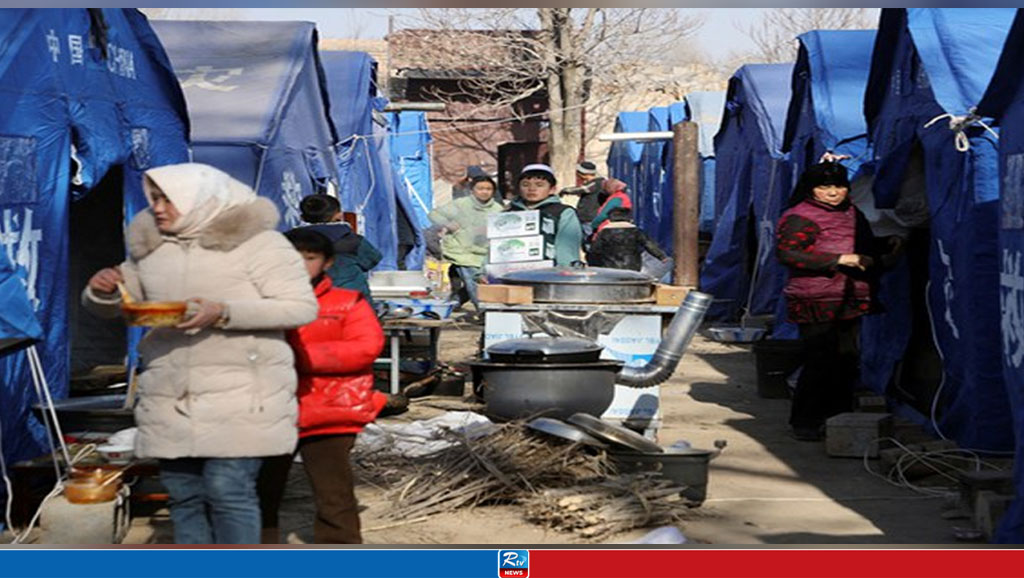
Tibetans in earthquake-affected areas of China’s Qinghai Province have received scarce help from the Chinese government, except for “some tent facilities” and utilities checks for those whose homes were destroyed by a December earthquake, at least three sources inside the country told Radio Free Asia.   A magnitude 6.2 earthquake rocked the northwestern Chinese provinces of Qinghai and Gansu on Dec. 18 — one of the most powerful earthquakes the country has seen in recent years — killing at least 149 people and injuring over 780 others.    The earthquake brought down buildings across Jishishan county and Linxia Hui Autonomous Prefecture in Gansu — the worst hit province — as well as in parts of neighboring Qinghai, a province on the Tibetan plateau. The affected areas in Qinghai are mainly populated by Tibetans. In the absence of adequate aid from the Chinese government, Tibetans in other parts of Chinese-occupied Tibet as well as Tibetan lay and monastic communities have sent funds and supplies to those displaced by the quake, said the sources, who asked not to be identified for safety reasons.    “Other than laying a few tents three days after the quake, the Chinese government did not provide any special assistance or aid, but many Tibetan individuals, organizations, and monasteries from all over Tibet have volunteered help with funds and relief materials, so we have not faced any immediate difficulties,” at least two sources told RFA. Another source noted that more than a week after the earthquake, Chinese authorities had conducted checks to see if water and electricity supplies were flowing but that no other aid or housing and relocation facilities had been provided.   China’s local housing and urban-rural development bureau, however, said it is building 15,000 prefabricated houses in Gansu for quake-affected people and estimates they will be completed by the end of December, Chinese state media reported.
Tibetans in quake-hit areas get scarce aid from Chinese government
North Korea plans to launch three satellites in 2024
Pyongyang has carried out a record amount of missile tests this year. North Korean leader Kim Jong Un said that it was a "mistake" to try to reunify with Seoul and warned of the risk of "war" in the peninsula. North Korea plans to launch three satellites in 2024, state media reported on Sunday. Meanwhile, North Korean leader Kim Jong Un said that it is a "mistake" to pursue unification with the south. Pyongyang announces satellite plan at party meeting "The task of launching three additional reconnaissance satellites in 2024 was declared" as one of the key policy decisions for 2024 at a party meeting, the KCNA news agency said. The meeting lasted for five days and was attended by Kim. North Korea has carried out a record number of weapons tests in 2023 and aims to increase its military capabilities. This month, it launched its most powerful intercontinental ballistic missile. North Korea also announced plans to build unmanned drones and develop electronic warfare capabilities, as well as to strengthen nuclear and missile forces. Japan, South Korea and Washington have stepped up cooperation in reaction to Pyongyang's increased missile tests. The three countries have recently activated a system to share real-time data on North Korean missile launches. North Korea has previously described Washington's participation in joint drills on the Korean peninsula as a "provocation." Kim dismisses unification with south, warns of 'war' North Korea's leader said that Pyongyang would no longer seek unification with Seoul. "I believe that it is a mistake that we should no longer make to consider the people who declare us as the 'main enemy'... as someone to seek reconciliation and unification with," Kim was cited by KCNA as saying. "Because of reckless moves by the enemies to invade us, it is a fait accompli that a war can break out at any time on the Korean peninsula," he said. He accused Washington of posing "various types of military threat" and ordered North Korea's military to maintain "overwhelming war response capability." "We must respond quickly to a possible nuclear crisis and continue to accelerate preparations to pacify the entire territory of South Korea by mobilising all physical means and forces, including nuclear force, in case of emergency," he said. "If we look closely at the confrontational military actions by the enemy forces .... the word 'war' has become a realistic reality and not an abstract concept," Kim said. He said that South Korea had been transformed into a "forward military base and nuclear arsenal" of the United States.
North Korea plans to launch three satellites in 2024
Venice bans large tourist groups
Venice officials are imposing new rules on groups of visitors coming to the popular lagoon city, aiming to curb negative effects of mass tourism. The city of Venice will ban tourist groups consisting of more than 25 people and will outlaw loudspeakers — which can "generate confusion and disturbances" — on such tours, the city council decided on Saturday. The new rules also prevent stopping at narrow streets, bridges or places of passage. They are set to take effect on June 1. The changes are part of the authorities' effort to limit mass tourism and its negative effects on the northern Italian lagoon city. The rules apply to the city center and the islands of Murano, Burano and Torcello. They are aimed to protect residents from noise and nuisance, the cuty council said in a press release. Mass tourism has been causing problems for Venice — one of the most famous tourist destinations in the world — for many years. The historic center with the famous Piazza San Marco, the Rialto Bridge and the many canals no longer has even 50,000 permanent residents. On some days during the high season, visitors outnumber the locals by more than two to one. In September, local officials decided to charge an admission fee of €5 ($5.50) for short-term visitors from April 2024. In a report published in summer 2023, the UN cultural agency UNESCO pointed at over-tourism and over-development as some of the major threats to the Italian hotspot, with a growing number voices calling for the city to be placed on  UNESCO's list of heritage sites in danger. Restricting tour groups to less than 25 people and the ban on loudspeakers will contribute to sustainable tourism, said Elisabetta Pesce, Venice's city councilor for security.  
Venice bans large tourist groups
Emboldened Iran silences critics as world looks elsewhere
In the shadow of the Israel-Gaza war Iran's rulers are settling scores with internal critics. Women who refuse to wear the headscarf are being severely punished, activists are persecuted and prisoners have been executed.   As least 690 prisoners were executed in Iran in 2023, as of December 1, according to the human rights organizations Center for Human Rights in Iran and the Oslo-based Hengaw Organization for Human Rights, whose data was based on official Iranian statistics.   However, rights organizations believe a considerable number of unreported executions have been carried out hidden from the public eye and often only come to light years later, when bereaved relatives have the courage to speak out. "The world is distracted by the Gaza war. The Islamic Republic of Iran is taking maximum advantage of this situation to crack down on its critics, especially with executions that I would characterize as state murder for revenge, and to intimidate society through violence," Saeid Dehghan, an Iranian human rights activist, told DW. Dehghan, who has lived in Canada since 2022, has founded a worldwide network of Iranian lawyers. He heads a legal center called Parsi Law, which provides legal advice to people in Iran. The center also supports international organizations, such as UN bodies, in their efforts to improve human rights in Iran.  "The sad reality is that as soon as the streets in Iran are emptied of protesters, the country is forgotten and the global community returns to business as usual with the Islamic Republic," said Dehghan.  "Human rights activists understand that every country worldwide pursues its own interests. Nevertheless, the massive oppression in Iran must not be ignored. Especially not by politicians in Western countries, where human rights are one of the fundamental principles of politics," he added.   Iran cracks down on women's rights movement At least eight people who were arrested during nationwide women's rights demonstrations under the slogan "Woman, Life, Freedom" have been sentenced to death in sham trials and executed in recent months. One of them was 21-year-old Milad Zohrevand. On November 30, he was executed without warning, and without the opportunity to say goodbye to his family. According to human rights activists, Zohrevand was not allowed access to a lawyer or family visits during his imprisonment.  "Slaughter and killing do not only happen in war," wrote imprisoned Iranian Nobel Peace Prize laureate Narges Mohammadi in a letter to UN Human Rights Commission. In this open letter, which Mohammadi's husband shared with DW, she asks the UN human rights commissioner to take urgent, decisive and swift action to stop executions in Iran.  "In this world where everything is globalized, is humanity an exception? Is it enough to make a statement on paper? Is the global will to stop the unsafe and widespread executions in Iran's cities paralyzed by empty and baseless excuses?" Mohammadi wrote.   Since December 3, Iranian authorities have cut off all of Mohammadi's connections with the outside world. She is not allowed to make phone calls or receive visitors. Her voice, and that of other critics, has been silenced.  On December 2, Iranian rapper Toomaj Salehi was arrested several days after being released from prison. The judiciary justified the arrest with statements he made in a video allegedly "spreading lies and violation of public opinion."  The musician had posted a video sharing details of how he had been arrested and harassed. Salehi was initially arrested for showing solidarity with the nationwide women's rights protests in the fall of 2022, and was later sentenced to six years in prison.   No space for free speech in Iran Journalists and media professionals in Iran are under enormous pressure not to publish any critical articles.  At the end of November, the public prosecutor's office in Tehran took legal action against the newspaper Etemad, which is cautiously critical of the government.  The newspaper had published a secret document showing an excerpt from a ministerial directive for "arrests" and "other measures" against women who refuse to wear the obligatory headscarf in public. According to the document, the duties of Iran's "morality police" include taking photos and videos of women to ensure dress code compliance in the "metro areas," including "inside the wagons."  The newspaper published this document after Iran's interior minister claimed on November 22 that female morality watchdogs are citizens who want to "fulfill their religious duties and prohibit evil."   The last victim of this ostensible religious sense of duty was a 16-year-old schoolgirl, who was on her way to school at the beginning of October and wasn't wearing a headscarf. According to a source who spoke with the British newspaper The Guardian, she was attacked by a morality police officer on the subway.  Instead of going to school that day, she fell into a coma and was taken to hospital. She later died and was buried at the end of October.
Emboldened Iran silences critics as world looks elsewhere
Read More
Tracing Pakistan’s Policy of State-Sponsored Terrorism; and Consequences
Pakistan records 29 suicide attacks in 2023, highest since 2014
Pakistan court grants bail to former PM Imran Khan
Pakistan’s Neglect of Gurdwara