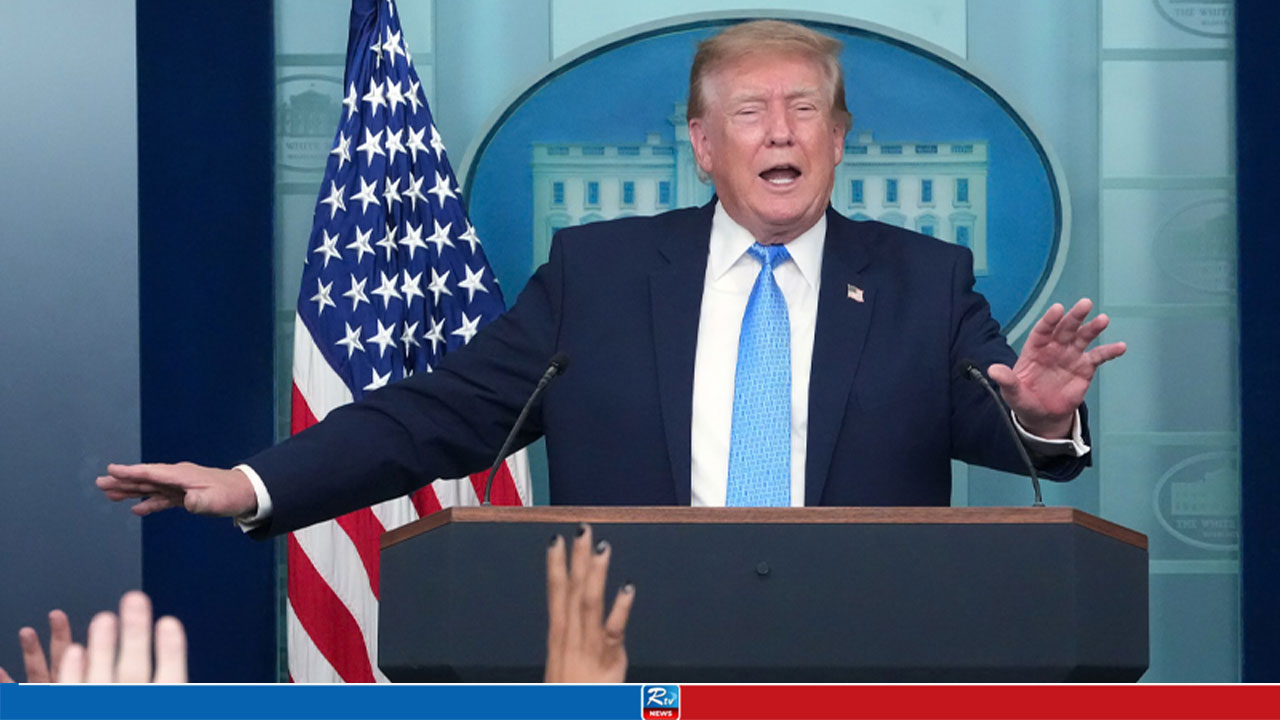
US President Donald Trump has stated that the war waged by the United States and Israel against Iran is "virtually over." He made the remarks following a high-level meeting with the Prime Minister of Qatar, claiming that Iran's military capability has been completely destroyed. However, despite signaling an end to major active combat, Trump indicated that the naval blockade on Iranian ports would remain in place.
According to Al Jazeera, Trump held an unannounced press conference in Washington on Monday (November 9) local time following his talks with the Qatari leader. During the briefing, he reiterated that the US had neutralized Iran’s military infrastructure while hinting that Washington faces increasing pressure from its Middle Eastern allies to halt hostilities.
"Militarily, Iran is virtually over," Trump said. "We are simply maintaining the current posture, largely at the request of neighboring countries."
Trump’s comments came after closed-door talks with US Vice President JD Vance and Qatari Prime Minister Sheikh Mohammed bin Abdulrahman bin Jassim Al Thani. Following the discussion, Qatar's Prime Minister expressed optimism in a social media post regarding the progress made during the talks.
"We discussed the overall situation in the region and ways to advance US-Iran talks," the Qatari Prime Minister wrote. "I am grateful for the constructive discussions aimed at reaching an agreement and establishing peace in the region."
However, Trump acknowledged that maintaining the status quo entails keeping the US naval blockade active around Iranian ports alongside the operations of the recently announced "Task Force Iron Gate"—an initiative aimed at cutting off Iran's land-based and Caspian Sea trade routes.
"Countries like Qatar, Saudi Arabia, the United Arab Emirates, Bahrain, and Kuwait want the current posture maintained," Trump stated. "In other words, they want us to sustain what is perhaps the largest naval blockade in our nation's history, and likely in world history."
Trump also signaled that the United States remains ready to resume direct military operations if necessary. "We don't see the need for further military action right now, but should conditions change, we are fully prepared to act at a moment's notice," he added.
"Israel and the entire Middle East are now safe from the threat and danger posed by Iran," Trump asserted. "We are seeing progress toward ending this conflict, and I believe it will come to a final conclusion very soon."
Meanwhile, Iranian officials dismissed Trump's latest remarks as a desperate attempt to divert attention from reality.
Mohsen Rezaee, head of Iran's Supreme National Security Council, wrote in a social media post: "This war against Iran has already crippled the US government, yet Washington continues to act like a desperate gambler."
"Stop the game," Rezaee added. "Stop spreading fake news about imaginary negotiations."
Concurrently, Iranian President Masoud Pezeshkian stated that Iran's Supreme Leader Mojtaba Khamenei favors an end to the current situation, describing the state of affairs as "neither war nor peace."
According to Iranian media reports, Pezeshkian reiterated that Tehran remains open to diplomatic channels but will not succumb to external intimidation. "We will not surrender to force or bullying," he emphasized.
Since hostilities broke out against Iran on February 28, the conflict quickly spilled over into neighboring nations, destabilizing international trade. Almost immediately after the initial US and Israeli strikes, Iran closed the Strait of Hormuz—a vital maritime bottleneck for global shipments of oil, gas, and fertilizer.
In response to US and Israeli operations, Iran launched barrage strikes involving missiles and drones targeting neighboring Gulf states, including Qatar, Bahrain, Kuwait, and the United Arab Emirates, with many strikes aimed at US military installations in the region.
The main conflict triggered secondary escalations across the region. Saudi Arabia launched renewed military operations against Iran-backed Houthi forces, while Israel initiated an occupation of southern Lebanon alongside lethal airstrikes in the area.
Over the nine months since the conflict began, US military operations against Iran have turned intermittent, marked by periodic retaliatory strikes. In recent days, the Trump administration announced "limited strikes" targeting Iran's Qeshm Island.
Furthermore, the US announced a $20 million reward for actionable intelligence regarding Iran's nuclear program, specifically targeting information on its facilities, equipment, and associated personnel.
Trump had previously claimed, following a 12-day war in June 2025, that Iran's uranium enrichment program was completely dismantled. However, curbing Iran's nuclear ambitions has remained a focal point of the ongoing campaign.
Tehran has consistently denied allegations of pursuing nuclear weapons, maintaining that its uranium enrichment program serves strictly civilian energy and electricity needs.
Meanwhile, Iranian officials have outlined seven prerequisites for the US to meet in order to end the conflict. These conditions include the complete lifting of US sanctions, the unfreezing of Iranian financial assets, the recognition of a new maritime corridor in the Strait of Hormuz mediated by Oman, and a total cessation of hostilities across all fronts, including Israeli operations in Lebanon.
Qatar has acted as a primary mediator in the crisis. Sheikh Mohammed, who serves dual roles as Prime Minister and Foreign Minister, is widely recognized as a bridge builder between Washington and Tehran.
Reports indicate that during Monday's closed-door session, Sheikh Mohammed presented Trump with a two-day proposal put forward by Iran to end the war. When journalists asked Trump during the press conference why he did not simply declare an end to the conflict, he framed the sustained naval blockade as a matter of regional security, emphasizing long-term stability over short-term fixes.
"We have several close allies over there, and their security must be guaranteed; otherwise, they will suffer," Trump noted.
"They are far safer today than they were six months ago because Iran's leadership and military structure have been extensively dismantled," Trump added. "Yet, Iran still attempts to assert dominance in the Middle East."






 Live TV
 RTV Plus