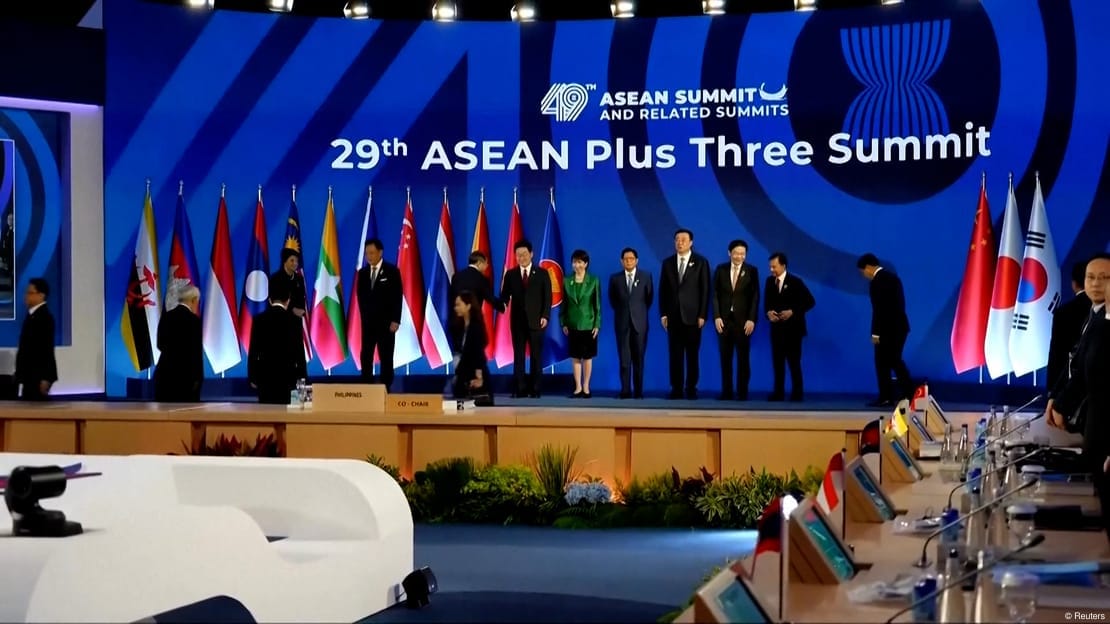
It was supposed to be a breakthrough year. The Philippines had intended to set up a code of conduct with China for the South China Sea during its 2026 ASEAN presidency. However, at the summit in Manila in mid-November they had to abandon their goal. Some 80% of the text had been negotiated, declared Philippine Foreign Secretary Theresa Lazaro, but the key areas of dispute had remained unsolved.
Much more than diplomatic wording is at stake. The South China Sea is one of the world's most important shipping routes, it is rich in fishing grounds and may harbor significant oil and gas reserves. Primarily, however, it's a region of strategic competition: With its so-called Nine-Dash Line (often drawn in red), China claims a large portion of the sea. Its claims overlap with those of the Philippines, Vietnam, Malaysia and Brunei.
A code of conduct is to set up rules for parties dealing with one another and prevent incidents at sea from escalating. However, opinions differ, particularly with regard to its binding nature and its geographic scope.
"The basic problem with establishing such a code of conduct is that China is supremely powerful and has no real interest in a legally binding agreement," said political scientist Andreas Ufen, Southeast Asia expert at the German Institute of Global and Area Studies (GIGA). Beijing had little incentive to impose restrictions on itself as long as it was able to pursue its interests in the region even without such an agreement, Ufen told DW.
Mere recommendations or legally binding set of rules?
The Paracel Islands serve as an example of just how difficult the unresolved issues are. In China, the group of islands is known as Xisha, in Vietnam as Hoang-Sa. Hanoi apparently wants to include them in the code's geographic scope, but China rejects this. An agreement within the ASEAN framework could indirectly affect the territorial claims of the parties involved.
"A fundamental problem is that so far there's no consensus on whether the code of conduct should be legally binding," said Felix Heiduk, head of research division Asia at the German Institute for International and Security Affairs (SWP). China and the ASEAN nations have been negotiating an agreement for 12 years without major progress so far.
There were reservations about such a treaty not only in China but also in other ASEAN countries. They would subsequently have to ratify a legally binding agreement under international law in their own countries. A non-binding code of conduct, by contrast, would be little more than a voluntary declaration of intent, Ufen told DW.
The definition of an "incident" is controversial as well. Are coast guard missions with use of water cannons included? Or blockades of supply vessels? Or is the code only applicable when military force is involved? This will determine which actions will be covered by the regulations in the future.
"These are by no means just technical details. Their clarification determines to a great extent whether the code of conduct will in fact be effective or will ultimately remain only a non-binding declaration of intent," Heiduk said. An agreement without valid commitments would bring about little change.
Diverging interests
Ufen views China's attitude as a strategic calculation. "I believe that China is interested in keeping the conflict simmering, so to speak, without having to commit itself to a truly binding legal regulation," he said. In this way, Beijing could strengthen its position in the South China Sea without limiting its room for maneuver.
At the same time there are also diverging interests within the ASEAN group. The 11 member states are by no means united. The Philippines and Vietnam are particularly vocal in their opposition to China. Malaysia and Indonesia pursue a more restrained approach. Cambodia and Laos have close economic ties with Beijing and don't have any territorial claims in the South China Sea.
"From the start of the negotiations, the lack of unity within ASEAN has been a problem. In a way, it's a permanent obstacle," Heiduk said. The group makes decisions based on the consensus principle, which basically means that every member state can block a unified position. Recurring confrontations between China and the Philippines exacerbated the problem by undermining trust and making it more difficult to reach compromises.
Ufen also believes that diverging interests are a key impediment. "Reconciling them is extremely difficult," he said. China could take advantage of the discord. Beijing preferred bilateral negotiations with individual countries rather than dealing with an entire, united group of nations.
Fundamental conflicts unresolved
A study published by the Singapore-based Yusof Ishak Institute (ISEAS)reaches similar conclusions. Not only China but internal divisions within ASEAN stalled negotiations. The authors warn against exclusively relying on a comprehensive, legally binding treaty. Initially, partial agreements — for example, on crisis communication, rescue operations at sea or maritime environment protection — could be a first step. Developing the 2002 agreement on a non-binding Declaration on the Conduct of Parties in the South China Sea could also be an intermediate step.

Ufen doubts whether Beijing is interested in a binding result. "For this reason, I can't really imagine that China has a real interest in a code of conduct that includes legally binding regulations," he said.
Heiduk warns against overestimating the significance of a potential agreement. "Even if the code of conduct was signed at some point, in whichever shape, that would in no way solve the conflict in the South China Sea," he said. The code could regulate how to handle incidents, but it could not eliminate territorial disputes and competing claims to maritime areas.
Hopes for future negotiations
This constitutes the dilemma for ASEAN nations as well, whose foreign policy oscillates between China and US ties: An agreement that's as binding as possible could fail because China and individual member states have reservations. A weak, non-binding code, however, could give the impression everyone agreed but would hardly change conduct at sea.
The American Center for Strategic and International Studies (CSIS) summed up the situation after the summit in Manila: "Whatever progress was made this year, it is almost certain that the hardest sticking points remain unresolved."
Negotiations will be continued in 2027 under Singapore's chairmanship. Whether this will turn into more than just another diplomatic effort will depend on whether China is prepared to submit itself to regulations which limit its scope of action and whether ASEAN will be able to reach a consensus.






 Live TV
 RTV Plus