Dhaka 19 September, 2026

Tesla Launches Self-Driving 'Cybercab' in Texas

BSS

Publish : 04 Sep 2026, 09:45 AM
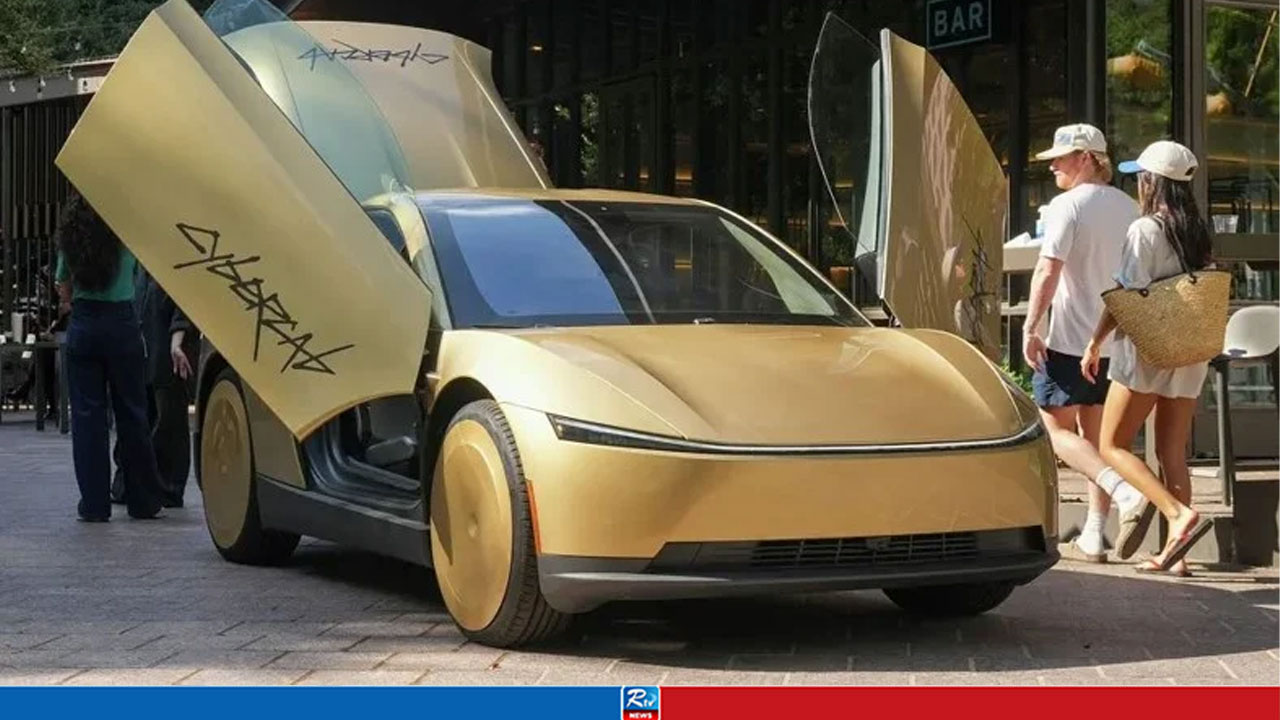
Self-driving robotaxi, Cybercab. Photo: Collected

Electric-vehicle maker Tesla announced the debut of its self-driving robotaxi, dubbed "Cybercab," on Thursday in a bid to compete with the likes of Uber and Waymo.

First unveiled in October 2024, the gold-colored vehicle has no pedals or steering wheel. With a capacity to carry two passengers, it was specifically designed to provide driverless taxi services.

CEO Elon Musk on Thursday posted an image on X of a Cybercab looming over the Texas capital city Austin, where Tesla is headquartered, a cloud of dust behind it.

Cybercabs have been seen in the streets of Austin leading up to the event, with passengers now seeing the option to choose the new vehicle in Tesla's updated dedicated app. This is "humanity changing," Graham Sprigg, a tourist from Australia, told AFP.

"It'll change transportation from owning your own car to actually just getting transportation as a service, which is fantastic for disabled people and old people like I'm becoming," Sprigg added. Musk forecast a "storm of Cybercabs" in Austin, where Tesla held an invite-only event at an entertainment venue, and which was not open to the media.

According to the Austin American-Statesman news outlet, event attendees were the first to get rides in driverless Cybercabs, which will become available to the public starting Friday. Posts on social media showed fans arriving for the event, some dressed in gold to match the vehicle.

Tesla's posts touted what it called the vehicle's safety and ease of use for disabled people, and said the Cybercab was "democratizing clean transportation for all."

Last year Tesla debuted its self-driving cars in Austin using its Model Y SUV vehicles, with the "Robotaxi" service gradually expanding to several other cities in Texas, Florida and California.

However, state laws require many of the vehicles to have a human supervisor or driver ready to take over control if necessary. Waymo, the self-driving vehicle subsidiary of Google parent company Alphabet, offers its services in 11 US cities.

Tesla had registered 314 robotaxis in Texas as of Wednesday, including 45 Cybercabs, according to FSD Database, based on data from the Texas Department of Motor Vehicles.

Itay Michaeli, an analyst at TD Securities, told AFP he expects a "slow launch" of the Cybercab similar to that of the Robotaxi. Tesla will likely take into account feedback from early users before expanding the service, he said.

Texas has regulations favorable to autonomous vehicles, making it one of the preferred testing grounds for many such services already in operation, such as Waymo and Zoox, or in trials, such as Motional.

"Tesla is really just getting started," said Anthony Townsend, a senior research associate at Cornell Tech, a policy research organization in New York. It remains to be seen which company in the crowded field has the best business model, he said.

"It's always been the promise that AV taxi companies will become cheaper than human-driven rides, but it's not clear that's even within sight," Townsend said in a note, adding that it's not known either when the companies could break even.

Follow google news channel to get RTV news Google News
Is it Possible to Slow Down the Development of AI?
Top AI executives say they want to slow the breakneck pace of artificial intelligence development, but competition, US government reluctance and geopolitical factors stand in the way.
Is it Possible to Slow Down the Development of AI?
ChatGPT Becomes First AI Chatbot to Face Tougher EU Rules
ChatGPT will have to comply with tougher safety rules after the EU added it Monday to a list of digital services subject to greater legal scrutiny in Europe, a first for an AI chatbot. Brussels also designated the Reddit forum and the popular gaming network Roblox as "very large" online platforms, a label that comes with additional obligations and oversight. "ChatGPT, Reddit and Roblox will now be held to a higher standard of scrutiny and accountability in the European Union, in line with their large impact on our citizens and society," EU technology chief Henna Virkkunen said. The "very large" designation applies to platforms and search engines with more than 45 million monthly active users in the 27-nation bloc, a threshold ChatGPT, Reddit and Roblox reported meeting, the commission said. The three now have four months to comply with additional obligations under the Digital Services Act (DSA), a content law that is a major weapon in the legal armoury the EU has deployed to rein in Big Tech in recent years. These include "assessing and mitigating" risks related to "the dissemination of illegal content, the negative effects on minors, users' physical and mental well-being, fundamental rights, electoral processes and public  security," Brussels said. To bring it under the DSA's regulatory umbrella, the commission qualified ChatGPT as a search engine. 'Proud' The hugely popular artificial intelligence chatbot developed by US company OpenAI reported more than 159 million users in the EU at the end of March, representing over a third of the bloc's population. ChatGPT said it was "preparing to meet the additional compliance requirements" that came with the designation, while Roblox said it was "proud to be the first gaming platform" to gain the "very large" label in the EU. "Safety is foundational to everything we do and we look forward to continuing our constructive engagement with the European Commission," said the US-based platform's general manager for Europe, Joost Hagesteijn. Hugely popular with children and known for its immersive world of colourful graphics, Roblox says it has 46.6 million active players in the EU, just above the DSA threshold for tougher scrutiny. The sprawling US discussion platform Reddit says it has more than 57 million users in the bloc. Heavy fines The designations come as the EU has stepped up regulatory enforcement against the world's biggest digital platforms, including many American ones, despite strong US pushback and threats of retaliation. The EU has separately adopted the world's most far-reaching rules to govern artificial intelligence. Its flagship AI Act entered into force in 2024, with obligations kicking in over several years to curb potentially dangerous uses of the technology. Lena-Maria Boswald, of the German tech think tank Interface, said ahead of ChatGPT's designation that the expected move would set a "precedent" and "influence the regulatory expectations for every large generative AI system used in the EU". "OpenAI already has risk-management obligations under the AI Act, but the DSA could widen the scope," she said. Around 30 services have been listed for extra scrutiny under the DSA, most of them owned by major technology companies such as Google, Apple, Microsoft, TikTok, X, Amazon and Shein. The list also includes several porn sites and the collaborative online encyclopedia Wikipedia. Companies found in breach of the law face heavy penalties, including fines of up to six percent of their annual global turnover and, in cases of serious and repeated violations, a possible ban on operating in Europe. The EU recently told TikTok to change what it deemed its addictive design or face large DSA fines. To date, the bloc has hit three firms with penalties under the law: shopping giants Temu and AliExpress, and Elon Musk's social media platform X, which was handed a 120-million-euro ($138 million) fine for transparency and other violations.
ChatGPT Becomes First AI Chatbot to Face Tougher EU Rules
NASA Launches First Telescope Named after Female Scientist
NASA has launched a powerful new telescope designed to explore distant planets, exploding stars and black holes while surveying the universe on an unprecedented scale. The Nancy Grace Roman Space Telescope, named after one of the first women to hold a senior leadership position at NASA, was launched aboard a Falcon Heavy rocket operated by Elon Musk's SpaceX from Cape Canaveral, Florida, on Sunday. The telescope is expected to reach its destination, approximately 1.6 million kilometers (about one million miles) from Earth, in approximately one month's time. The mission has a total budget of more than $4 billion (€3.45 billion). The first images are expected back on Earth in early 2027. What will the Roman telescope do?Astronomers will use "Roman" to investigate a wide range of cosmic phenomena, including black holes, exoplanets and exploding stars. "It's going to find thousands of supernovae, tens of thousands of planets, billions of galaxies and tens of billions of stars," said NASA science mission director Nicky Fox. "It's going to be able to do things that we've never been able to do before with its massive field of view." Roman operates in a similar way to the Hubble Space Telescope, which was launched in 1990 and is now showing signs of age while operating with reduced capabilities. However, Roman is designed to survey the sky far more quickly and will be capable of completing in just one month observations which would have taken Hubble a century. Scientists expect Roman to generate more than 500 terabytes of data every year. By way of comparison, Hubble has collected approximately 400 terabytes of data in over three decades in space. "Roman's vast reach will allow us to find the weird, the rare and the unusual," senior project scientist Julie McEnery said on Saturday. "We'll redefine what it means to find a needle in a haystack." Who was Nancy Grace Roman?The James Webb Space Telescope, named after former NASA administrator James Webb, was launched in late 2021 to complement Hubble. Webb observes the universe at different wavelengths, complementing the observations that will be made by Hubble and Roman. Launching nearly a year ahead of schedule and within budget, Roman is NASA's first space telescope to be named after a woman. Nancy Grace Roman served as NASA's first Chief of Astronomy throughout the 1960s and 1970s, and retired NASA scientist Ed Weiler said the honor was long overdue. "This is very, very fitting," he said. "I think Nancy would be very proud."
NASA Launches First Telescope Named after Female Scientist
World Robot Conference 2026 Opens in Beijing Showcase
The World Robot Conference 2026  kicked off on Wednesday in the Chinese capital, assembling a broad array of advanced robotic innovations aimed at industrial labor, medical care, academic instruction, and domestic life. Organized around the theme "Human-Robot Symbiosis, Production-Demand Convergence," the global forum showcases cutting-edge advancements across the robotics sector. Attendees at the exhibition observed machines completing various complex maneuvers and physical tasks, including participating in soccer and ping-pong games, executing dance routines, sewing materials, categorizing parcels, and neatly folding garments. Bipedal humanoid models and quadrupedal robotic dogs drew significant crowds, alongside displays featuring dexterous robotic hands, medical surgical equipment, and specialized learning tools. Read More Beijing to Host 2nd World Humanoid Robot Games as Entries Quadruple Domestic automation was prominently featured, with multiple units demonstrating household chores such as floor sanitation, dining table cleanup, and garment management. Recreational and performance units also featured heavily throughout the venue, where automated musical bands delivered live performances while other mechanical exhibits entertained attendees with choreographed routines, including a traditional lion dance. Young spectators and general attendees gathered around the interactive displays to watch live operational showcases and pose for photographs with the units. Additionally, the event underscored the expanding footprint of automated systems within highly technical sectors, highlighting specialized apparatuses such as an orthopedic surgical robot and a quadrupedal detection unit. The international gathering serves as an interactive hub for commercial enterprises, academic researchers, and the general public to evaluate recent technological breakthroughs and analyze their potential integration across industrial frameworks and everyday routines. Source: Xinhua
World Robot Conference 2026 Opens in Beijing Showcase
Beijing to Host 2nd World Humanoid Robot Games as Entries Quadruple
Participation in the upcoming second World Humanoid Robot Games is projected to increase fourfold compared to last year's inaugural tournament, organizers announced on Thursday. Scheduled from August 22 to 26 in Beijing, the event has registered 666 teams and 2,056 robots spanning 16 countries, according to Jiang Guangzhi, director of the Beijing Municipal Bureau of Economy and Information Technology. The international field includes competitors from prominent robotics leaders such as the United States, Germany, and Japan, alongside a Brazilian national roster formed by five RoboCup squads.  Collected Photo Host nation China will have a formidable presence, contributing 641 teams and 1,975 robots from 157 commercial enterprises and 200 academic and research entities, including major industry firms and 27 leading universities. Organizers highlighted that the 2026 iteration will encompass more than 30 individual events. Newly introduced categories include weightlifting, table tennis, long jump, and tug of war, which are designed to rigorously test structural engineering, motion control, and core hardware components. Read More Google's Gemini AI Assistant Reaches One Billion Users At the same time, scenario-focused challenges are expanding into functional, real-world operational environments, such as manufacturing plants, hotels, residential spaces, and logistics hubs.  Participating machines will face practical tests across diverse duties, including domestic housekeeping, emergency response management, industrial assembly, and sorting library books. Reflecting on the event's broader industry impact, Jiang noted that many of the competition's governing guidelines are expected to evolve into technical standards, helping drive the transition of advanced robotics technologies into commercial industrial uses. Source: Xinhua
Beijing to Host 2nd World Humanoid Robot Games as Entries Quadruple
Read More
NASA Launches First Telescope Named after Female Scientist
SpaceX Shifts Focus from Mars to Moon, Musk Says
NASA Astronaut Suni Williams Retires