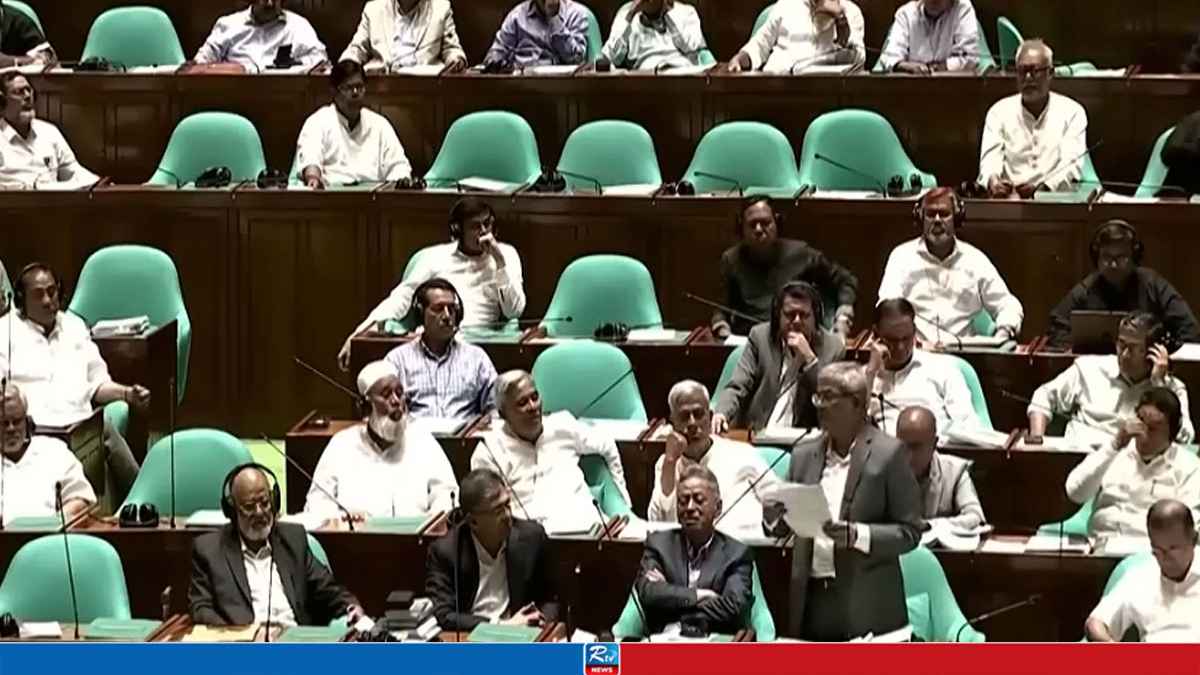
Prime Minister Tarique Rahman delivered a comprehensive address to the National Parliament on Monday during the general discussion on the proposed budget for the 2026–27 fiscal year, characterizing the plan as a "roadmap for nation-rebuilding" and a "life-centric" instrument designed to restore economic discipline.
Presided over by Speaker Hafiz Uddin Ahmad, Bir Bikram, the session featured a detailed government agenda focused on fostering an inclusive economy, equitable development, and long-term institutional reform.
"This budget should not be seen only as the government's budget. Let us view it as a budget for rebuilding the nation," the Prime Minister stated, emphasizing that his administration is committed to resolving the "deep-rooted corruption, irregularities, and mismanagement" inherited from the previous regime.
He expressed unwavering confidence in the nation's future, noting, "The people of Bangladesh are hardworking. Our youths are talented, our farmers are productive, our expatriates are patriotic and our entrepreneurs are full of potential. Therefore, we have no alternative but to rise again."
Central to the Prime Minister’s economic platform is an aggressive asset recovery campaign.
He revealed that Bangladesh has already dispatched 23 Mutual Legal Assistance Requests to 13 countries to trace and repatriate funds siphoned abroad, with several affected banks having signed over 60 non-disclosure agreements with international asset recovery organizations.
"We will bring back the people's money and assets as much as possible through legal means and international cooperation," he affirmed.
To achieve fiscal stability without over-burdening citizens, the Prime Minister proposed several people-friendly amendments to the budget.
He requested a phased increase in the tax-free income threshold for individual taxpayers, rising from BDT 375,000 to BDT 500,000 by the 2030–31 fiscal year.
Furthermore, he bowed to public opinion by requesting the withdrawal of the controversial provision for legalizing undisclosed income, noting, "Unfortunately, many people perceive this provision as another opportunity to legalize black money."
The Prime Minister’s reform proposals spanned multiple sectors, including education, agriculture, and industrial manufacturing.
He proposed lowering the tax rate for private universities from 10 percent to 5 percent, contingent upon their investment in research, language laboratories, and tuition-free education for underprivileged students.
Supporting the industrial sector, he called for the removal or reduction of various import duties, VAT, and regulatory duties on raw materials such as copper, honey, PVC, petro-resin, and materials for LED lamp and prefabricated building manufacturing.
He also urged for a reduction in VAT on digital advertising services from 15 percent to 5 percent to encourage formal payment channels and boost state revenue.
Additionally, the Prime Minister announced an unprecedented BDT 500 crore allocation for a Startup Fund, aimed at empowering young entrepreneurs and creating employment.
Regarding the shrimp industry, he proposed the total elimination of import duties and taxes on essential farming inputs, including feed, probiotics, and machinery.
During his address, the Prime Minister underscored the importance of an independent judiciary and a professional civil administration, proposing an additional BDT 100 crore for the Supreme Court and BDT 500 crore for the Ministry of Law to improve judicial infrastructure and address accommodation shortages for judges.
He also issued a powerful call for national unity to safeguard democracy, stating, "On the question of strengthening democratic institutions, we will all remain united, InshaAllah. Let this be our pledge that no fascist or authoritarian rule can ever take root in Bangladesh again and that no one can turn Bangladesh into a subservient state."
He invited bipartisan collaboration on constitutional reforms and initiatives linked to the "July Charter," stressing that political differences should not impede national interests.
Following the Prime Minister's extensive policy outline, which was met with repeated applause from the treasury benches, Finance and Planning Minister Amir Khosru Mahmud Chowdhury delivered the winding-up speech on the budget, following prior remarks from Opposition Leader Dr. Shafiqur Rahman.
With Inputs from Agencies






 Live TV
 RTV Plus