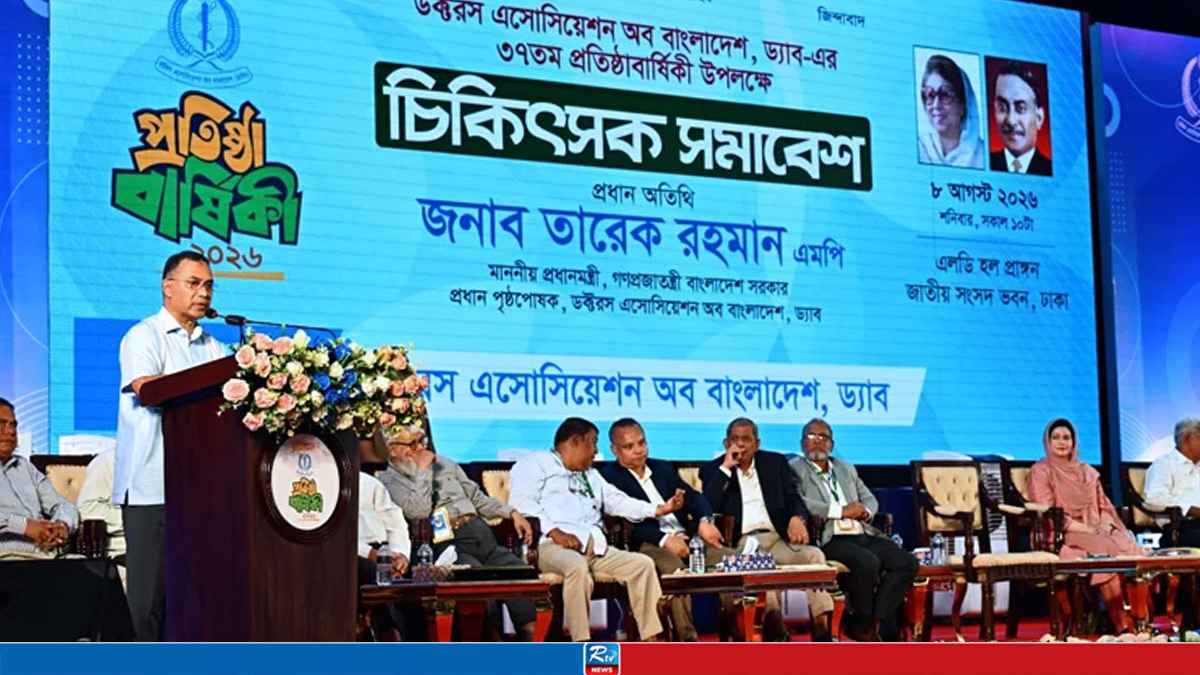
Prime Minister Tarique Rahman urged medical professionals on Saturday to ensure that political activism does not compromise their professional duties or patient care, emphasizing that delivering healthcare must remain their top priority.
"Political involvement should never become a reason for failing to perform professional duties. This is most important," the Prime Minister stated while addressing a doctors' rally organized for the 37th founding anniversary of the Doctors Association of Bangladesh (DAB) on the LD Hall grounds of Jatiya Sangshad.
Acknowledging that political decisions influence nearly every sphere of society, PM Tarique Rahman noted that it is understandable for students, educators, and professionals in a democratic society to maintain political awareness or align with organized political ideologies.
"But political involvement must not hinder the performance of your professional duties," he cautioned, urging DAB-affiliated physicians to remain vigilant on this matter.
The Prime Minister observed a growing public call nationwide for a qualitative shift in political practices, stating that citizens are eager to move past traditional paradigms and pursue structural reforms across sectors, particularly following the events of August 5.
Shifting to health policy, he emphasized prioritizing preventative care, explaining that educating the public early about disease causes and precautions can prevent numerous health conditions.
Referring to a statement attributed to inventor Thomas Edison—who foresaw that future physicians would place less emphasis on drugs and greater focus on bodily care, nutrition, and disease prevention—PM Tarique Rahman remarked, "In healthcare, the policy of the present government is ‘prevention is better than cure’."
To operationalize this preventive model, the Prime Minister announced plans to recruit an additional 100,000 health workers tasked with educating the public on basic health measures, stressing that providing thorough training to these new workers will be essential for their success.
Turning to economic and administrative challenges, PM Tarique Rahman explained that his administration inherited a deeply vulnerable state structure characterized by a struggling economy, an administrative divide, and distressed education and healthcare networks, all of which the government is actively working to rehabilitate.
He warned that despite these challenges, vested interest groups that gained under past fascist structures remain active within the nation's political, administrative, and governance spheres. He highlighted that a faction has recently sought to instigate instability in the power and energy sectors through misleading claims.
While acknowledging ongoing public hardships regarding electricity and gas supplies, PM Tarique Rahman stressed that these shortages stem from inherited structural defects, including poorly conceived historical energy policies designed to benefit select groups.
He confirmed that the government has commenced systematic planning to progressively guide the nation out of the fuel and gas crisis.
The Prime Minister called upon medical professionals at all administrative tiers—from upazila and district hospitals to divisional and central institutes—to partner with state authorities in transforming health services. "Without your cooperation, support and help, it will not be possible for the government to implement these plans," he affirmed.
Highlighting financial commitments, PM Tarique Rahman noted that the government has designated the second-highest portion of the national budget to the health sector to modernize infrastructure. Groundwork is also underway to roll out universal health coverage rapidly, with plans to integrate every upazila health complex into the framework.
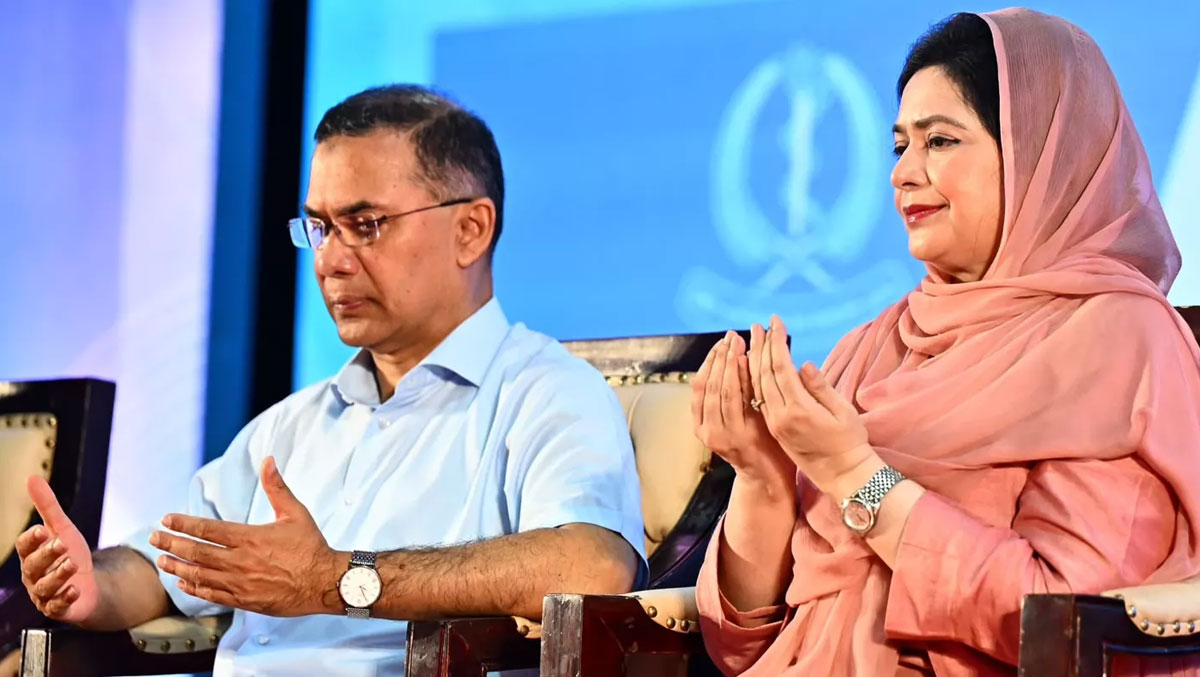
However, he cautioned that physical improvements alone cannot yield results without practitioner dedication. "If doctors do not dedicate themselves to their profession with a spirit of service, infrastructure development alone will not bring success," he warned.
Acknowledging the challenging environments in which medical staff operate, PM Tarique Rahman noted that occasional oversights or perceived laxity damage public trust in both the healthcare apparatus and state governance.
"People expect doctors to play a more responsible and humane role," he stated, calling for a unified effort to build a healthcare-friendly Bangladesh where every citizen receives quality care locally without needing to travel overseas for advanced treatment.
Earlier in the program, Prime Minister Tarique Rahman and his wife, Dr. Zubaida Rahman, planted two tree saplings on the LD Hall grounds. The Prime Minister then hoisted the national flag during the national anthem before officially launching the rally by releasing balloons and peace pigeons.
During the event, two key presentations—titled "Bangladesh’s health sector: From crisis to solution" and "The rise of the national health system"—were delivered by Dr. Mostafa Adib Suman and Saif Mohammad, respectively.
The rally was chaired by DAB President Prof. Harun Al Rashid. Addresses were also delivered by Local Government Minister Mirza Fakhrul Islam Alamgir, Dr. Zubaida Rahman, Women and Children Affairs Minister Prof. AZM Zahid Hossain, Health Minister Sardar Md. Sakhawat Husain, State Minister MA Muhit, Prime Minister’s Special Assistant for Health SM Ziauddin Haider, and DAB Secretary General Zahirul Islam Shakil.
With Inputs from UNB



 Live TV
 RTV Plus