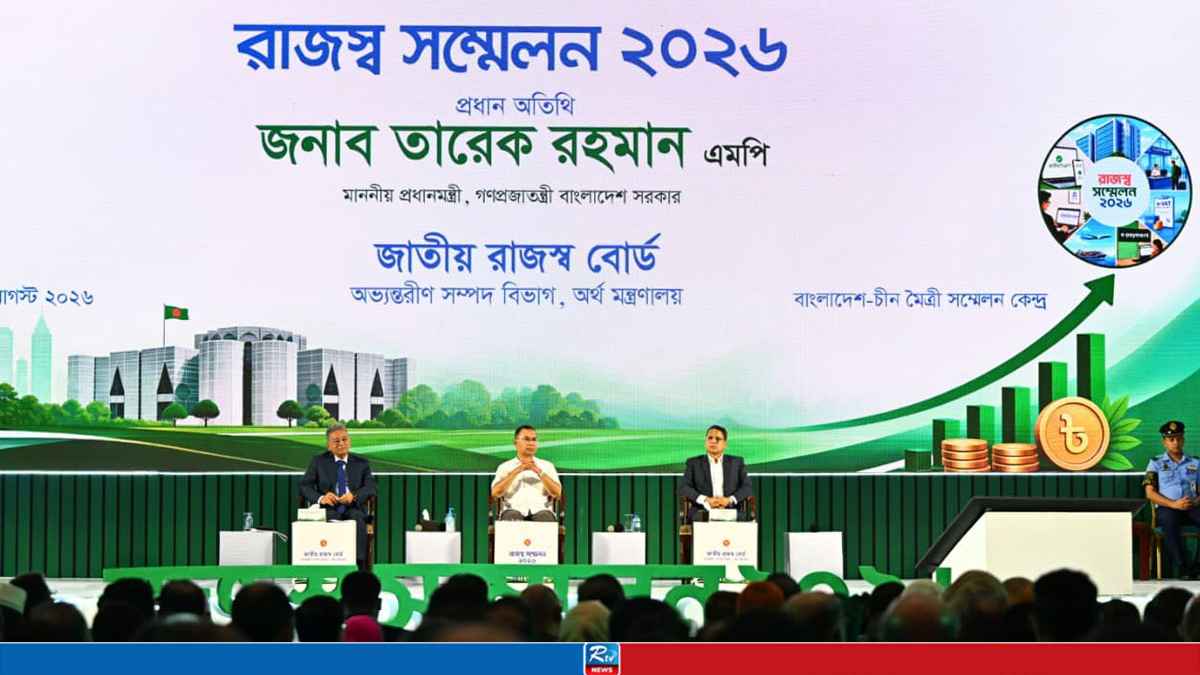
Prime Minister Tarique Rahman on Tuesday emphasized the necessity of expanding Bangladesh’s tax net instead of imposing heavier financial burdens on existing taxpayers, stressing that a modernized, digitalized, and data-driven revenue setup is vital for sustainable fiscal growth.
Speaking as the chief guest at the Revenue Conference 2026 at the Bangladesh-China Friendship Conference Centre in the capital, the Prime Minister highlighted that the country's tax-to-GDP ratio remains disproportionately low relative to its economic potential.
He noted that the tax base remains narrow, placing the majority of the financial obligation on a limited pool of compliant citizens.
“Repeatedly increasing the tax burden on the same taxpayers is not a sustainable policy for increasing revenue,” the Prime Minister remarked, urging officials to identify non-paying individuals who possess taxable capacity and bring them into the system through target-oriented mechanisms.
He added that establishing a modern, digital, and data-centric tax framework is essential to achieve this objective.
The Prime Minister voiced the administration's resolve to overhaul the National Board of Revenue (NBR) and the broader tax ecosystem into a people-oriented service where citizens feel trust rather than intimidation.
“After the period of fascism, it is now time for us to turn around — in other words, it is time for Bangladesh to turn around. The people of the country expect the NBR to be a reliable and trustworthy institution. Taxpayers, in particular, want to see the NBR as an institution they can trust,” he stated.
Underscoring that robust and transparent revenue management is the key to gaining public confidence, he told NBR officials, “You must take the necessary steps to meet the expectations of taxpayers. The present government wants to transform the NBR and the overall revenue structure into a people-friendly system.”
Urging all personnel to display commitment toward building a prosperous nation, he added: “We all need patriotism and sincerity. Let us work together to build a strong revenue system…I wish success to this revenue conference with the expectation of a more prosperous, more investment-friendly and more business-friendly revenue management system.”
Highlighting recent performance, PM Tarique Rahman praised the positive revenue collection trend recorded between mid-February and the end of June.
“I want to speak of a hope, a possibility and an expectation. Revenue collection remained positive from the middle of February until the end of June,” he said, encouraging the workforce by adding, “This proves that you can do it. You are the ones who can do it, and you certainly will be able to do it, Insha-Allah.”
The Revenue Conference 2026 was jointly organized by the NBR and the Internal Resources Division (IRD) under the Ministry of Finance.
During the event, field-level customs and tax officials from the income tax, value-added tax (VAT), and customs wings shared operational insights, practical challenges, and suggestions regarding tax administration, alongside presentations on overall revenue management.
Listening attentively to their inputs, the Prime Minister issued directives to resolve operational bottlenecks, noting that NBR’s operational success directly impacts the government's ability to finance national development plans.
“This is why I do not see today’s conference as an ordinary conference,” PM asserted, expressing confidence that the session would offer clear strategic direction moving forward.
Addressing historical challenges, the Prime Minister noted that Bangladesh inherited a fragile economy, with the revenue administration suffering from legacy mismanagement.
He pointed out that past practices—such as ignoring NBR rules, showing political or personal favoritism, demonstrating hostility, and collecting revenue arbitrarily—severely eroded public confidence.
He stressed that modern taxation should focus on encouraging voluntary compliance rather than relying solely on aggressive coercion.
Regular taxpayers must receive state respect, while deliberate tax evaders should be systematically integrated into the framework.
Furthermore, he insisted that tax procedures must be streamlined and rid of corruption and harassment.
“Customs, VAT or tax collection is not only a matter of enforcement,” Tarique Rahman observed, adding that public trust naturally drives higher revenue collection.
Turning to global trade dynamics, the Prime Minister advised revenue officials to adapt to rapid technological shifts, evolving international trade patterns, and complex financial systems.
He stressed that personnel must cultivate multidimensional expertise in e-commerce, the digital economy, transfer pricing, international taxation, trade finance, financial crime, money laundering, and artificial intelligence (AI).
Touch upon VAT administration, he described it as a major revenue engine for any modern economy, urging authorities to ensure that administrative complexities do not create unnecessary barriers for business operations.
Referring to a “regrettable incident” within the department during the interim government's tenure, the Prime Minister called for organizational harmony, advising all stakeholders to settle internal grievances through dialogue rather than disruption.
He reiterated the administration's commitment to inclusive progress, stating, “We want those who are working in government to be able to work safely and comfortably for building the country.”
He assured that necessary steps will be taken to ensure a stable working environment and prevent similar occurrences in the future.
Following his address, the Prime Minister toured various stalls showcasing NBR's operational activities, administrative procedures, and tax base expansion strategies.
The conference was also addressed by Finance Minister Amir Khosru Mahmud Chowdhury, Prime Minister’s Adviser on Finance and Planning Dr. Rashed Al Mahmud Titumir, and acting NBR Chairman Ahsan Habib.
With Inputs from UNB



 Live TV
 RTV Plus