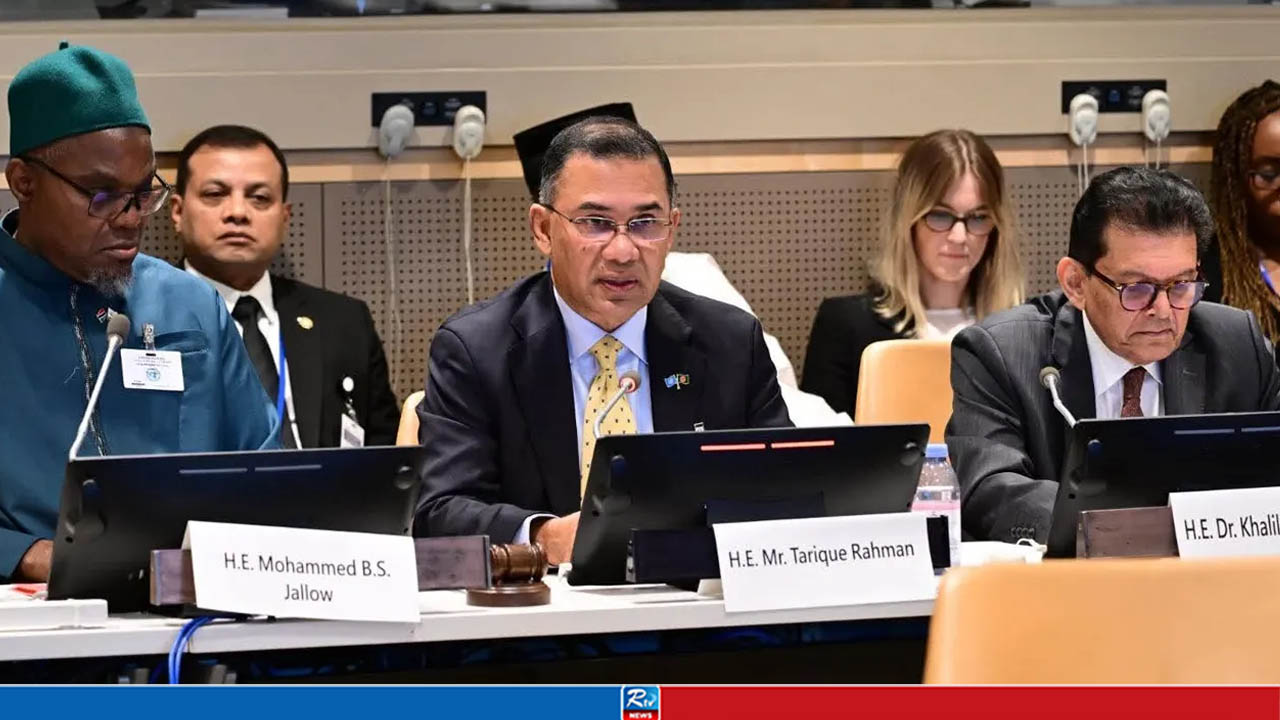
Prime Minister Tarique Rahman has put forward a five-point proposal to resolve the protracted Rohingya crisis, emphasizing that it is time to move from commitments to effective action.
He presented the proposals on Wednesday, September 23, local time, during a high-level side event on the Rohingya crisis at the 81st session of the United Nations General Assembly in New York.
Growing Pressures and Regional Security Risks
Highlighting that Rohingya have faced decades of discrimination, persecution, and deprivation in Myanmar, the Prime Minister noted that the costs of prolonged displacement are rising daily—not only for the Rohingya themselves, but also for the host communities in Cox's Bazar. He stressed that the social, economic, environmental, and security pressures on Bangladesh are immense.
Escalating Challenges: Long-term uncertainty and despair are fueling new security risks, including human and migrant trafficking, drug smuggling, and other transnational crimes.
Dangerous Journeys: Desperate individuals continue to risk their lives on boats heading toward Malaysia.
Regional Threat: An unresolved crisis in a single country can evolve into a security threat for the entire region.
The Five-Point Proposal
To shift the focus from managing displacement to ending it, Prime Minister Tarique Rahman outlined the following urgent measures:
Clear Repatriation Roadmap: International and regional stakeholders must formulate a clear and credible roadmap for the swift, safe, voluntary, dignified, and sustainable repatriation of Rohingyas to Myanmar. The international community and other states must support stability efforts and leverage their influence to create conditions inside Myanmar conducive to return.
Cessation of Violence: Violence against the Rohingya and other civilians in Myanmar must stop. Fundamental rights and security must be ensured for the Rohingya in their homeland so they can regain confidence in returning.
Predictable Humanitarian Assistance: The international community must ensure adequate and predictable humanitarian support for the Rohingya. Equal support must be extended to local host communities to ensure their generosity does not stall their own development aspirations.
Justice and Accountability: Justice and accountability are prerequisites for sustainable repatriation. Bangladesh is deeply grateful for The Gambia's leadership in pursuing accountability at the International Court of Justice. The vital role of the International Criminal Court—alongside other international judicial and investigative mechanisms—must be supported, and perpetrators of grave crimes must be held accountable.
Countering Transnational Crime: Regional and international cooperation must be intensified to combat illicit drug economies, human trafficking, digital scams, illegal arms, and other cross-border crimes fueling instability in the region.





 Live TV
 RTV Plus