Dhaka 26 September, 2026

What's Powering Gold and Bitcoin Surges?

Arthur Sullivan, Deutsche Welle

Publish : 07 Oct 2025, 10:39 AM
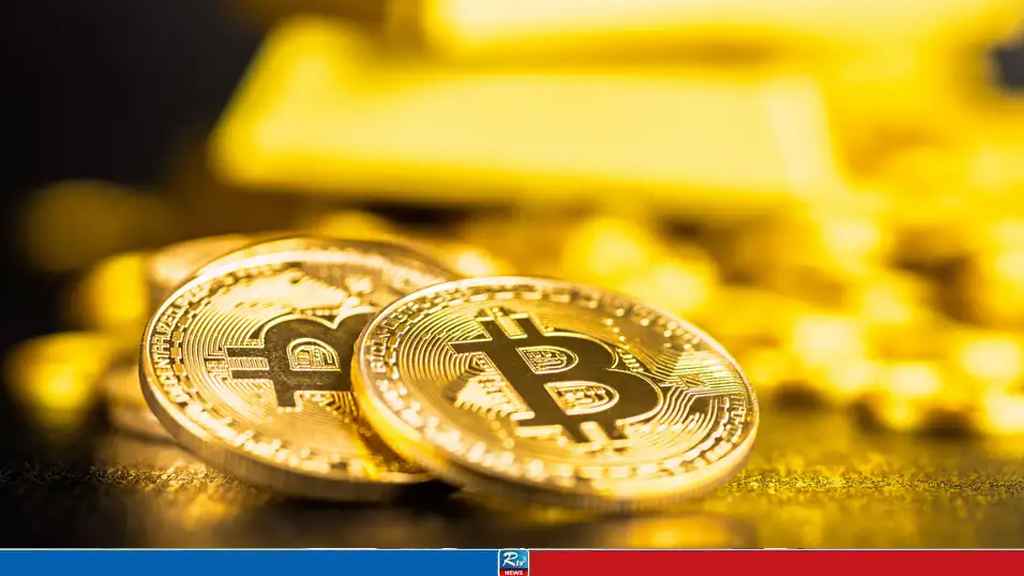
As economic and political instability rises, investors flee to safety, with gold and bitcoin growing in demand. Photo: picture alliance

It's been a happy few weeks for those who hold stocks of gold and bitcoin in their trading arsenals. The commodities have both reached record highs as investors continue to back them.

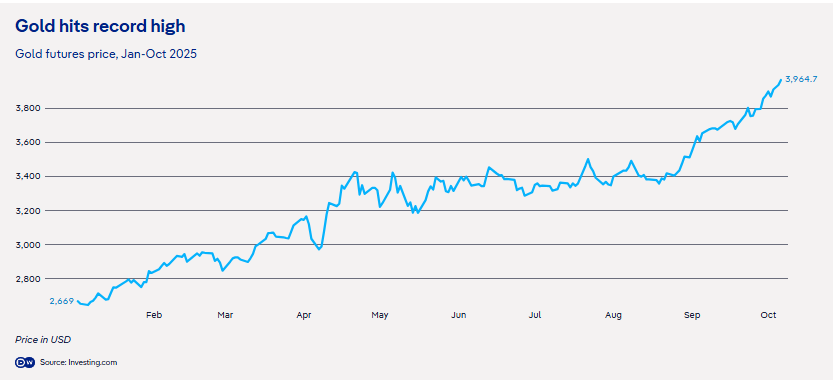
Gold smashed through the $3,900 (€3,334) a troy ounce barrier this week — a troy ounce being the unit of weight for precious metals and equivalent to 31.1 grams.

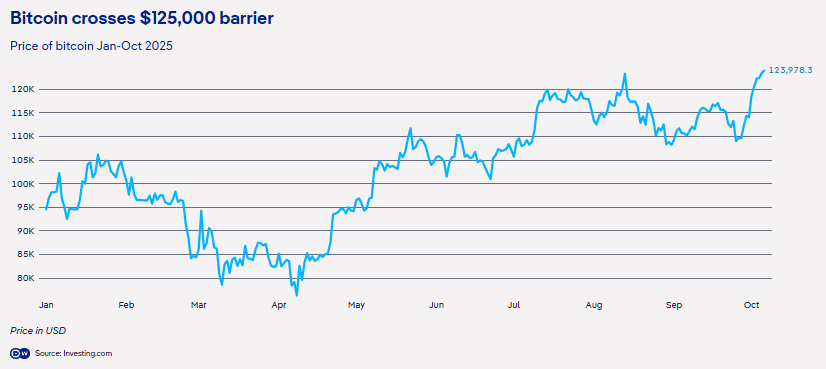
Meanwhile, on Sunday (October 5), the world's oldest and best-known cryptocurrency, bitcoin, hit a record when it broke through the $125,000 barrier for the first time, before falling back a little.

It has so far been a bumper 2025 for both commodities. Gold has been on its biggest rally since the 1970s, with the price jumping by more than 50% since January 1. Bitcoin has had some falls during a turbulent 2025, but its value has risen by around a third since the start of the year.

Why is it happening?

Long seen as a so-called safe-haven asset which investors back during periods of uncertainty, gold has been on a steep upward curve since late 2018, with its value having increased by more than 300% since then.

Uncertainty has been a factor in the current rally, with US President Donald Trump's reciprocal tariffs in April fuelling concerns over the global economy, the sustainability of US government debt levels and the future viability of the US dollar as the world's reserve currency.

There has also been ongoing geopolitical uncertainty as a result of Russia's war in Ukraine and the war in Gaza.
image

Another recent factor has been the US government shutdown. Gold is widely seen by investors as an alternative option to the US dollar, which has fallen sharply in value this year.

Gold has also benefited from a fall in support for the Japanese yen as a safe-haven asset. Japanese stocks surged on Monday after it was confirmed that Sanae Takaichi was elected as leader of the ruling party LDP, setting her up to be the nation's first female prime minister. However, the yen continued to fall back.

"Yen weakness on the back of the Japanese LDP elections has left investors with one less safe-haven asset to go to, and gold was able to capitalise," KCM Trade Chief Market Analyst Tim Waterer told news agency Reuters.

The US situation was adding to the attraction of gold. "The enduring US government shutdown means that a cloud of uncertainty still hangs over the US economy, and the potential size of any GDP impact," he added.

However, experts say there is more to gold's current surge than doubts over the future of the US economy or indeed, the global economy. Several analysts say there has been a rise in demand for gold-backed exchange traded funds (ETFs), with more and more investors from a wider range of backgrounds seeking to invest.

"The fact that ETF demand has re-entered the scene so forcefully means that there are two forms of 'aggressor' bids for gold, from central banks and ETF investors," wrote Deutsche Bank analysts in a note to clients.

Gold has long been purchased by central banks around the world but the new ETF demand has fuelled the current rally. Recent data from the US Commodity Futures Trading Commission (CFTC) shows that hedge funds now hold record holdings of $73 billion worth of gold.

What about bitcoin?

Bitcoin's record rally has been largely driven by the reelection of Donald Trump as US President, with his clear and often-stated support for cryptocurrencies helping to increase demand and trust in the sector.

However, there is evidence that more institutional investors are ploughing into bitcoin, similar to the trend seen with gold. The commodity is becoming favored as an alternative to other bets, such as the US dollar. Expected interest rate cuts are also apparently luring investors to take greater risks on the asset.
image

Bitcoin also appears to be strengthening on the back of uncertainty over the US economy, with the ongoing government shutdown driving up demand.

"The shutdown matters this time around," Geoffrey Kendrick, head of digital assets research at Standard Chartered Bank, wrote in a note to investors.

"This year, bitcoin has traded with 'US government risks,' as best shown by its relationship to US Treasury term premium," he added, referring to the metric which measures the extra yield investors demand in order to hold long-term government bonds — which reflects the extent of their faith in long-term economic stability.

Another factor in bitcoin's current strength may be related to its annual cycle. October has historically been one of its strongest months, with the price having only fallen twice during the month of October since 2013.

Can the rally continue?

Many observers see gold and bitcoin continuing to rise in value, with new milestone breakthroughs expected.

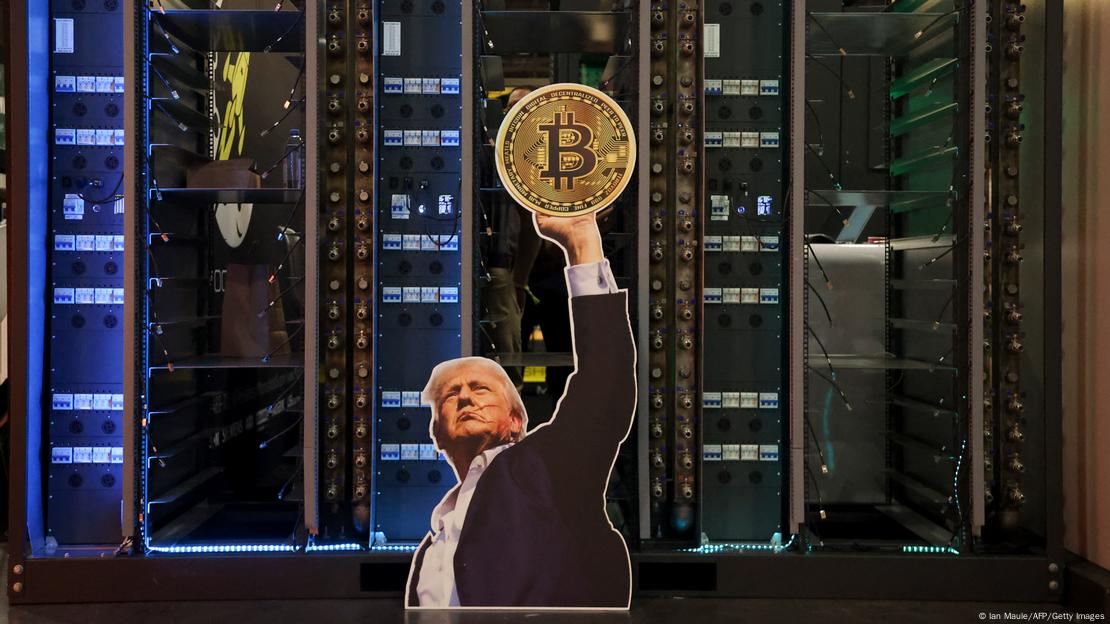
"I suspect bitcoin will rise throughout the shutdown and will soon reach $135,000," Geoffrey Kendrick predicted. The fact that the Trump administration is likely to continue pursuing favorable policies for cryptocurrencies adds to the sense of optimism.
As for gold, few see it losing value anytime soon.

"Rallies can continue into 2026 aided by official sector buying; institutional demand for gold as a diversifier can stay robust," HSBC said in a note to investors on Friday.

The London, UK-based bank said it expected central banks to continue buying gold in large quantities as an ongoing hedge against geopolitical risk.

That chimes with what the World Gold Council said in its last quarterly statement in late July, that its annual central bank survey showed that "95% of reserve managers believe that global central bank gold reserves will increase over the next 12 months."

That, along with the growing demand around ETFs from hedge funds and other institutional investors, suggests the commodity is likely to breach the $4,000 mark soon.

Follow google news channel to get RTV news Google News
Government Grants Permission to Import Onions
To stabilize the market, the government will allow limited onion imports starting Sunday. Fifty Import Permits (IPs) will be issued daily, with each IP authorizing a maximum import of 30 tonnes of onions. This information was shared in a press release sent by Mohammad Zakir Hossain, Senior Information Officer of the Ministry of Agriculture. The release stated that only importers who applied for an import permit since August 1 of the current year will be eligible to resubmit their applications. Each importer will be allowed to apply only once. The notice further mentioned that this initiative will continue until further notice to keep the onion market stable. About a month ago, the onion market suddenly became volatile. The price surged by about Tk 40 within four to five days, reaching Tk 115 to Tk 120 per kilogram. The price briefly dropped after the government initially decided to allow imports, slowly decreasing to Tk 105 to Tk 110. Last week, the government stated there were sufficient onion stocks and new onions would soon arrive, so import permits were being withheld to protect the interests of farmers. However, hoarders and traders reportedly exploited this decision, causing prices to rise again. On Wednesday, onions were sold at Tk 115 to Tk 120 per kg in Dhaka's retail markets, an increase of Tk 10 per kg within a week. However, according to TCB (Trading Corporation of Bangladesh) data, the current onion price is still 10% lower than it was last year. Although the new Murikata (harvested) onions have not yet arrived, Pata Pẽyaj (spring onions/onions with greens) are available, selling for Tk 70 to Tk 80 per kg. Onion traders reported that prices increased due to the news that imports would not be allowed. The impact of rising prices at the storage and farmer levels has been reflected in both the wholesale and retail markets. Earlier on November 9, Commerce Advisor Sheikh Bashir Uddin had announced that import approval would be granted if onion prices did not fall within four to five days. He stated, "We are keeping a close eye on the market. There is a large stock of onions in the country, and new onions will be harvested within the next two weeks. Nevertheless, if the price does not come down in the next four to five days, import approval will be granted." He added, "Currently, the government has 2,800 applications for onion imports. If approval is given for ten percent of these, the country will be flooded with onions. However, the government is monitoring the situation to ensure that farmers are not harmed by a sudden crash in prices."
Government Grants Permission to Import Onions
Govt Approves Edible Oil Increase of Up to Tk 16
Traders in Bangladesh have decided to raise the prices of edible oil in the local market following discussions with the government. The price of bottled and loose soybean oil has been increased by Tk 6 and Tk 7 per liter, respectively. Furthermore, the price of palm oil has risen by Tk 16 per liter, and the price of a five-liter bottle of soybean oil has increased by Tk 33. The Bangladesh Vegetable Oil Refiners and Vanaspati Manufacturers Association issued a notification on Sunday announcing the price hike. The organization stated that the new prices will be effective from Monday, December 8. The notification mentioned that the new price adjustment was made in consultation with the Ministry of Commerce to keep domestic prices consistent with the international market. According to the notification Bottled soybean oil has been increased by Tk 6 per liter, setting the new price at Tk 195. Loose soybean oil has been increased by Tk 7 per liter, setting the new price at Tk 176. A five-liter bottle of soybean oil has been set at Tk 955. The price of loose palm oil has been set at Tk 166 per liter. The Ministry of Commerce held a meeting with importers and marketing companies regarding edible oil prices on December 4. However, no decision was made in that meeting regarding increasing or decreasing prices. The Ministry of Commerce called another meeting on Sunday, where the decision to increase edible oil prices was finalized. Earlier, the government had expressed displeasure when traders attempted to increase edible oil prices without prior official approval. The government had sought an explanation from the traders regarding the move to raise prices without authorization.
Govt Approves Edible Oil Increase of Up to Tk 16
Domestic Onion Stocks Depleted, Prices Expected to Rise Throughout November
Onion prices in the capital's markets have surged, increasing by Tk 30 per kilogram in two weeks, now reaching Tk 100 to Tk 120. The domestic onion stock is nearing depletion, and the suspension of imports has created significant pressure on the market. Old-stock domestic onions are currently being sold for Tk 110 to Tk 120 per kg, up from Tk 70 to Tk 80 just two weeks ago. Furthermore, new spring onions (onion shoots) from the current season are selling for Tk 80 to Tk 100 per kg. Vendors state that new leafy onions are starting to arrive, and murikata (early harvest) onions will follow in a few days, which should cause prices to start falling. Traders predict that prices are likely to remain high throughout November and the market may only stabilize in December with the arrival of the early murikata onions. Early Winter Vegetables Arrive, Other Staples Fluctuate Meanwhile, early winter vegetables have started appearing in Dhaka markets, but consumers are yet to find relief from high prices. No vegetable is available for under Tk 50 per kg. Potato prices have increased by Tk 5 per kg, now selling for Tk 25. However, the prices of coarse rice and eggs have dropped. The price of farm-raised chicken eggs has decreased by Tk 10 to Tk 20 per dozen. A dozen eggs, which were selling for Tk 150 about a month ago, are now priced between Tk 130 and Tk 140. Broiler chicken is selling for Tk 170 to Tk 180 per kg, while Sonali (layer/Kadar) chicken is priced at Tk 280 to Tk 300 per kg.
Domestic Onion Stocks Depleted, Prices Expected to Rise Throughout November
US Sanctions Firms Aiding Iran's Oil Trade; Hitting Shipments to Bangladesh
In a major enforcement action, the United States has imposed sanctions on over 50 entities and ships for actively aiding Iran’s illicit petroleum trade. The enforcement network explicitly targeted by the US Treasury includes shipments that reached South Asian countries, notably Bangladesh and Sri Lanka. The US Treasury’s Office of Foreign Assets Control (OFAC) announced the measures as part of Washington's ongoing "maximum economic pressure" campaign aimed at degrading Iran’s cash flow and cutting off funding to designated terrorist groups. Treasury Secretary Scott Bessent stated that the new sanctions aim to dismantle Iran's "energy export machine." Bangladesh Shipments Named in Action The Treasury Department’s statement cited two specific Iranian LPG deliveries to Bangladesh that involved newly sanctioned vessels and entities: In early 2025, the Panama-flagged vessel Gas Dior delivered over 17,000 tonnes of Iranian LPG to Bangladesh for Octane Energy FZCO, which has also been sanctioned. In late 2024, the Comoros-flagged vessel Ada (formerly Captain Nikolas) carried Iranian LPG to several customers in Bangladesh. Read More Trump Says He will Impose Additional 100% Tariffs on China This vessel, which caught fire at Chattogram Port last year, and its owner are now listed as "blocked property" under the sanctions. The network also includes UAE-based firms like Slogal Energy DMCC and Markan White Trading Crude Oil Abroad Co LLC, accused of facilitating Iranian LPG shipments to South Asia since 2024. Global Implications The newly sanctioned firms, which are based in the UAE, Hong Kong, the Marshall Islands, and China, are accused of concealing the oil's origin through "shadow fleet" operations—including vessel-to-vessel transfers and shell companies. Two Chinese firms, Shandong Jincheng Petrochemical Group and Rizhao Shihua Crude Oil Terminal, were also targeted for importing Iranian crude. While no Bangladeshi company or government body was named, the mention of these deliveries signals Washington's intent to expand enforcement against intermediaries across Asia. Under US law, foreign firms involved in sanctioned trades risk secondary sanctions, including exclusion from the US financial system. Analysts warn the move may disrupt parts of the South Asian fuel trade and force local importers to recheck their supply channels for spot LPG purchases.
US Sanctions Firms Aiding Iran's Oil Trade; Hitting Shipments to Bangladesh
Gold Price Hits Record High: Vori Crosses Tk2 Lakh
The Bangladesh Jewellers' Association (BAJUS) has announced yet another increase in gold prices in the domestic market, with a maximum rise of Tk3,149 per vori. With the new prices, the cost of one vori (about 11.664 grams) of the best quality, 22-carat gold, will stand at Tk200,726 (2 lakh, 726 Taka)—the highest price ever recorded. Previously, gold was selling at Tk197,576 per vori today. BAJUS announced the new prices in a press release on Monday (October 6). The new rates will be effective from Tuesday (October 7). The statement noted that the price of acid gold (pure gold) in the local market has risen, leading to the decision to readjust the gold prices. New Gold and Silver Prices According to the new rates: 22-Carat Gold: Tk200,726 per vori 21-Carat Gold: Tk191,605 per vori 18-Carat Gold: Tk164,229 per vori Traditional Method Gold: Tk136,445 per vori The price of silver remains unchanged. The current rates for one vori of silver are: 22-Carat Silver: Tk3,628 21-Carat Silver: Tk3,453 18-Carat Silver: Tk2,963 Traditional Method Silver: Tk2,228 Previous Prices for Comparison The previous selling prices were: 22-Carat Gold: Tk197,576 per vori 21-Carat Gold: Tk188,595 per vori 18-Carat Gold: Tk161,651 per vori Traditional Method Gold: Tk134,253 per vori
Gold Price Hits Record High: Vori Crosses Tk2 Lakh
Read More
World Bids Farewell to 2025, A Year of Trump, Truces and Turmoil
Trump Warns Iran Against Rebuilding Nuclear Program
Trump Says Ukraine Deal Closer But No Talks Breakthrough
Powerful Explosions Rock Ukrainian Capital