Dhaka 03 November, 2026

Reclaiming Our Legacy in a Fractured World

Probir Chandra Das, Senior Assistant Director, UGC

Publish : 28 Jul 2026, 03:58 PM
Collected Photo

A land etched by the rivers of time, Bangladesh stands today at a moral crossroads. Our history books, our folk songs, and our national identity are built upon a profound legacy of communal harmony, resilience, and collective compassion.

This is the soil that gave birth to the spirit of Ekattor, where religion, ethnicity, and creed blurred into a singular, unstoppable force for liberation.

This is the culture that venerates Lalon Shah, whose verses transcended the artificial walls of faith, asking the most human of questions: “What form does the soul take?” Yet, scrolling through today’s news feeds or hearing whispers in our neighborhoods, we are confronted with a jarring, painful contradiction.

A rising tide of barbaric incidents—communal violence, brutal attacks on minorities, venomous speech, and acts of shocking cruelty—threatens to tear the very fabric of our society. How did we, a nation born from a symphony of unity, find ourselves listening to this dissonant cacophony of hate?

In the months following the political upheaval of August 2024, Bangladesh witnessed a disturbing surge in violence against religious minorities. According to the Bangladesh Hindu Buddhist Christian Unity Council (BHBCUC), more than 2,010 incidents of communal violence occurred between August 4 and 20, 2024, alone—including attacks on 69 temples, damage to over 1,000 homes and businesses, and the loss of innocent lives.

In the first half of 2025, the Council documented another 258 incidents, including 27 murders, 59 attacks on places of worship, and 20 cases of violence against women. Odhikar and Human Rights Watch have also recorded the continued targeting of Hindu, Buddhist, Christian and Ahmadiyya communities, as well as indigenous groups.

These numbers are not abstract statistics. They represent shattered homes, desecrated temples, and families living in fear. One harrowing case that shocked the nation was the lynching of 25-year-old Hindu garment worker Dipu Chandra Das in December 2025—beaten, hanged, and set ablaze over an alleged blasphemy accusation.

Such acts of barbarity stand in stark, heartbreaking contrast to the compassionate Bangladesh we know ourselves to be.

The gap between our historical self-image and our present reality is not just alarming; it is an existential warning. We must confront this contradiction not with denial, but with fierce, collective introspection. The barbarity we witness is not an alien invasion; it is a corrosion from within.

Read More

It is the fruit of cultivated prejudice, of political and social narratives that have, for years, quietly exchanged our rich, complex identity for a narrow, monolithic one. It is the result of an empathy deficit, where the “other”—be they of a different faith, ethnic community, or social standing—is slowly dehumanized, turned from a neighbor into a caricature, and then into a target.

This dehumanization is the bedrock of all barbarism. When we strip a person of their individual story, their dreams, and their capacity for pain and joy—reducing them to a mere label of “they” or “them”—we grant ourselves unconscious permission for cruelty.

The assailant does not see a humble shopkeeper, a devout worshipper, or a diligent student; he sees only an abstract symbol he has been taught to fear or despise. This is where our collective failure lies. We have allowed the space for shared stories to shrink.

We have forgotten the profound Bengali tradition of ‘mohamaya’—the divine illusion that separates us—and instead of seeking the underlying unity, we have begun to believe the illusion is real.

Therefore, the antidote to this barbarity is not merely stricter laws or louder condemnation, though both are necessary. The fundamental antidote is a conscious, deliberate, and massive reawakening of compassion—not as a soft, passive feeling, but as the most robust and revolutionary human quality.

Compassion is not mere pity; it is the courageous recognition of oneself in another. It is the active force that propelled hundreds of Muslim villagers to form protective rings around Hindu puja mandaps in times of tension and Hindu families to shelter their Muslim neighbors.

These are not fairy tales; they are living, breathing examples from our own recent past, proving that our better nature is not extinct, only dormant. Reclaiming this compassion requires a personal and public revolution.

First, we must practice Radical Empathy in our daily orbits. This starts in our homes—in what we tolerate and what we challenge. It means correcting a prejudiced joke at the family meal, intervening when a colleague is unfairly maligned for their background, and choosing kindness in traffic and in queues.

It means visiting the neighborhoods and houses of worship of communities different from our own, not as tourists, but as learners and guests.

We must consciously consume media that humanizes rather than demonizes, sharing stories of inter-community friendship, collaborative business ventures, and the countless mixed neighborhoods where life continues in peaceful synergy. These narratives are our true national news.

Second, we must demand and cultivate responsible speech from our leaders, influencers, and ourselves. Words are the architects of reality. The venom that flows from political platforms, social media pulpits, and even some pulpits of faith is not “just talk”; it is the kindling for the fire of violence.
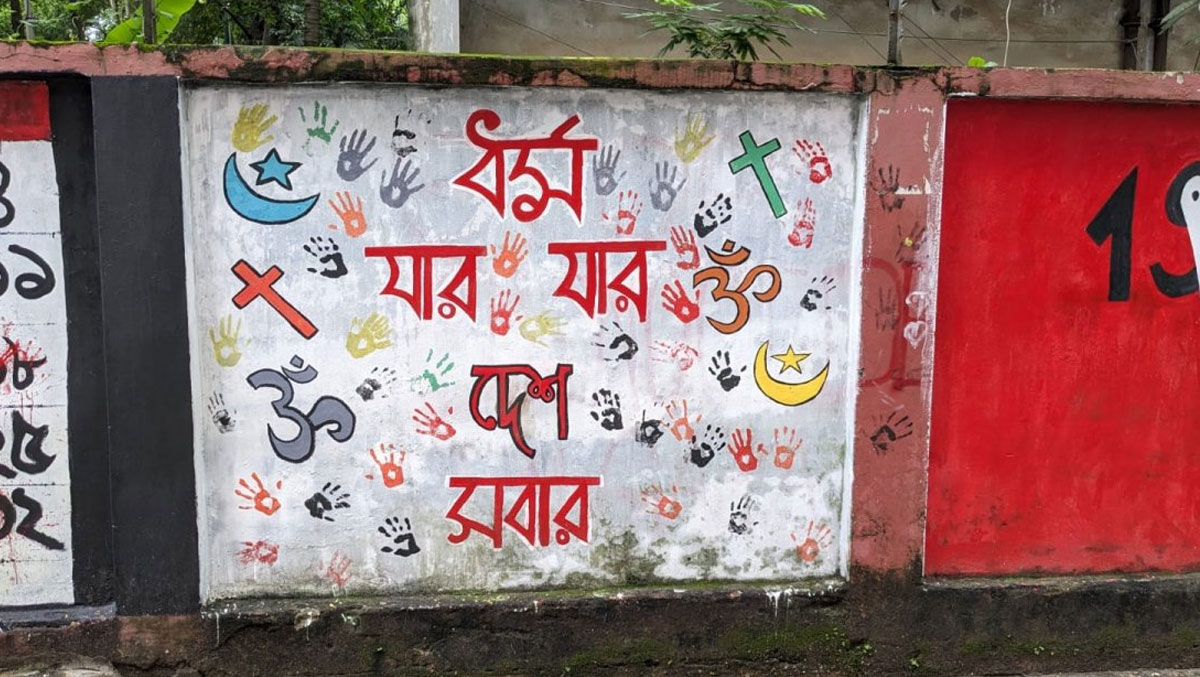
religious
Collected Photo

We must collectively shift our moral compass to honor those who build bridges with their words and withdraw our attention—and our votes—from those who trade in division. Silence in the face of hateful rhetoric is complicity. Our public discourse must be re-sanctified by the values of liberty and equality that our forebears died for.

Finally, we must actively rebuild our civic friendship. The strength of Bangladesh has always been in its samajik bonds—the community organizations, cultural groups, and relief committees that form spontaneously in crises.

We need to revive and reinvent these spaces as integrated, inclusive forums. Let our literary festivals, football tournaments, flood relief efforts, and cultural jatra be deliberately pluralistic. Let our children study together, play together, and work on community projects together, so their friendships become an unbreakable barrier against future bigotry.

Our harmony was never the absence of diversity, but its celebration. Bangladesh is not, and must never become, a nation defined by the barbarism of a few. It is defined by the quiet compassion of millions—the farmer who shares his harvest, the rickshaw puller who returns a lost wallet, and the strangers who pull together during a cyclone. This is our true character. This is the soul of this land, waiting to be reaffirmed.

The rivers of Bangladesh do not compete—they merge before flowing into the sea. Let our diverse streams of humanity do the same. Let compassion become the mighty current that sweeps away the debris of hatred. In a world full of conflict, only humanity can stop this.

Our history commands it. Our future depends on it. Every day, in every conversation and every act, let us choose to be healers, not hurters. Let us rebuild, together, the Bangladesh that was always meant to be—a sanctuary for the human heart.

Follow google news channel to get RTV news Google News
Donald Trump Loses Allies After Elections in Serbia and Brazil
Flavio Bolsonaro failed to gain power, Aleksandar Vucic was voted out of office, and even Benjamin Netanyahu's position has weakened. An unhappy US President Trump is crying electoral fraud.
Donald Trump Loses Allies After Elections in Serbia and Brazil
What Would a New Israeli Government Mean for Arab Neighbors?
A new Israeli government is unlikely to bring big changes on controversial topics like Palestinian statehood and Israeli troops in Lebanon and Syria, experts say. Some small positives may be possible though.
What Would a New Israeli Government Mean for Arab Neighbors?
Protests Against Hijab Ban in Azerbaijan: Why are Children Involved?
Girls wearing headscarves have been turned away from schools in Azerbaijan, triggering unusual protests involving children. The government rules do not mention hijabs. Why are schools enforcing unwritten rules?
Protests Against Hijab Ban in Azerbaijan: Why are Children Involved?
India: Can 'Cockroaches' Threaten Modi's Political Grip?
Thousands detained, leaders arrested on arrival, and a capital under lockdown: The youth-led protests against the election chief have the attention of the Indian government. But experts say toppling it is another matter.
India: Can 'Cockroaches' Threaten Modi's Political Grip?
French Students Decry Failures of Education System
For weeks, schoolchildren in France have been protesting the failing education system. Compared to many other countries, France invests heavily in education but critics say that the funds are not distributed fairly. Rats in the toilets, leaking roofs, broken heating systems: Cellphone videos filmed by French schoolchildren and circulating on social media bear witness to the dilapidated infrastructure in many educational institutions across France. At the Lycee Paul Eluard in the Parisian suburb of Saint-Denis, a center of the current protests, young people have reported that there are vermin in the building, and say burst pipes are a regular occurrence. In nearby Pantin, pupils complained that windows couldn't be opened, even when temperatures soared to 40 degrees Celsius (over 104 degrees Fahrenheit) in summer. Pupils also complain of overcrowded classrooms and frequently cancelled lessons. The protests, which have erupted all over the country, show no sign of coming to an end.  Problems of centralization Yet, by EU standards, France invests a substantial amount in its education system — 6.7% of its GDP. The fact that this investment has not translated into a better learning environment may be partly attributable to the way responsibilities are divided. The central government in Paris mainly deals with paying teachers, and setting national curricula. But the responsibility for maintaining school buildings lies with France's various levels of local government. For elementary schools, the administration responsible is the municipality; for "colleges" (lower secondary schools, ages 11–15) it is the wider department, and for lycees (upper secondary schools, ages 15–18) it is the region. Depending on the region, the local authorities have different financial possibilities at their disposal, and must plan renovation projects themselves. Progress on making improvements is often very slow as a result. In addition, more than two-thirds of their budget is already allocated to staffing costs and pension payments, leaving relatively little room for investment. Dilapidated infrastructure Over 80% of elementary school buildings in France are more than 50 years old. An estimated 10 to 20% of all school buildings are considered to be in serious need of renovation. In many instances, politicians have been trying to address the problem. Ile-de-France, which covers Paris and the region surrounding it, approved a 10-year program of renovation and expansion for the period 2017 to 2027 at a cost of €6.6 billion ($7.4 billion). According to the local authorities, two-thirds of upper secondary pupils now attend a new school, or one that has been renovated. But even after mold has been removed and roofs repaired, it is still rare for buildings to have effective protection against the summer heat. It is also a bitter irony that some buildings newly constructed at considerable expense, or renovated just a few years earlier, have been damaged in the recent protests. Macron tried in vain to address problem Imbalances are also evident in ongoing education expenditure. While France invests a comparatively large amount in upper secondary education, according to OECD calculations Paris spends less per primary school pupil than the average for industrialized countries. Education researchers emphasize that it is precisely these early years that lay the foundation for subsequent academic success. The governments put in place by French President Emmanuel Macron have attempted to address this imbalance. Since 2017, class sizes in the first years of primary school have been halved in socially disadvantaged areas, and around 16,000 additional teaching posts created.  Amid the ongoing protests, the government has said it now intends to recruit more than 3,000 supply teachers at short notice. French Education Minister Edouard Geffray  announced that software would be used to identify schools that are in a particularly difficult situation. These announcements are the government's first concrete response to the demands of the students, who have been demonstrating for almost two weeks now, calling for better facilities in secondary schools, more supply teachers and greater investment in the education system generally. Increasing deficiencies The latest scores for the Organization for Economic Cooperation and Development’s (OECD) program for international student assessment (Pisa), which were published in September, illustrate the scale of the problems in the education system. According to the results, more than one in three 15-year-olds in France no longer achieve a basic level of competence in mathematics, for example. Macron's reform of the upper secondary education system has also been criticized. The abolition of academic streaming in favor of specialist subjects selected by the individual was meant to give pupils greater freedom of choice. However, the large number of possible subject combinations make it difficult to timetable lessons. Students complain that they have too many free periods and longer school days. The problems also extend to universities. A lecturer at a Paris university described a seminar attended by 50 students — so many that they have to fetch chairs from other rooms or sit on the floor. So far, she said, the university administration had done nothing about it. Cancelled lessons Compared with pupils in other EU countries, French schoolchildren have a high number of teaching hours per school year — on paper, at least. But the French Court of Accounts recorded that 9% of lessons at state colleges were cancelled in the 2023–24 school year. A study from the school year 2024–25 suggests that only around 12% of lessons cancelled at short notice are covered by other teachers. The relatively low salaries of French teachers compared to those in neighboring countries are also a problem. OECD data shows that after 15 years in the profession teachers at lower secondary schools in France only earn about half as much as their German counterparts. Broken promises of equality France takes pride in its republican model of education, which is supposed to provide all children with equal opportunities, irrespective of their background. In reality, academic success in France is much more dependent on parents' socioeconomic circumstances than in many other countries. This is also apparent in that children from poorer families are far more likely to be affected by the cancellation of lessons. The government's financial room for maneuver is currently restricted by the country's precarious budgetary situation. Although the draft budget for 2027 includes an additional €1.2 billion for the Ministry of Education, there are also plans to cut teaching posts, on the grounds that pupil numbers are falling. Protests in the run-up to the presidential election It's not just videos of dilapidated school buildings that are circulating on social media. As the discontent has spread, there is also footage of demonstrations where people carry placards with political slogans that have little to do with education policy. Some videos show burning barricades and clashes with the police, which faces accusations of using disproportionate force. Some members of the far-left France Unbowed (LFI) party have associated themselves with the protesting students. Lawmakers have appeared at school blockades and shared related videos. The government has accused LFI of deliberately exploiting young people's anger for political purposes, an allegation that the party rejects. With the French presidential election just six months away, the protests over the crisis in education are evolving into a power struggle.
French Students Decry Failures of Education System
Read More
Dhaka, Washington Discuss Preserving History of 1971 War and July Uprising
49,982 Pilgrims Return to Bangladesh After Fulfilling Hajj
32,832 Bangladeshi Pilgrims Return Home from Hajj
Nation Celebrates Eid-ul-Azha in True Spirit of Devotion and Sacrifice