Dhaka 04 November, 2026

India: Can 'Cockroaches' Threaten Modi's Political Grip?

Seerat Chabba, Deutsche Welle

Publish : 14 Oct 2026, 09:10 AM
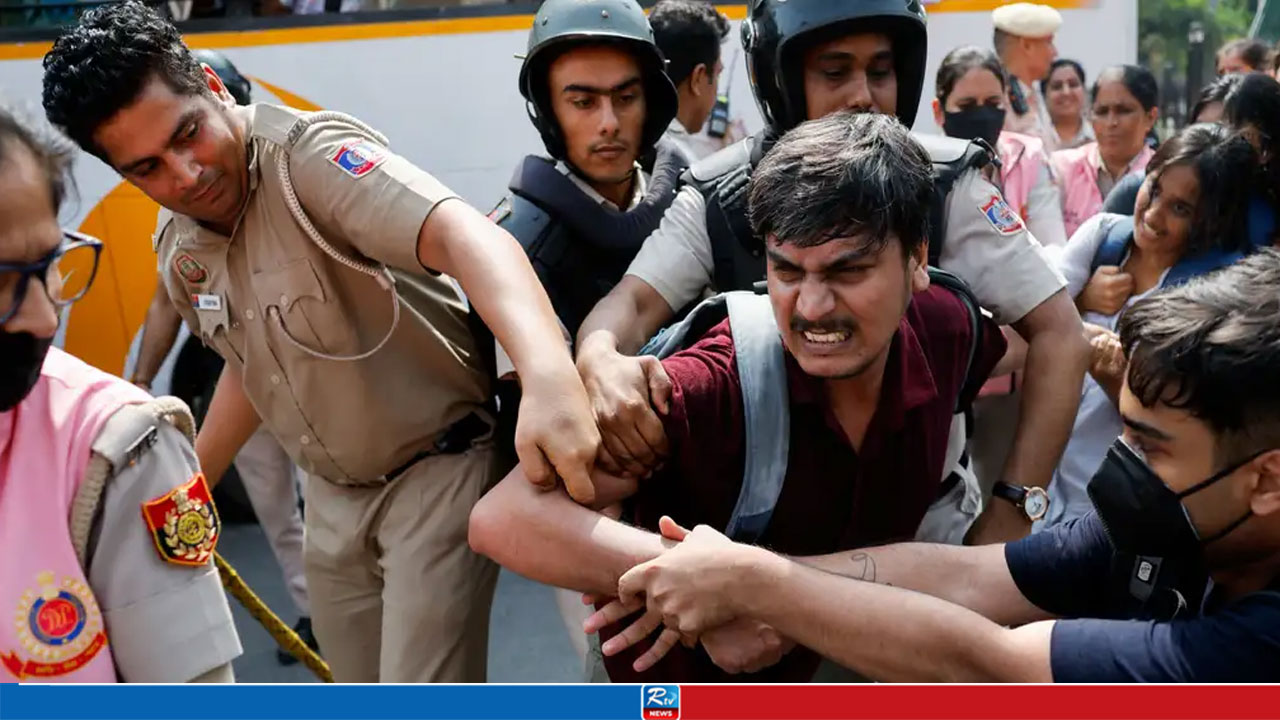
Despite the momentum, the CJP has not been able to replicate its success from July. Photo: Reuters

India's Cockroach Janata Party (CJP) may have anticipated pushback from the government after its first round of protests in July, but the scale of barricading and detentions that greeted its leaders in a fortress-like New Delhi on October 10 was unlike anything they had anticipated.

The CJP began as a satirical online movement after the chief justice of India, Surya Kant, referred to unemployed young people as "cockroaches" in an offhand remark. The name is an ironic riff on the name of Indian Prime Minister Narendra Modi's ruling Bharatiya Janata Party (BJP).

In its latest round of agitation, they are demanding the resignation of the country's controversy-hit Chief Election Commissioner Gyanesh Kumar, after more than 130 million names were reportedly removed from electoral rolls nationwide.

What happened over the weekend?
CJP founder Abhijeet Dipke, accompanied by co-conveners Ashutosh Ranka and Saurav Das, was detained from the plane in which he landed in the national capital on Saturday.

Meanwhile, police were stationed outside the homes of several other faces associated with the movement, including social media personality Dhruv Rathee, who has nearly 20 million followers on Instagram.

In central Delhi, buses were loaded with protesters, many of whom were taken to far-flung centers, where they were kept for hours. According to local media, at least 3,000 people were detained across the city.

How the government is handling the protests
The protests come as Modi marks 25 uninterrupted years leading elected governments, first in Gujarat state as chief minister and then as prime minister of India.

Ironically, "this celebration has happened at the time when he's politically at his weakest," Delhi-based writer Nilanjan Mukhopadhyay told DW. Mukhopadhyay is the author of Modi's 2013 biography "Narendra Modi: The Man, The Times."
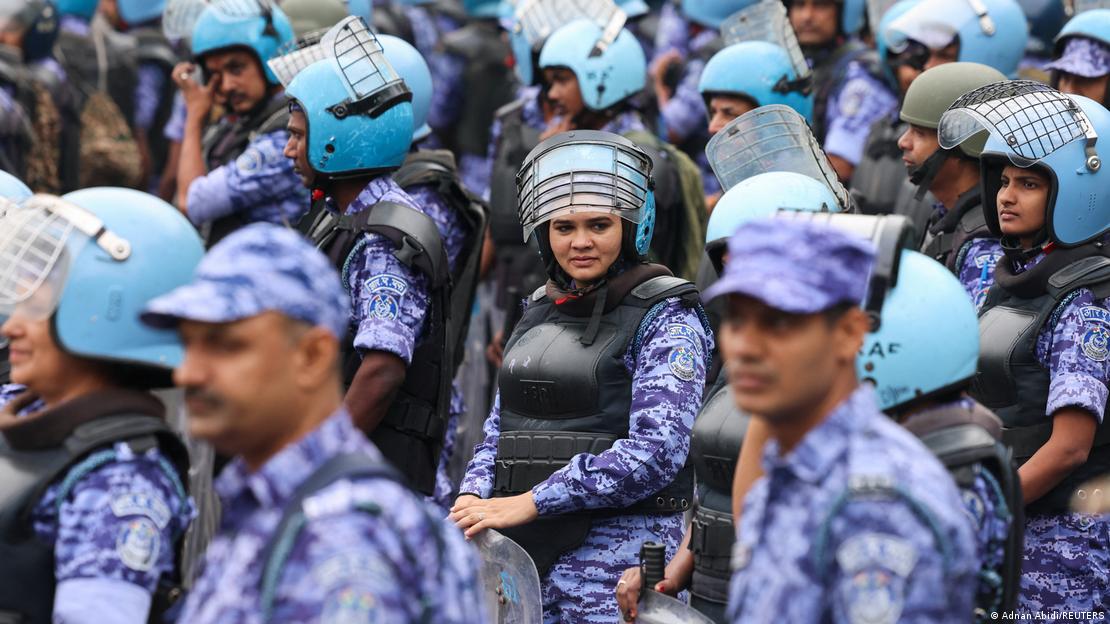
India New Delhi 2026 | Rapid Action Force mobilize ahead of protests

He contrasted the government's current response with its approach in July, when thousands of young protesters took to the streets to demand the resignation of Modi's education minister over repeated exam paper leaks.

At the time, authorities had used batons, detentions and pellets to disperse the crowds gathered in central Delhi, which had been on the streets for days.

This time, authorities shifted to mass security deployments and preemptive action on a large scale. This included notices to those associated with earlier protests, transport cuts, the internet cutoff and airport arrests.

"The government has learned from its previous experience. They didn't allow people to sit at Jantar Mantar for any length of time, so it couldn't balloon," Pearl Pandya, senior analyst for Asia at global monitor ACLED, told DW.
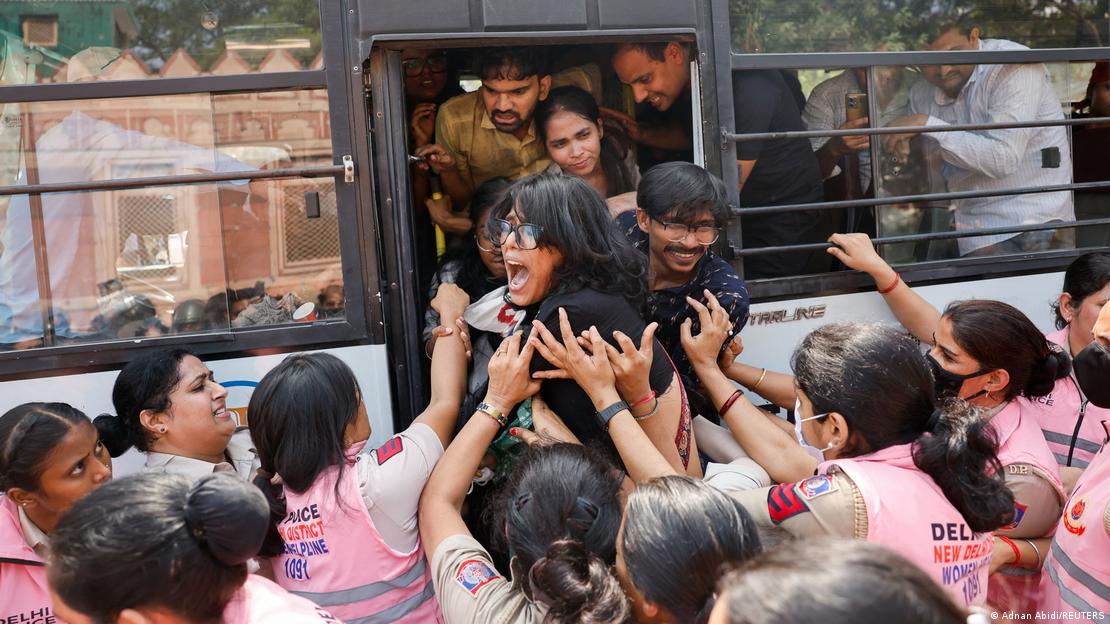
India New Delhi 2026 | Protest Cockroach Party

"What's worrying is whether this becomes a playbook for the future — that you are not allowed to protest in the first place," she added, referring to the government's decision to remove the 18th-century observatory Jantar Mantar in central Delhi from the list of designated protest sites.

Authorities, however, have announced three new designated protest sites in the national capital.

Mukhopadhyay had a different reading of the situation. "The scale of this deployment is actually a defeat for Mr. Modi," he said.

Mukhopadhyay argued that it was already a setback for the government if it was forced to deploy security forces on such a scale in response to protests from a completely new socio-political movement.

Why October hasn't matched July
Despite the momentum, the CJP has not been able to replicate its success from July, with the protests against Kumar being led primarily by opposition leaders and student organizations.

"Education was far more of a cross-cutting issue... the right to vote is still seen as an intrinsically political one, where it's the opposition versus the BJP," Pandya said.

The CJP, however, has long maintained that it is non-political. This is often cited as the reason for them amassing such a large following of young followers.

Mukhopadhyay criticized that stance, saying: "You cannot raise issues about electoral neutrality... without saying that these are political issues."

Despite the differences between the previous round of CJP protests in July and the current wave of demonstrations, sociologist Surinder Singh Jodhka emphasized continuity.

"I don't think they're qualitatively different. Once again, young people are the ones who are mobilized, and they are much more encouraged because the earlier round of protests was successful," he told DW. "And it's also asking similar questions about institutions, about democracy, about transparency and accountability."

"There is a new hope for those who had earlier given up on India, and felt like the right wing was in complete control," Jodhka added.

Abrupt change of government unlikely
Dismissing comparisons with volatile protests in neighboring Nepal and Bangladesh, which brought down their governments, the analysts pointed to India's strong institutions as a safeguard against a dramatic change of government.

"India has had a very strong state system and state institutions," Jodhka explained, highlighting that even the opposition parties were asking for "the revival of institutions, rather than an overthrow of the state."

Pandya also stated that faith in the judiciary "would prevent these protests from tipping over into a popular revolution which unseats the government."

Nevertheless, she said, sustained discontent "might come to bite the government in 2029... or before that in the state elections."

It could also erode Modi's popularity, which has been a defining feature of Indian politics over the past decade, the expert indicated.

For Mukhopadhyay, the most troubling aspect of the current protests is the erosion of the electoral body's credibility.

Recalling the pride he felt when he registered to vote at 21, he drew comparisons with young Indian voters today. "The youngsters are now fighting for their vote."

Follow google news channel to get RTV news Google News
Donald Trump Loses Allies After Elections in Serbia and Brazil
Flavio Bolsonaro failed to gain power, Aleksandar Vucic was voted out of office, and even Benjamin Netanyahu's position has weakened. An unhappy US President Trump is crying electoral fraud.
Donald Trump Loses Allies After Elections in Serbia and Brazil
What Would a New Israeli Government Mean for Arab Neighbors?
A new Israeli government is unlikely to bring big changes on controversial topics like Palestinian statehood and Israeli troops in Lebanon and Syria, experts say. Some small positives may be possible though.
What Would a New Israeli Government Mean for Arab Neighbors?
Protests Against Hijab Ban in Azerbaijan: Why are Children Involved?
Girls wearing headscarves have been turned away from schools in Azerbaijan, triggering unusual protests involving children. The government rules do not mention hijabs. Why are schools enforcing unwritten rules?
Protests Against Hijab Ban in Azerbaijan: Why are Children Involved?
French Students Decry Failures of Education System
For weeks, schoolchildren in France have been protesting the failing education system. Compared to many other countries, France invests heavily in education but critics say that the funds are not distributed fairly. Rats in the toilets, leaking roofs, broken heating systems: Cellphone videos filmed by French schoolchildren and circulating on social media bear witness to the dilapidated infrastructure in many educational institutions across France. At the Lycee Paul Eluard in the Parisian suburb of Saint-Denis, a center of the current protests, young people have reported that there are vermin in the building, and say burst pipes are a regular occurrence. In nearby Pantin, pupils complained that windows couldn't be opened, even when temperatures soared to 40 degrees Celsius (over 104 degrees Fahrenheit) in summer. Pupils also complain of overcrowded classrooms and frequently cancelled lessons. The protests, which have erupted all over the country, show no sign of coming to an end.  Problems of centralization Yet, by EU standards, France invests a substantial amount in its education system — 6.7% of its GDP. The fact that this investment has not translated into a better learning environment may be partly attributable to the way responsibilities are divided. The central government in Paris mainly deals with paying teachers, and setting national curricula. But the responsibility for maintaining school buildings lies with France's various levels of local government. For elementary schools, the administration responsible is the municipality; for "colleges" (lower secondary schools, ages 11–15) it is the wider department, and for lycees (upper secondary schools, ages 15–18) it is the region. Depending on the region, the local authorities have different financial possibilities at their disposal, and must plan renovation projects themselves. Progress on making improvements is often very slow as a result. In addition, more than two-thirds of their budget is already allocated to staffing costs and pension payments, leaving relatively little room for investment. Dilapidated infrastructure Over 80% of elementary school buildings in France are more than 50 years old. An estimated 10 to 20% of all school buildings are considered to be in serious need of renovation. In many instances, politicians have been trying to address the problem. Ile-de-France, which covers Paris and the region surrounding it, approved a 10-year program of renovation and expansion for the period 2017 to 2027 at a cost of €6.6 billion ($7.4 billion). According to the local authorities, two-thirds of upper secondary pupils now attend a new school, or one that has been renovated. But even after mold has been removed and roofs repaired, it is still rare for buildings to have effective protection against the summer heat. It is also a bitter irony that some buildings newly constructed at considerable expense, or renovated just a few years earlier, have been damaged in the recent protests. Macron tried in vain to address problem Imbalances are also evident in ongoing education expenditure. While France invests a comparatively large amount in upper secondary education, according to OECD calculations Paris spends less per primary school pupil than the average for industrialized countries. Education researchers emphasize that it is precisely these early years that lay the foundation for subsequent academic success. The governments put in place by French President Emmanuel Macron have attempted to address this imbalance. Since 2017, class sizes in the first years of primary school have been halved in socially disadvantaged areas, and around 16,000 additional teaching posts created.  Amid the ongoing protests, the government has said it now intends to recruit more than 3,000 supply teachers at short notice. French Education Minister Edouard Geffray  announced that software would be used to identify schools that are in a particularly difficult situation. These announcements are the government's first concrete response to the demands of the students, who have been demonstrating for almost two weeks now, calling for better facilities in secondary schools, more supply teachers and greater investment in the education system generally. Increasing deficiencies The latest scores for the Organization for Economic Cooperation and Development’s (OECD) program for international student assessment (Pisa), which were published in September, illustrate the scale of the problems in the education system. According to the results, more than one in three 15-year-olds in France no longer achieve a basic level of competence in mathematics, for example. Macron's reform of the upper secondary education system has also been criticized. The abolition of academic streaming in favor of specialist subjects selected by the individual was meant to give pupils greater freedom of choice. However, the large number of possible subject combinations make it difficult to timetable lessons. Students complain that they have too many free periods and longer school days. The problems also extend to universities. A lecturer at a Paris university described a seminar attended by 50 students — so many that they have to fetch chairs from other rooms or sit on the floor. So far, she said, the university administration had done nothing about it. Cancelled lessons Compared with pupils in other EU countries, French schoolchildren have a high number of teaching hours per school year — on paper, at least. But the French Court of Accounts recorded that 9% of lessons at state colleges were cancelled in the 2023–24 school year. A study from the school year 2024–25 suggests that only around 12% of lessons cancelled at short notice are covered by other teachers. The relatively low salaries of French teachers compared to those in neighboring countries are also a problem. OECD data shows that after 15 years in the profession teachers at lower secondary schools in France only earn about half as much as their German counterparts. Broken promises of equality France takes pride in its republican model of education, which is supposed to provide all children with equal opportunities, irrespective of their background. In reality, academic success in France is much more dependent on parents' socioeconomic circumstances than in many other countries. This is also apparent in that children from poorer families are far more likely to be affected by the cancellation of lessons. The government's financial room for maneuver is currently restricted by the country's precarious budgetary situation. Although the draft budget for 2027 includes an additional €1.2 billion for the Ministry of Education, there are also plans to cut teaching posts, on the grounds that pupil numbers are falling. Protests in the run-up to the presidential election It's not just videos of dilapidated school buildings that are circulating on social media. As the discontent has spread, there is also footage of demonstrations where people carry placards with political slogans that have little to do with education policy. Some videos show burning barricades and clashes with the police, which faces accusations of using disproportionate force. Some members of the far-left France Unbowed (LFI) party have associated themselves with the protesting students. Lawmakers have appeared at school blockades and shared related videos. The government has accused LFI of deliberately exploiting young people's anger for political purposes, an allegation that the party rejects. With the French presidential election just six months away, the protests over the crisis in education are evolving into a power struggle.
French Students Decry Failures of Education System
Is Bangladesh Backtracking on Post-Hasina Reforms?
Two years after a student-led uprising toppled PM Sheikh Hasina, critics say Bangladesh's reform momentum is fading as political divisions deepen and key changes stall. Just two years after a student-led uprising ended the nearly 16-year rule of Sheikh Hasina, many fear Bangladesh is slipping backward. With Hasina, now in exile in India, planning a return in December and critics accusing the current government of failing to deliver on its promises, the country's political future is once again in doubt. "At the end of the day, we did not see the elimination of discrimination, the creation of an inclusive society, or the new political order that was promised," Mohammad Tanzimuddin Khan, a professor of international relations at Dhaka University, told DW. "It seems we are forgetting the very reasons behind the uprising of last July, especially those who came to power." The protest movement began in 2018 over a controversial quota system for government jobs. In 2024, a court-backed move to reinstate parts of the system sparked fresh demonstrations that grew into a wider anti-government uprising. In August 2024, after more than 1,000 people were killed in the unrest, then Prime Minister Hasina fled to India. Rebuilding Bangladesh's institutionsBangladesh's interim government, which was led by Nobel Peace Prize winner Muhammad Yunus and backed by the military and key figures from the uprising, facilitated the signing of a reform roadmap. It was named the "July Charter" after the month when the uprising that toppled Hasina began.  In a February 2026 referendum, around 70% of voters approved the charter, which proposed term limits for prime ministers, the creation of an upper house of parliament, stronger presidential powers and greater judicial independence. The Bangladesh Nationalist Party (BNP) won a decisive majority in a general election that took place alongside the referendum. Critics say the BNP has since failed to implement several pre-election reform commitments. Ali Riaz, who led the interim government's Constitution Reform Commission, said there had been "time-bound commitments," including the creation of a constitutional reform council and steps to implement reforms within 180 working days. "That was not done," he said, adding that it was "deeply regrettable." Is Bangladesh moving in the wrong direction?The interim government introduced 133 ordinances as part of its reform agenda, but after the BNP came to power, it refused to adopt 20 of them — including measures concerning the National Human Rights Commission (NHRC), the Anti-Corruption Commission, enforced disappearances and referendums. The BNP argues that constitutional and institutional changes should be enacted through proper legislative procedures in Parliament. The BNP and the opposition Jamaat-e-Islami-led alliance have clashed over the July Charter, including proposals for a constituent assembly to oversee constitutional reforms. Salahuddin Ahmed, who led the BNP's representatives in the National Consensus Commission, now serves as Bangladesh's Home Minister. Speaking in Parliament in March, Ahmed described the charter's implementation order as "a document of endless deception" by the interim government. Asif Mahmud, spokesperson for the student-led National Citizen Party (NCP), accused the BNP of "betraying the public" on its reform promises and cast doubt on "whether voters would trust the party again if a similar political moment were to arise." Mahmud, a leading figure in the uprising who later served as an adviser in the interim government before resigning ahead of the national election, told DW: "The BNP is taking the country backward by revoking the very ordinances and reforms that the interim government had implemented."  However, Khan believes the opposition party also bears responsibility for this. "It is not just the ruling party; there is no sign of the opposition breaking free from this tendency either." While he sees some change in the way prime ministerial power is exercised, he believes "politicization has returned to major institutions, including educational ones." Have public aspirations been realized?Mahmud said "political parties were eager to secure power" through early elections, forcing student leaders of the uprising to "make compromises on key reform demands." Alleged enforced disappearances were among the most serious accusations against Hasina's government. A commission set up by the interim administration reported that, of 1,913 complaints received, 1,569 were verified and classified as cases of enforced disappearance. Among those who later returned alive, about 75% were linked to the Islamist party Jamaat-e-Islami and 22% to the BNP, the main political rivals of Hasina's Awami League party. In an effort to prevent future abuses, Bangladesh signed the UN Convention against Enforced Disappearances in August 2024. The interim government later introduced an ordinance to criminalize the practice. "We wanted to ensure permanence by incorporating this into the constitution and making the necessary legal changes," Asif Mahmud said. However, rather than seeking parliamentary approval for the ordinance, the BNP-led government published a new draft bill in July 2026. Critics say the proposal weakened safeguards by assigning investigations into alleged enforced disappearances from the National Human Rights Commission (NHRC) to the police. Human Rights Watch (HRW)  warned that "allowing the police to investigate enforced disappearances will not ensure accountability and will not create the deterrence necessary to bring this practice to an end." HRW also cited the April 21 alleged abduction of Miraj Sheikh by men allegedly posing as Coast Guard personnel as the first reported enforced disappearance since the 2024 uprising. More than three months later, his whereabouts remain unknown. "We see signs of a return to those old times," Khan said. "Naturally, this is alarming." The 'Hasina Factor' persists in Bangladesh politicsThe Awami League and its affiliated organizations remain banned under an executive order and were excluded from February's elections. Hasina, meanwhile, has been sentenced to death by Bangladesh's International Crimes Tribunal over crimes against humanity committed during the 2024 uprising and remains self-exiled in India. Yet despite her fall from power, Hasina and her Awami League continue to loom large over Bangladesh's political landscape. In a Reuters interview last month, Hasina said she plans to return to Bangladesh in December and surrender to the authorities. The authorities in Dhaka "want to take me back, they are repeatedly sending letters to India seeking to have me sent back," she said. "I will go myself." "I believe in justice and I feel that once proceedings start, it will be ​clear to the people how farcical the court is," Hasina added, "and that I want to prove it." The announcement of her planned return has fueled fresh debate. NCP spokesperson Asif Mahmud argued that "even India no longer wishes to host Hasina" and suggested her remarks reflect growing uncertainty about her future there. Mahmud added that sheltering Hasina now provides India with little political benefit and complicates relations with Bangladesh's current government. Bangladesh's attorney general has declared that Hasina would be arrested immediately upon her return and stand trial. Ali Riaz, however, warned that Hasina's return could create new challenges. "During the trial proceedings, she and her followers might attempt to destabilize the law-and-order situation in Bangladesh for political gain," he said, calling on the government to guard against any resulting instability. Others, however, see a different possibility. Khan said the tensions surrounding Hasina's return could instead help "forge broader political unity in a deeply divided country."
Is Bangladesh Backtracking on Post-Hasina Reforms?