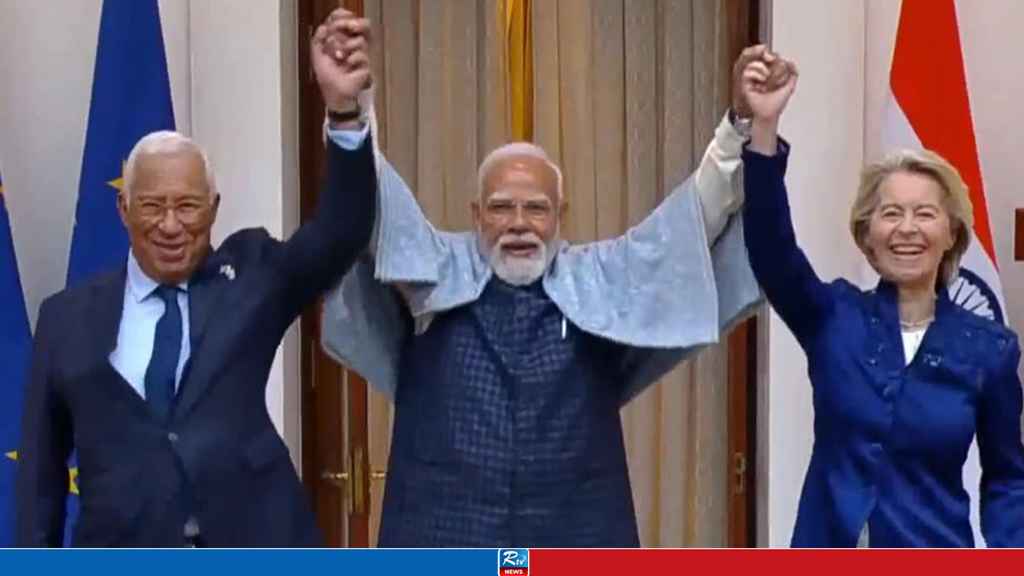
The India-European Union Free Trade Agreement (FTA) is poised to fundamentally reshape global economic integration, uniting two of the world's most influential trading blocs.
Union Minister for Electronics and Information Technology Ashwini Vaishnaw highlighted the pact's immense scale, noting that the partnership accounts for one-third of global trade and underpins 25 percent of the global GDP.
This strategic alignment aims to streamline market access and catalyze technological cooperation between the world's leading economies.
Under the terms of the agreement, the European Union will eliminate tariffs on 9,425 lines of Indian exports, granting preferential access to trade valued at approximately USD 75 billion.
This transition is a critical milestone for India’s industrial sector, providing a direct gateway into the USD 2 trillion EU market and supporting the nation’s target of reaching USD 300 billion in engineering exports.
Beyond traditional trade, Minister Vaishnaw emphasized that the deal will focus on "advancing collaboration in future-ready sectors such as AI, clean technologies and semiconductors."
This partnership is specifically designed to support India’s technological progress through R&D collaboration and technology transfer.
The agreement serves as a blueprint for "enhancing the competitiveness of the engineering and manufacturing ecosystem" by strengthening MSME networks and regional industrial clusters.
These initiatives are structured to help Indian firms secure global contracts and integrate seamlessly into high-value international supply chains.
Furthermore, the deal is geared toward "supporting Indian startups to compete and grow across global value chains," providing them with the necessary framework to scale their operations within the European market.
A major pillar of the agreement is the robust protection of the knowledge economy.
The framework "reinforces intellectual property protections under TRIPS" while firmly affirming the Doha Declaration to protect public interest.
India has successfully secured technical assistance and specialized incentives to modernize its patent ecosystem and the agreement provides unique recognition to India’s Traditional Knowledge Digital Library (TKDL).
Minister Vaishnaw highlighted that these provisions are essential for "reinforcing innovation and IP protection, supporting India's knowledge economy."
Source: ANI






 Live TV
 RTV Plus