Millions of South Asian workers in the Middle East provide a vital economic boost by sending money home. Economists warn these flows would be at risk if a protracted conflict dents the Gulf region's economies.
As the rich Arab states of the Persian Gulf are targeted by Iranian drones and missiles, protracted economic disruption brought on by the Iran war could threaten the hundreds of billions of dollars in remittances sent home every year by millions of South Asian foreign workers in the region.
Most of them come from India, Pakistan and Bangladesh, and for decades they have helped drive the Gulf nations' economic boom, taking jobs in construction, hospitality, tourism and health care.
Their remittances have not only provided families at home with essential income, but also become a major source of foreign currency inflows for India, Pakistan and Bangladesh, acting like a financial cushion for their economies, and helping cover trade deficits.
With energy infrastructure under attack and oil and gas transit blocked in the Strait of Hormuz, the combination of prolonged high energy prices and a drop in remittances could pose a double threat for these developing economies.
Remittances a key economic lifeline for South Asian states like India
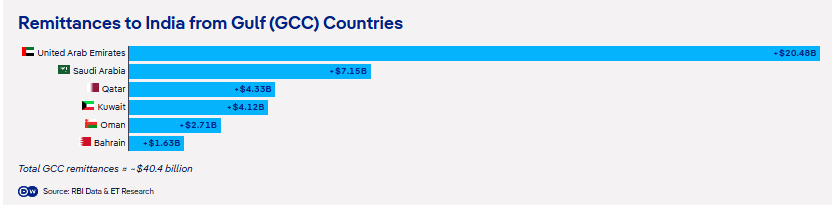
India is the world's largest recipient of remittances, with record high inflows amounting to $135 billion (€117 billion) in 2025, according to government data.
The previous year, India took in nearly $40 billion in remittances from Gulf Cooperation Council (GCC) countries alone, accounting for about 38% of its total inflows. Those incoming billions helped finance a good chunk of the nation's merchandise trade deficit, the data shows.
India is also the top source of foreign workers in the Gulf, with more than 9 million Indian expatriates living and working there.
Bangladesh and Pakistan follow, with each sending about five million workers to GCC countries. These workers accounted for the majority of Bangladesh's $30 billion and Pakistan's $38 billion in remittance inflows last year.
Danger to migrant workers in Gulf states
The war has also put civilians across the GCC — including migrant workers — at heightened risk.
Across the region, at least 11 civilians have been killed and more than 260 injured, with some deaths caused by falling debris, according to a Human Rights Watch (HRW) press release from March 17.
"Civilians, particularly migrant workers, across Gulf states are being threatened, killed, and injured by Iranian drones and missiles," Joey Shea, senior Saudi Arabia and UAE researcher at Human Rights Watch (HRW) said.
At least three Pakistani workers were killed in the UAE, including one man who was struck by falling debris from a drone strike.
Despite the danger, most South Asian expatriates in the Gulf appear to be staying put, with no reports of a mass exodus.
"Economic survival trumps perceived risks for the vast majority" of workers, Harsh Pant, head of the strategic studies program at the Observer Research Foundation (ORF), a New Delhi think tank, told DW.
He said most Indian workers in the Gulf are assessing the current situation as "temporary and manageable unless it escalates dramatically."
However, even if the workers stay, the long‑term risk is that their jobs may not — especially if the war drags on for months. The most immediate shocks have been felt in migrant-heavy sectors like air travel and tourism.
Still, besides some irregular bumps in payment systems due to panic transfers, the war has yet to impact remittance inflows.
No remittance shock — yet
"The duration of the conflict has so far been too short to severely impact employment of migrant workers or their remittance transfers." Rajiv Biswas, CEO at the Singapore-based macroeconomic and geopolitical risk research firm Asia-Pacific Economics, told DW, adding that he believes there is a low probability of a protracted war.
"However, if the duration of the conflict does become more protracted and extends into months, then it will become increasingly likely that migrant worker jobs will be impacted, as key sectors such as tourism and commercial aviation suffer increasing economic losses," he said.
ORF analyst Pant said that for India, some estimates have shown that a 10% to 20% hit to Gulf remittance inflows would translate to a $5 to 10 billion annual loss.
If the war lasts for a few weeks, Gulf economies could expect a drop in GDP of 1% to 2%, which would translate to "a drop in remittances of about 5%,” according to an estimate by Capital Economics, a London-based analytics firm.
However, if it drags on for three months or longer and severely damages the region's energy infrastructure, the report warned that Gulf GDP could fall by 10% to 15% and remittances by around 30%.

Prolonged Iran conflict poses challenges
Biswas shares a similar view.
"In that scenario of a protracted war, which is still a low probability, migrant remittances could start to decline if the war extends into a timeframe of months,” the economist said. "How quickly remittance flows would recover will depend on how soon key sectors of the GCC economy such as international tourism and commercial aviation can rebound."
While a prolonged conflict could pose huge challenges, Biswas underlined, a short-lived dip in remittances would be unlikely to have a significant macroeconomic impact on either domestic demand or the external account positions of India, Pakistan or Bangladesh.
For now, the main economic threat of the Iran war for these countries stems from the disruption of oil, LNG and fertilizer shipments through the Strait of Hormuz — but a long-lasting slump in remittances would deepen South Asia's economic pain.






 Live TV
 RTV Plus