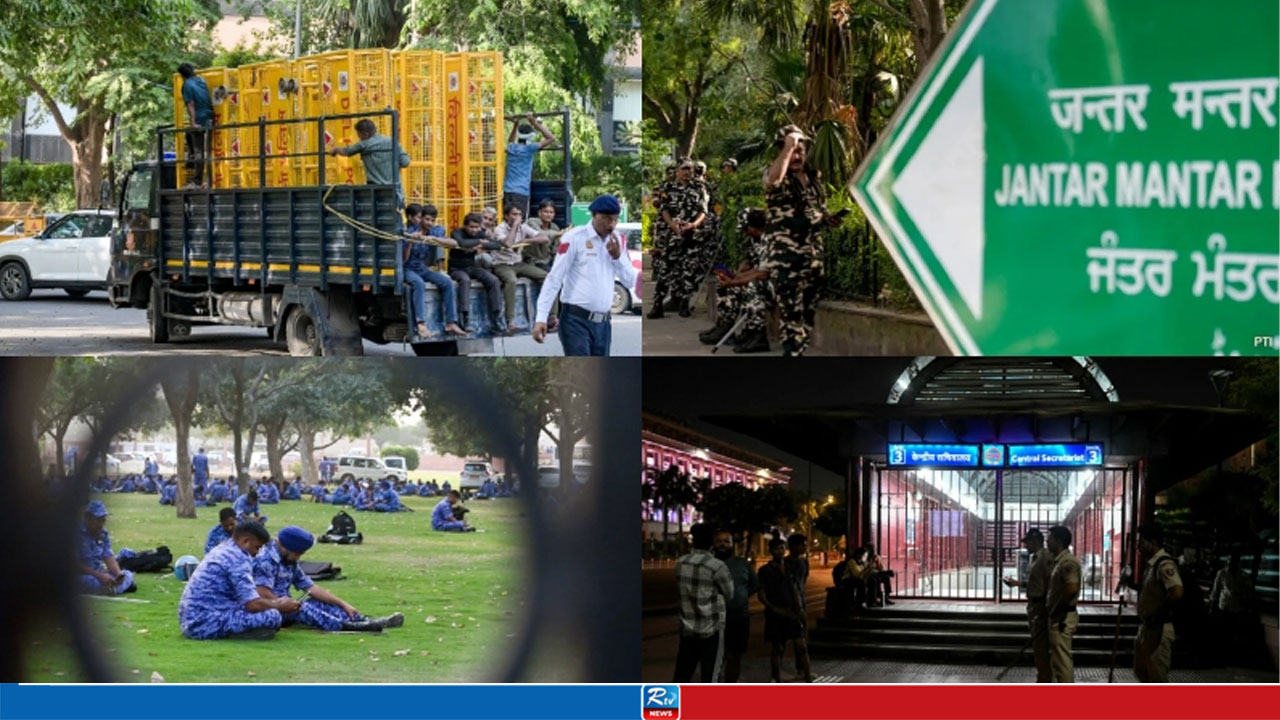
Preparations are underway for a major protest in central Delhi targeting Chief Election Commissioner of India, Gyanesh Kumar.
While the Cockroach Janata Party (CJP) is actively mobilizing supporters to gather at Jantar Mantar, the Central Government has deployed over 20,000 personnel from the Delhi Police and Central Armed Police Forces (CAPF) to maintain law and order.
According to an NDTV report on Saturday (October 10), the government is acting with heightened vigilance following the events of July 20.
On that day, widespread chaos and heavy-handed police actions erupted during protests over exam paper leaks, which ultimately led to the resignation of Education Minister Dharmendra Pradhan.
Authorities fear this new wave of demonstrations could take a similar turn. Although police have denied permission for the rally, officials have implemented a series of stringent measures to preserve order.
Entry and exit gates at 45 Delhi Metro stations—including Rajiv Chowk, New Delhi, Central Secretariat, Patel Chowk, and Kashmere Gate—will remain closed.
Additionally, over 250 local and inter-state trains scheduled to arrive at New Delhi and Hazrat Nizamuddin stations between 4:00 AM and 2:00 PM on Saturday have been canceled.
Mobile internet services have also been suspended for 24 hours within a four-kilometer radius of the Janpath–Kartavya Path intersection, starting at 10:00 PM Friday.
CJP founder Abhijit Dipke, however, asserted that despite the restrictions, party volunteers and supporters will proceed with their planned demonstration at Jantar Mantar.
"On one hand, you claim the protest will cause inconvenience to the public. On the other hand, you yourselves have shut down the metro, stopped train services, and blocked the roads. Does this not inconvenience the public?" Dipke questioned.
Delhi Police Strategy
The security apparatus designed by the Delhi Police focuses on two primary objectives: maintaining law and order and ensuring that police action during the protests does not spark fresh public backlash.
Officials noted that directives are clear—protesters must be prevented from entering the New Delhi district, and any gatherings in restricted zones must be dispersed immediately.
Delhi Police have designated a 1.5-kilometer radius as a high-sensitivity zone. This area encompasses critical landmarks including Jantar Mantar, Janpath, the Election Commission office, and the Delhi Police Headquarters.
Over 6,500 personnel will be deployed within this specific perimeter, effectively turning it into a fortress.
Surveillance has been significantly bolstered. More than 300 CCTV cameras equipped with audio-recording capabilities have been installed across sensitive locations in the New Delhi district to monitor real-time developments.
Seven-Layer Barricades at Jantar Mantar
Security measures at Jantar Mantar have been fortified to an unprecedented degree. At least seven layers of barricades have been erected on roads leading to the protest site.
The innermost layers have been welded together to make them nearly impossible to breach.
Loudspeakers installed at key locations are broadcasting pre-recorded announcements warning that the proposed demonstration lacks official authorization.
The public is being urged not to assemble, chant slogans, damage public property, or assault police personnel.
Community centers, mosques, and Resident Welfare Associations (RWAs) have been instructed to inform residents that the rally is unauthorized. Individuals traveling to New Delhi to participate have been warned of potential arrests and legal consequences.
Police are also conducting searches across hotels and guest houses in New Delhi and Central Delhi, instructing management to discourage guests from attending the rally.
Furthermore, Airbnb hosts and property owners have been advised against renting accommodations to prospective demonstrators.
Focus on Video Documentation
Following previous allegations of police misconduct and excessive force during recent demonstrations, Delhi Police are placing special emphasis on documenting every interaction during this event.
Footage circulating on social media following protests earlier this month showed alleged instances of police brutality, including accusations of assault and molestation of a female protester. These incidents raised serious questions regarding police conduct.
To record events from multiple angles, officers on duty—ranging from body officers to Additional Commissioners of Police—have been equipped with body-worn cameras.
Hundreds of photographers and videographers have also been deployed to capture both the protests and the police response in real time. Officials hope the video evidence will establish an accurate timeline, counter misleading claims with verifiable proof, and aid any subsequent investigations.
In an unusual move, the Delhi Police also issued an open letter reminding the public that police officers are also human beings with families waiting for them at home.
The letter appealed to all sides to exercise restraint and humanity, emphasizing that wearing a uniform does not strip an individual of their human dignity.








 Live TV
 RTV Plus