Dhaka 16 October, 2026

High-Tech Hajj: More Safety But Less Privacy, Spirituality?

Cathrin Schaer, Deutsche Welle

Publish : 04 Jun 2025, 10:30 AM
Photo: Saudi Press Agency

This year, it's drones featuring thermal imaging and robots handing out religious advice. A decade ago, it was all about the miracle of the mobile phone. And a century or so ago, the motor car was the highest of high-tech used during the annual Hajj pilgrimage.

The Hajj, one of the largest gatherings of humans on Earth, is meant to be undertaken by every adult Muslim once in their lifetime. It will begin in Saudi Arabia on June 4 and end June 9. During those days, up to 2 million pilgrims from over 180 countries will take part in a number of different religious ceremonies in Mecca.
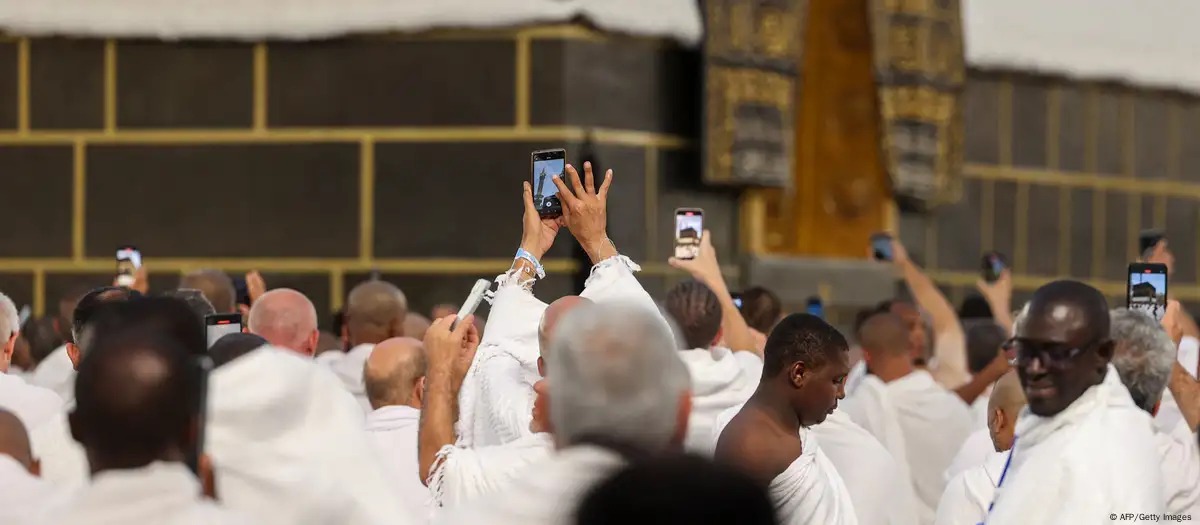
1
By early June, over 1 million visitors had already arrived in Saudi Arabia for the annual Hajj pilgrimage

But having so many people moving around in one comparatively small area has led to problems in the past. Thousands of pilgrims were killed in stampeding crowds in 1990 and 2015. Last year over 1,300 died due to extreme heat; pilgrims often walk up to 65 kilometers a day in 40-to-50 degrees Celsius heat. There have also been fires, protests, suicides, collapsing buildings and infectious diseases at the Hajj, as well as more everyday problems like people getting lost or having health problems.

No wonder then that the Saudi authorities are trying to use technology to improve how they control crowds and cater to their visitors. This year, Saudi Arabia will use drones with thermal imaging as well as artificial intelligence and facial recognition technology to ensure that only those who have Hajj permits are allowed in.
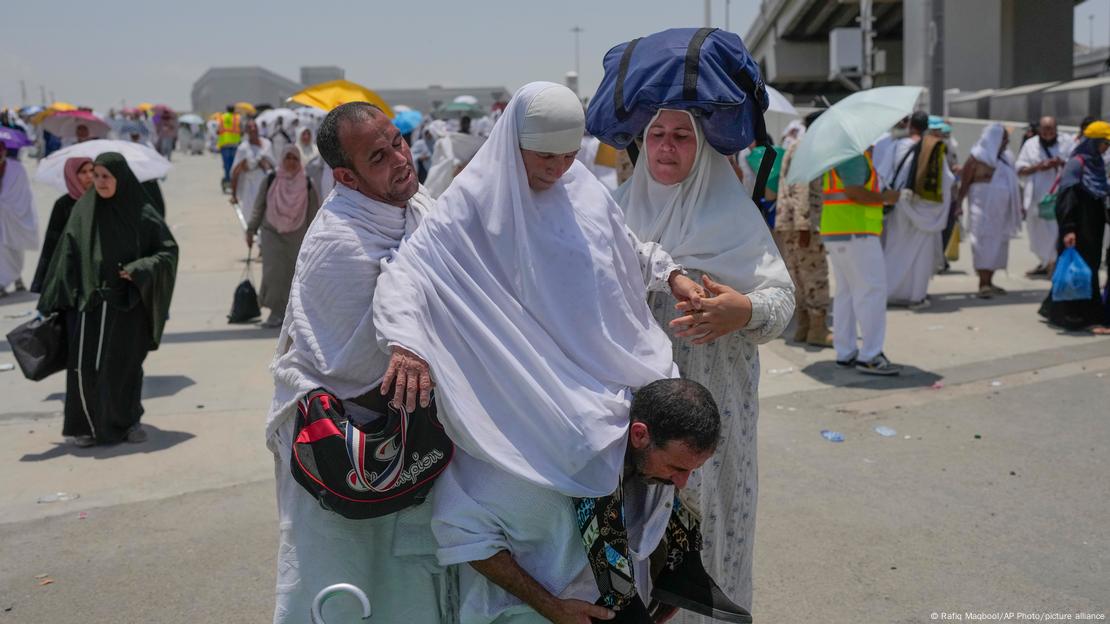
2
Last year extreme heat caused death and injury at the Hajj, where three-quarters of pilgrims are aged between 35 and 64

Last year's many deaths were mostly of pilgrims who didn't have official permission to be there and therefore couldn't access services like air-conditioned shelter in the extreme heat.

Can high tech boost safety?
To avoid overcrowding, Saudi Arabia's Nusuk website, also a mobile phone application, allows attendees to register to enter certain areas at allotted times. The Nusuk system includes an electronic identity card and a smart wristband, which hold information on the user's identity, travel plans, finances, health and accommodation, among other things. The Nusuk card must be carried throughout the pilgrimage and is used to access transport and other services. Some of the wristbands have location tracking, monitor the wearer's blood oxygen levels and heart rate, and can even be used to call for medical help.

Other technological advances at this year's Hajj include robots to guide visitors around religious sites and to hand out water, Korans or offer advice in 11 languages. There are also newly paved, more reflective (and therefore cooler) streets, paths that minimize vibration for walking comfort, and a special white pilgrim's gown made from futuristic fabric that keeps the wearer up to 2 degrees Celsius cooler.

All the technology, surveillance and advanced algorithmic calculation is meant to make the event safer and the chance of tragic accidents less likely. But as the amount of technology grows, so too do concerns about data privacy, state surveillance and potential cybercrime.

"All of these technologies are mandatory and those who refuse them are not allowed to perform the pilgrimage," explains Zeinab Ismail, a researcher and editor at the Lebanon-based digital rights organization, SMEX. "All of this, combined with Saudi Arabia's personal data protection law, which only partially aligns with international standards and contains concerning provisions and loopholes, raises increasing concerns about the safety and privacy of pilgrims' data."

Saudi officials have argued that privacy concerns must outweigh safety at such a huge event.

"Regardless of the [Saudi government's] justification, what worries me the most — and irrespective of the technology itself — is the fact that this technology is being deployed in a country where rule of law is weak, there's no transparency and no [state] accountability," argues Marwa Fatafta, policy director for the Middle East and North Africa at international digital rights organization, Access Now.

It would be difficult to audit the technologies for problems and even harder for individuals to question their use, Fatafta told DW.

"For the people who are going to the Hajj pilgrimage, they're not in any position to push back and say, 'I don't want to give my biometric data'," she continued. "So just the general context means that the door is wide open for abuse."

'Contact us'?
Reading the Nusuk app's terms and conditions, information about how long pilgrims' personal data can be kept is vague and even contradictory. DW e-mailed Saudi Arabia's National Data Management Office and the supervising Saudi Data and AI Authority to ask for more information on this. Both organizations publish e-mail addresses for the public to use if they have questions or want to make a complaint.

Two DW e-mails received no response. Another bounced back with the message: "Recipient's mailbox is full."

Since 2023, Saudi Arabia has had a personal data protection law — but as Ismail pointed out, "the current legal framework … allows legislation to be interpreted or manipulated in ways that may serve state interests over human rights."

It's not just potential misuse of millions of pilgrims' data by local authorities causing concern. Higher dependence on technology to monitor and control Hajj pilgrims also means more vulnerability in general, as there are more places for hackers to attack. And Saudi Arabia and other Gulf states are already some of the biggest victims of cybercrime.

The first platform Saudi Arabia used for registering pilgrims, Motawif, was run by a private company and unexpectedly sent spam to users. The state-run Nusuk app replaced it in 2022. The following year, cybersecurity experts found data submitted to Nusuk for sale on illicit websites that deal in stolen personal data.

Less religion, more cyber
New technology has also brought another worry: Is all that high tech taking away from the once-in-a-lifetime spiritual relevance of the Hajj?

A 2018 study conducted by researchers at the University of Central Lancashire in the UK suggested it might be.
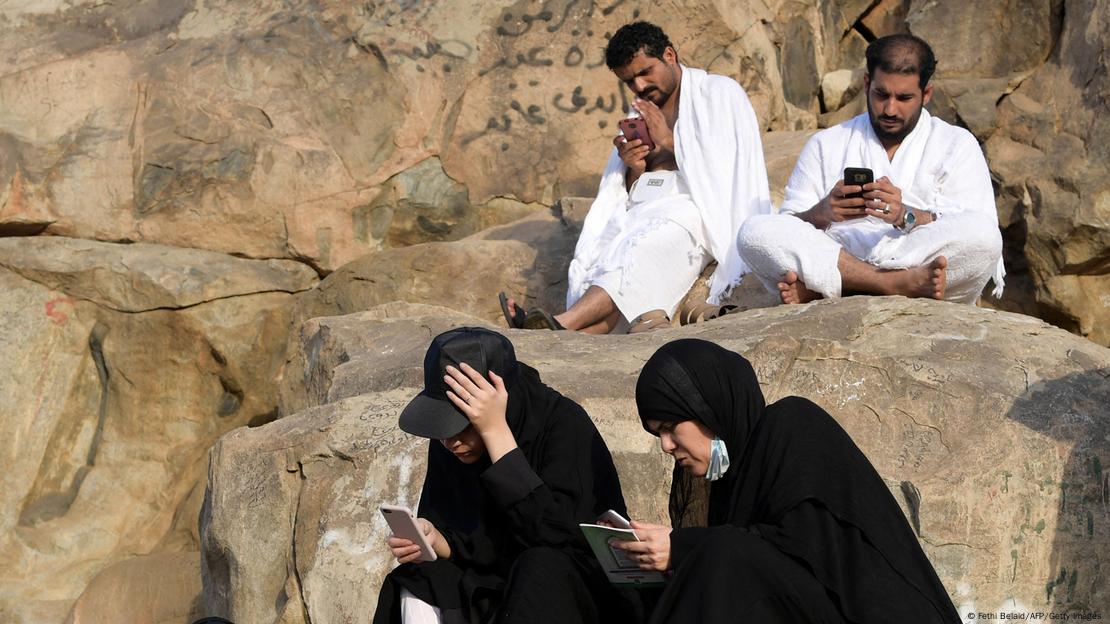
3
Last June, hackers stole the personal information of around 168 million people in Iran from a Hajj-related organization in that country

Pilgrims interviewed for the study complained about others taking selfies at holy sites, talking on the phone while performing rituals and behaving like tourists rather than pious visitors. "Smartphones are the fourth devil in Hajj," one interviewee said, referring to a ritual featuring three representations of the devil.

Some even complained all the technology was making the journey too easy.

Where once pilgrims walked between holy sites, now they ride a high-speed train. And where once they stayed in simple tents, now they're accommodated in 10,000 air-conditioned, fire-resistant tents.

"Since the Hajj has become 'high-tech,' the fundamental spirituality of the pilgrim's experience is arguably being transformed into something more akin to a 'cyber experience'," the UK researchers wrote. Traditionally the Hajj is meant to be all about simplicity, spiritual purity and contemplative worship, they explained.

As with every other kind of digital technology, high tech at the Hajj had its benefits and disadvantages, they concluded.

Follow google news channel to get RTV news Google News
Special Prayers Announced for Sharif Osman Hadi
The government has called for nationwide special prayers and munajat to be held following Friday’s Jummah prayers in all mosques, seeking eternal peace for the soul of Sharif Osman Hadi. In a press release issued Thursday night, the Islamic Foundation requested that imams and khatibs across the country arrange these special prayers and supplications. Read More New Decision on Umrah Visa Brings Major Change Sharif Osman Hadi was the spokesperson of Inqilab Moncho and an aspiring independent candidate for the Dhaka-8 constituency in the upcoming 13th National Parliament Election 2026.  The tragic incident occurred on December 12, when Hadi was shot while traveling in a battery-run auto-rickshaw on Box Culvert Road, under the jurisdiction of the Paltan Police Station. After battling for his life for six days, he breathed his last on Thursday night while undergoing treatment at a hospital in Singapore.
Special Prayers Announced for Sharif Osman Hadi
First Indian Sikh Pilgrims Enter Pakistan since May Conflict
More than 2,000 Sikh pilgrims from India arrived in eastern Pakistan on Tuesday, marking the first major border crossing between the two countries since the brief war in May. Hundreds of pilgrims made their way across the border with luggage in tow where were welcomed by Pakistani officials, who threw rose petals over them and gave them flowers. Last week, Pakistan's High Commission in New Delhi announced that visas had been granted to more than 2,100 pilgrims. They will attend a 10-day festival to commemorate the 556th anniversary of the birth of Guru Nanak, the founder of the Sikh faith. Read More New Decision on Umrah Visa Brings Major Change Pakistan facilitates pilgrimage In May, a conflict erupted after New Delhi accused Islamabad of backing a terror attack that killed 26 people in Pahalgam, in Indian-administered Kashmir. Pakistan denied the accusations. The Wagah border crossing had been closed for months due to the border conflict, but was reopened by Pakistani authorities to facilitate the pilgrimage, according to government official Nasir Mushtaq. "Granting visas to Sikh pilgrims and reopening the border demonstrates Pakistan's respect for religious minorities and commitment to fostering cultural ties, despite ongoing political disputes," Mushtaq said. On Wednesday, the pilgrims will gather in Nankana Sahib, Guru Nanak's birthplace, which is located west of Lahore. Then, they will visit other sacred sites in Pakistan, including Kartarpur, where Guru Nanak is buried. The Wagah border crossing had been closed for months. -Deutsche Welle Photo Sikhs in India and Pakistan Sikhs are a tiny minority in Pakistan. Sikhism, a monotheistic religion, originated in the 15th century in the Punjab region, which spans parts of modern-day India and Pakistan. Most Sikhs migrated to India during the 1947 Partition when the subcontinent was divided into Hindu-majority India and Muslim-majority Pakistan at the end of British rule. However, some of the holiest Sikh sites ended up in Pakistan. These include the shrines in Nankana Sahib and Kartarpur. "It doesn't feel like we are in another country. It feels like we are among our own people," one Sikh pilgrim from India told the AFP news agency. "We pray to God that when Pakistanis visit our side, we can reciprocate the same warmth and respect."
First Indian Sikh Pilgrims Enter Pakistan since May Conflict
New Decision on Umrah Visa Brings Major Change
The Saudi Arabian government has made a new decision regarding the validity period of the Umrah visa, introducing a significant change. The visa's validity is being reduced from the previously set three months to one month. This new policy is set to take effect starting next week, according to reports. Gulf News reported this information on Friday (October 31), citing Saudi Arabia's Ministry of Hajj and Umrah. Key Details of the New Umrah Visa Rules Validity Period: The period for a pilgrim to enter the Kingdom after the Umrah visa is issued will be reduced from three months to one month (30 days). Automatic Cancellation: Under the revised regulations, the Umrah visa will be automatically canceled if the pilgrim does not register to enter Saudi Arabia within 30 days of the visa being issued. Duration of Stay: The permitted length of stay for pilgrims after arrival in Saudi Arabia will remain unchanged at three months. Hajj Visa: The validity of the Hajj visa will also remain unchanged at three months. Reason for the Change The Ministry of Hajj and Umrah stated that this step is being taken to streamline visa management and facilitate the entry process for Umrah pilgrims. Ahmed Bajaeifer, an advisor at the National Committee for Umrah and Visit, said the decision is part of the ministry's preparations to handle the anticipated surge in Umrah pilgrims, especially during the cooler months when more people typically travel to Makkah and Madinah. The aim is to prevent overcrowding in the two holy cities. Earlier Initiatives Earlier this month, the Ministry of Hajj and Umrah announced that holders of various other visa types—including personal and family visit visas, e-tourist visas, transit visas, and work visas—are also now eligible to perform Umrah. A statement said this decision was part of efforts to simplify procedures for pilgrims and expand the scope of services, in line with the objectives of Saudi Vision 2030.
New Decision on Umrah Visa Brings Major Change
CA Greets Buddhist Community on Kathin Chibar Dan at Rajban Vihara
Chief Adviser Professor Muhammad Yunus greeted the Buddhist community of the country on the occasion of the Kathin Chibar Dan (Robe Offering Ceremony), one of the most important and biggest religious festivals of the Buddhist Community in Bangladesh, at Rajban Vihara in Rangamati. In a message on Wednesday, Professor Muhammad Yunus said, “I extend my greetings and congratulations to the Buddhists and other communities of Vihara on the occasion of the Kathin Chibar Dan Festival of Rajban Vihar in Rangamati. I extend my warmest greetings to the monks and all the pilgrims gathered for this festival. At the same time, I congratulate everyone involved in the publication of this souvenir.” He said hundreds of pilgrims will take part in the 49th two-day-long festival which will be held between October 30 and 31. Read More Romania Opens World's Biggest Orthodox Church CA said the offering of the Robe of the Rangamati Rajban Vihar is a shining example of the tradition of Buddhists. The offering of the Robe is not just a religious ritual; it is a festival of charity, restraint and human welfare. The teachings of Buddha - friendship and compassion for all living beings, transcending borders, caste and religion, are a universal truth. This teaching is a guide for humanity in today's turbulent world.  The Chief Adviser further said its relevance in building a conflict-free, peaceful, equal and just society is even more profound today. Compassion, cooperation and peaceful coexistence are necessary for sustainable human welfare and development, which can be achieved through the Kathin Chibar Dan.  He wished the overall success of all the events organized on the occasion of Rajvan Vihara's Kathin Chibar Dan 2025.
CA Greets Buddhist Community on Kathin Chibar Dan at Rajban Vihara
Romania Opens World's Biggest Orthodox Church
The construction of the largest Orthodox Christian church in the world took 15 years, with thousands flocking to the opening. It has an interior capacity for up to 5,000 worshippers. Thousands of pilgrims flocked to Romania's capital to consecrate religious paintings inside the world's largest Orthodox Christian church. The People's Salvation Cathedral, known as the National Cathedral, was opened after 15 years of construction as worshippers and officials arrived in droves. At its highest point the cathedral stands more than 125 meters (410 feet) and has an interior capacity for 5,000 worshippers in the conservative country. The cathedral's interior has been covered with frescoes and mosaics depicting saints and icons, which cover an area of 17,800 square meters (191,000 square feet), according the National Cathedral's website.   Read More First Female Archbishop Appointed to Lead Church of England Mega cathedral 15 years in the making Romania is one of the most devout countries in the European Union, with around 85% of the population identifying as religious. Construction for the cathedral began in 2010, and its altar was consecrated in 2018. It has so far cost a reported €270 million (USD 313 million), with the majority having been drawn from public funds. Some works are still yet to be completed. Sunday's service was attended by President Nicusor Dan and Prime Minister Ilie Bolojan. Many worshippers watched via TV screens set up outside the cathedral.  With one of the largest budget deficits in the EU, there has been some unhappiness about the cost of the project. Critics have bemoaned that the massive church has drawn on public funds, which could have been spent on schools or hospitals.
Romania Opens World's Biggest Orthodox Church
Read More
Govt Announces Three Hajj Packages with Reduced Costs
Hajj Return Flights Commence, to Continue Until July 10
Million-Plus Pilgrims to Begin Hajj Under Blazing Sun
Hajj Flights Conclude, Over 85,000 Pilgrims Reach Saudi Arabia
