Prime Minister Tarique Rahman on Saturday pledged that his administration would endeavor to ensure execution of justice within one month in the brutal killing of eight-year-old Ramisa Akter, clarifying explicitly that justice in this case means the death penalty.
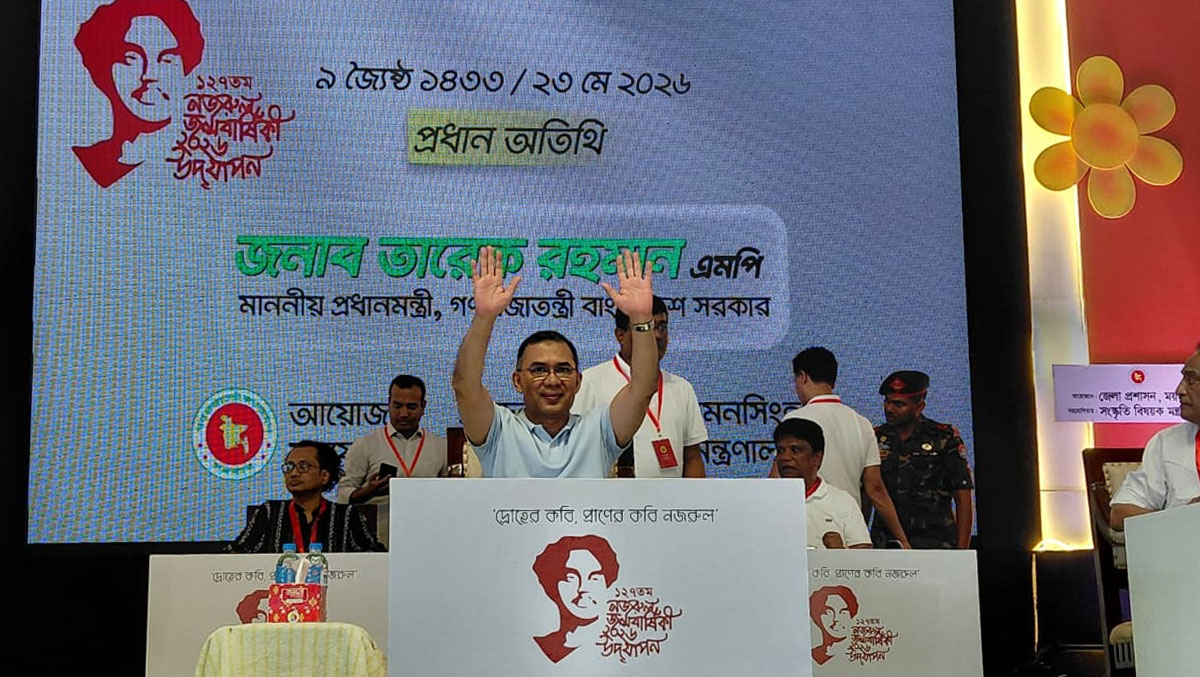
The premier made the statement while addressing a gathering of local residents after inaugurating the re-excavation work of the Dharar Khal in Trishal upazila.
He alleged that a quarter is actively trying to exploit the tragic murder of the young child to create unrest in the country, and he urged the public to remain alert against any conspiracy aimed at disrupting national development activities and the rule of law.
Confirming his government's commitment to establishing the rule of law, the Prime Minister assured that anyone found guilty would be punished strictly through due legal process.
“A few days ago, a very unjust and deeply heartbreaking incident took place in which a child was killed. You have all seen it. From the very beginning, we have said that anyone who commits a crime must face punishment under the law. We want to establish the rule of law,” he said.
He added that every activity in life follows a system and that rules must be followed in governance and justice as well, emphasizing that punishment must follow due process through established governmental rules and procedures.
However, the Prime Minister strongly condemned the violent civil reactions seen in recent days.
“But we have noticed in recent days, as you have seen in newspapers, radio and television, that some people are trying to create unrest by blocking roads, stopping vehicles, setting fire and creating tension in different places,” he said, asserting that such unruly activities are actively obstructing the rule of law.
“Are they allowing the law to function properly as it should? No, they are not.”
Drawing comparisons to the country's recent political timeline, Tarique Rahman pointed out that several untoward incidents took place when the interim government was in power.
“When those incidents occurred, I personally spoke with the mothers of those children. Our party’s lawyers and doctors provided medical treatment and legal assistance at that time,” he said.
He noted a stark contrast with current demonstrators, saying those who are now speaking loudly, staging blockades, and making big statements were not seen in the field or taking part in protests at that time.
“So, should we assume that since the people of Bangladesh voted for BNP in the 12th election and gave them the mandate to form the government, some are now frustrated, and this frustration is the reason behind the current situation?” the Prime Minister questioned.
He further claimed that there are direct connections between those currently trying to create anarchy and the evil forces ousted by the people through the mass uprising in 2024.
“We must remain alert. Read newspapers, check social media and look into who is behind these activities. Those who are now trying to create unrest have again quietly built ties with the people who were driven out on August 5. Just as they did in 1996 and in 1986, some new followers have also emerged alongside them,” Tarique Rahman stated.
Warning that instability would ultimately harm farmers, workers, students, and ordinary citizens, the Prime Minister alleged that the agitators are not genuinely concerned about the welfare of the public.
“They do not talk about canal excavation for farmers, farmers’ cards, or how poor village children walk barefoot to school. They do not talk about providing new clothes for those children,” he said.
He warned that continued unrest would halt critical welfare and development programmes across the country.
“If unrest is created, canal excavation work across Bangladesh will stop. Farmers will suffer. Distribution programmes will stop. Honorary allowances for imams, muezzins, khatibs and religious leaders of other faiths will also be affected,” he noted, adding that initiatives to provide school uniforms and bags for village children would also be severely disrupted by ongoing road blockades.
Reflecting on the political transition, the premier reminded the audience of the collective struggle against the previous regime.
“We removed authoritarian rule from this country through united movements. The people and students of Bangladesh stood together on the streets and removed a regime that had taken away people’s voting rights, freedom of speech and halted development for ordinary rural people,” he said.
He emphasized that the citizens of Bangladesh now want to focus strictly on nation-building and improving their livelihoods.
To bring real change, the Prime Minister stated that the strength and labor of the country's population must be fully mobilized. “If we want to change people’s fate, we must put the 40 crore hands of our 20 crore people to work. We must build roads, bridges, schools, colleges and hospitals through collective effort,” he said, reaffirming that BNP’s plans remain focused entirely on the country and its people despite the conspiracies of obstructing groups.
He concluded his address with a powerful call for public vigilance and self-reliance in protecting the state.
“We must remember that the people are the owners of this country. A small group cannot be allowed to create confusion and play with the future of the people,” he said, adding that “those who stand beside the people and work for them will ultimately be protected by the people of Bangladesh against any conspiracy.”
He asserted that the country's independence, sovereignty, and national interests must be fiercely protected by its own citizens, declaring, “Our country is our responsibility. We will protect our independence, sovereignty and people’s interests, and resist any conspiracy.”
The event was chaired by Mymensingh-7 lawmaker Mahbubur Rahman Liton, and also featured speeches from Disaster Management Minister Asadul Habib Dulu and various local leaders.
Prior to his speech, the Prime Minister officially unveiled a project plaque at the canal site, inaugurated the re-excavation work by cutting soil with a spade, and planted a palm sapling beside the canal.




 Live TV
 RTV Plus