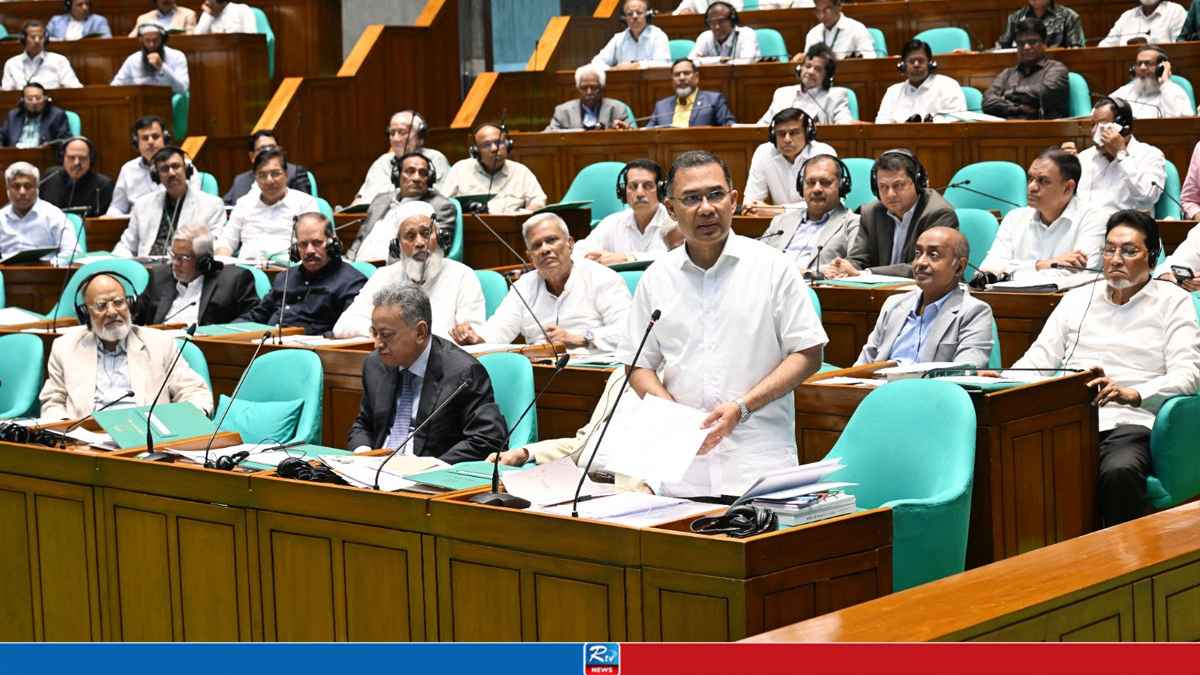
Prime Minister Tarique Rahman on Monday characterized the proposed national budget for the 2026–27 fiscal year as a "life-centric" plan, emphasizing that its primary focus is to provide "relief and comfort" to citizens from all walks of life.
Speaking during the general discussion on the budget in the National Parliament, with Speaker Hafiz Uddin Ahmad, Bir Bikram, in the chair, the Prime Minister stated, "I would like to give a name to the budget we are presenting today... I would call it a life-centric budget."
He further remarked that while the governing party has an obligation to present a "sound, balanced, and realistic budget," his administration faced a particularly difficult economic landscape.
"The reality is very challenging. Nevertheless, after considering various factors, we have used our utmost wisdom, judgment, and knowledge to prepare a budget that can provide at least some relief and comfort to people from all walks of life," he told the House.
Addressing the positive market response since the budget’s introduction, the Prime Minister noted that, contrary to historical trends where essential goods often saw "sudden and unjustified price increases" following budget announcements, this year has remained stable.
He highlighted that taxes on 61 essential items were almost entirely withdrawn to protect consumers, adding, "We believe that we have been able to fulfil at least part of our responsibility toward the people. We have been able to provide some degree of relief."
Regarding the state of the economy, the Prime Minister asserted that when his administration assumed office, they inherited a "fragile economy" devastated by "corruption, looting, mismanagement, and flawed policies."
He stated, "We have tried to revive the economy from that situation," noting that his government took office on February 18, immediately facing the challenges of maintaining affordability during Ramadan.
The Prime Minister did not shy away from the severity of the economic crisis left by the previous administration, citing stalled production, rampant inflation, and a shattered capital market where ordinary citizens lost their livelihoods.
He pointed to a 40 percent decline in the value of the taka, a significant drop in foreign exchange reserves, and the burden of "vanity projects" that were funded through excessive domestic and foreign borrowing.
"They do not generate revenue, forcing us to repay those foreign loans with resources from elsewhere. This burden may continue to weigh on the nation for a long time," he warned.
While acknowledging these stark realities, he rejected the use of such crises as an excuse for inaction.
"I do not want to deny the crisis I have briefly described. We cannot ignore it; doing so would be foolish. At the same time, we do not want to use the crisis as an excuse," he said.
Expressing agreement with the Opposition Leader, Dr. Shafiqur Rahman, the Prime Minister affirmed, "I fully agree with the opposition leader that, with the support of the people, political goodwill, and effective policies, we want to confront this crisis successfully."
During his address, which was met with repeated applause and desk-thumping from ruling party members, the Prime Minister concluded by reiterating his confidence that through collective effort, the nation can overcome its current economic hurdles.






 Live TV
 RTV Plus