Prime Minister Tarique Rahman said on Monday that Bangladesh has entered a critical phase of national restoration, aimed at reversing the fragility, systemic debt, and import dependency fostered during the last 15 years of "fascist rule."
Addressing the national conference titled ‘Navigating Five-Year Strategic Framework for Achieving SDGs: Policy, Partnership and Priority 2026’ at the Bangladesh-China Friendship Conference Centre, the Premier emphasized that the United Nations’ Sustainable Development Goals (SDGs) are fundamental to this reconstruction effort across all sectors, including health, education, and environmental protection.
The conference, organized jointly by the General Economics Division (GED) of the Planning Commission and the Governance Innovation Unit (GIU) of the Prime Minister’s Office, served as a platform for the Premier to detail his government’s five-year economic roadmap.
He asserted that his administration’s "Bangladesh for All" policy is designed to uphold the core SDG principle of "No One Left Behind," ensuring equitable benefits for citizens regardless of their social background.
Highlighting the consistency of his party’s ideology with global standards, the Prime Minister noted, “There is very little difference between the development agenda of BNP and MDGs and SDGs of the United Nations. Shaheed President Ziaur Rahman’s 19-point charter and ‘Vision 2030’ of former Prime Minister Begum Khaleda Zia perfectly enshrined the UN sponsored vision and mission.”
To formalize this trajectory, the government has adopted a "Three-R" strategy—Recovery, Rehabilitation, and Reconstruction—intended to stabilize the economy and successfully transition Bangladesh beyond its status as a Least Developed Country (LDC).
As part of this reform, the government is aggressively expanding its social safety net. Programs introduced since the administration took office include the Family Card, Farmer Card, e-Health Card, and the newly launched Sports Card.
Furthermore, the government has extended honorarium allowances to imams, muezzins, and various religious leaders.
“In one way or another, the government’s support network is expanding to reach people from every class and profession,” the Prime Minister stated, adding that a roadmap is in place to provide financial coverage to all citizens within his current tenure.
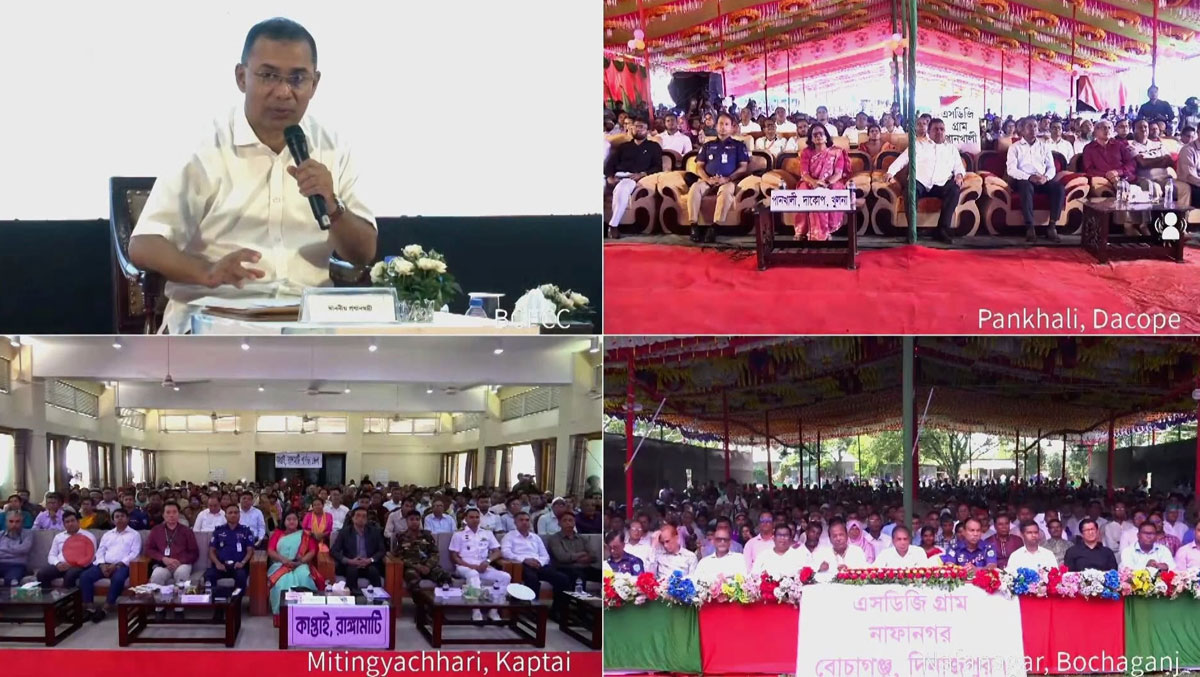
To demonstrate the efficacy of these policies, the Premier announced the launch of an "SDG Village" pilot project in three locations: Mitingachhari in Rangamati’s Kaptai upazila, Pankhali in Khulna’s Dacope upazila, and Nafanagar in Dinajpur’s Bochaganj upazila.
These villages will serve as testing grounds for an integrated development package covering SMEs, renewable energy, madrasa-based education, and local infrastructure projects like canal excavation and ecotourism.
“I hope the SDG Village initiative will emerge as an exemplary project for presenting the current government’s election pledge to the world as an internationally recognised development model,” he added.
Looking toward the nation’s future, the Prime Minister articulated a vision for a country defined by three pillars: a democratic state ensuring the rule of law and institutional accountability; a humane state guaranteeing universal rights to healthcare and education; and a welfare state promoting intergenerational equity.
He urged the private sector, development partners, civil society, and the media to collaborate with the government to meet these 2030 targets.
The event saw the attendance of high-profile government figures, including LGRD and Cooperatives Minister Mirza Fakhrul Islam Alamgir, Finance and Planning Minister Amir Khosru Mahmud Chowdhury, State Minister for Planning Zonayed Saki, Planning Division Secretary S M Shakil Akhter, and the Prime Minister’s Adviser for Finance and Planning, Dr. Rashed Al Mahmud Titumir.





 Live TV
 RTV Plus