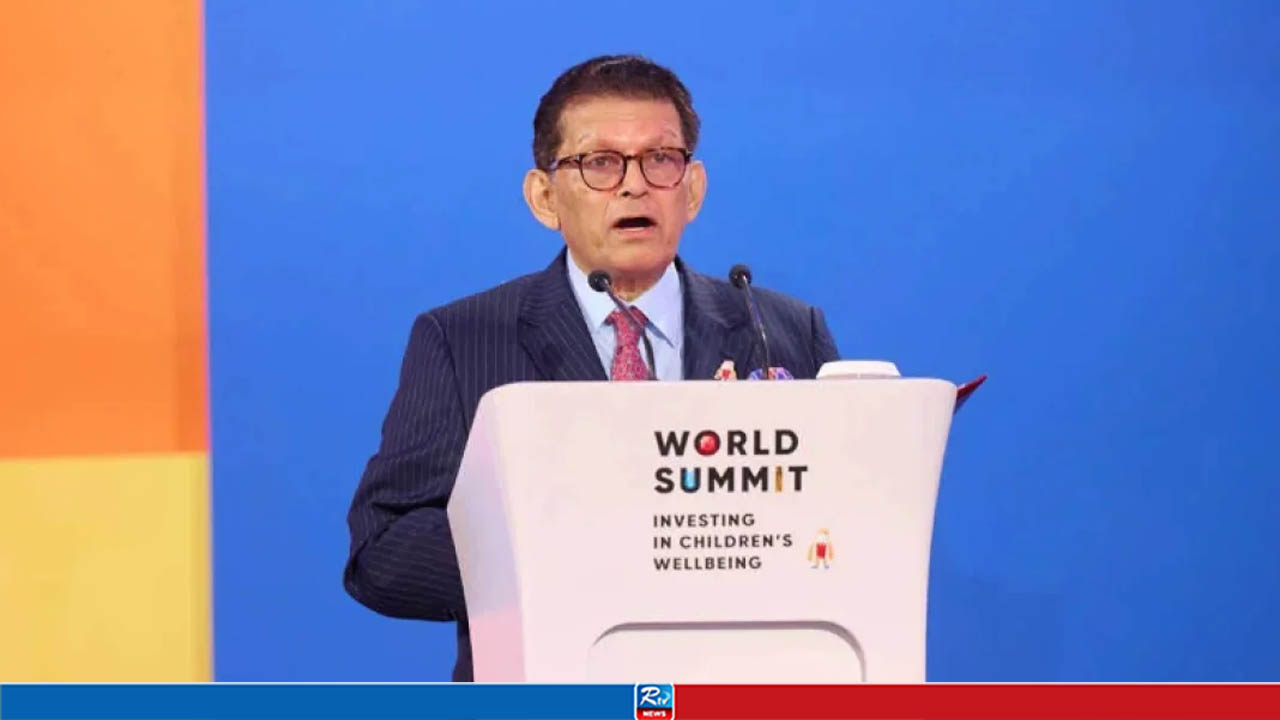
Dr. Khalilur Rahman, President of the 80th session of the United Nations General Assembly, has stated that today's transformed world cannot be governed using the current structure of the United Nations, which was built on the post-World War II realities of 1945.
He said that despite massive shifts in the global balance of power, the structure of the UN Security Council remains unchanged, making its reform urgent to align with the current world order.
He made these remarks during an appearance on TRT World's interview program One on One on the sidelines of the UN Climate Change Conference (COP31) in Antalya, Turkey.
In the interview, Dr. Khalilur Rahman addressed Security Council reform, accountability for the Rohingya genocide, international conflicts, and the effectiveness of the UN at the grassroots level.
Responding to questions from journalist Zafar Hasnain regarding the modernization of the Security Council and the unilateral authority of powerful nations, he noted that the current world differs vastly from the era when the UN was founded in 1945.
Referring to Turkish President Recep Tayyip Erdogan's remark that "the world is bigger than five," Dr. Rahman pointed out that while global power dynamics have shifted significantly since World War II, the permanent membership and structure of the Security Council have remained static.
He also mentioned that as President of the General Assembly, he has already appointed co-chairs to coordinate intergovernmental negotiations on Security Council reform.
Regarding African representation, Dr. Khalilur Rahman said Africa is one of the continents historically subjected to the greatest discrimination. Although critical decisions concerning African peace and security are made at the Security Council, the continent holds no permanent seat at the decision-making table. In his words, "Africa must be at the table; it cannot be on the menu."
He explained that altering the permanent or non-permanent membership structure of the Security Council requires amending the UN Charter, which demands the consent of all five permanent members.
Consequently, reform cannot happen overnight and must proceed step by step, though he aims to achieve visible progress in the reform discussions during his presidency.
Addressing the Security Council's failure to halt wars and violence worldwide—and how resolutions passed by an overwhelming majority in the General Assembly are blocked by vetoes in the Council—he stated that maintaining international peace and security is the Security Council's primary responsibility.
However, conflicting interests among permanent members and the use of the veto have prevented the Council from acting on major international crises, perpetuating protracted conflicts across the globe.
On the issue of taking action against member states that violate international law, he noted that while the UN Charter contains provisions for expelling a member state, its application in history is exceedingly rare.
He cited the past instance where the People's Republic of China was recognized as China's representative at the UN in place of the Republic of China (Taiwan), noting that there is no precedent for the direct expulsion of a member state.
Turning to justice for the Rohingya genocide, Dr. Khalilur Rahman highlighted the role of the International Court of Justice (ICJ). He noted that the court is scheduled to deliver a crucial ruling in The Gambia v. Myanmar case on November 19, adding that the ICJ is fulfilling its judicial mandate regarding international crimes and violations of international law.
In response to criticisms of the UN's global efficacy, Dr. Khalilur Rahman argued that the political gridlock within the Security Council should not be conflated with the UN's humanitarian and service-oriented work on the ground.
He dismissed the idea of dissolving the UN as unrealistic, saying that if the organization were abolished today, a similar body would have to be created tomorrow in the interest of global peace and cooperation.
He added that young people and ordinary citizens around the world still place their trust in the UN to tackle the climate crisis and resolve global challenges.
Illustrating the UN's field-level contributions, he drew on his past experience overseeing Rohingya refugee affairs in Bangladesh.
Despite a severe international funding crunch for the Rohingya response in Bangladesh, the UN country team sustained humanitarian operations through innovative initiatives—engaging local institutions, local personnel, and youth from the Rohingya camps.
This approach allowed services to continue amid financial shortfalls, even improving service quality in some areas.
Sharing insights from a recent visit to the Democratic Republic of the Congo in Central Africa, he said he spoke with the country's government, local UN teams, and donor representatives, all of whom affirmed that the UN country team plays an effective role in saving lives and serving ordinary people there.
On the UN's role in combating climate change, Dr. Khalilur Rahman noted that the COP31 summit in Antalya is part of the UN's multilateral process.
The UN provides a platform that brings both influential nations and climate-vulnerable countries together to curb global warming, limit temperature rise, and secure climate finance for affected nations—international consensus that would be impossible without the organization.
Regarding the appointment process for a new UN Secretary-General once the current chief's term concludes, he explained that under the UN Charter, the General Assembly appoints the Secretary-General upon the recommendation of the Security Council.
On all nine previous occasions, the General Assembly has unanimously appointed the candidate recommended by the Security Council.




 Live TV
 RTV Plus