Dhaka 07 October, 2026

World Cotton Day Observed Today

Huge Potential for Import-Dependent Bangladesh

RTV News

Publish : 07 Oct 2026, 08:48 AM
Photo: Collected

World Cotton Day is being observed today, October 7. The day is marked to highlight the contribution of cotton to agriculture, employment, international trade, and industrialization, as well as to emphasize the importance of sustainable cotton production.

This year's theme is "Cotton for Good: Building Prosperity through Trade, Transformation, and Collaboration."

According to the United Nations Food and Agriculture Organization (FAO), cotton is one of the world's most important natural fibers, with applications in apparel, household goods, and various industrial sectors.

Millions of farmers, workers, and their families are engaged in cotton cultivation, processing, and trade worldwide.

Cotton serves as a source of livelihood and income for hundreds of millions of people in about 80 countries globally, with nearly 80 percent of it used in apparel manufacturing.

The UN General Assembly officially recognized October 7 as World Cotton Day in 2021. Prior to that, the observance began in 2019 at the initiative of four cotton-producing African nations: Benin, Burkina Faso, Chad, and Mali.

The top five cotton-producing countries in the world are China, India, Brazil, the United States, and Pakistan. Approximately 24 million farmers are engaged in cotton cultivation worldwide.

From production to processing and trade, the cotton sector employs an estimated 125 million people. Globally, cotton is the most widely used fiber after polyester, accounting for roughly 20 percent of total fiber demand.

However, the market share of cotton has declined over the past few decades due to the increasing use of synthetic fibers.

Additionally, climate change, supply chain disruptions, competition from synthetics, shifting policies, and changing consumer preferences have become major challenges for the cotton sector.

To address these challenges, increasing emphasis is being placed on science, research, new technologies, sound management, and enhanced investment.

For Bangladesh, the importance of cotton is even greater. Cotton is one of the primary raw materials for the country's readymade garment (RMG) industry, which is its largest export sector.

Field-grown cotton is processed into yarn, fabric, and ultimately readymade garments, which are then exported to consumers around the world.

Despite having massive garment production and export capacity, Bangladesh lags far behind in cotton production.

The country's annual demand for cotton is about 8.5 million bales, whereas domestic production in fiscal year 2024 was only around 205,000 bales. This means a very small fraction of total demand is met through local production.

According to FAO data, while nearly 24 million farmers are involved in cotton cultivation globally, Bangladesh's domestic production is minimal, requiring almost the entire demand to be met through imports.

Consequently, any volatility in international cotton prices, freight charges, foreign exchange shortages, or supply chain instability directly impacts the country's yarn, textile, and RMG sectors.

In recent times, Brazil has emerged as one of the primary cotton suppliers to Bangladesh, alongside imports from India, the United States, African nations, and Australia.

While there are opportunities to increase domestic cotton production, limited arable land makes it difficult to boost output merely by expanding acreage.

Therefore, emphasis needs to be placed on increasing yields per acre through high-yielding seed varieties, modern farming techniques, irrigation, mechanization, pest control, and farmer training.

Ensuring guaranteed markets and fair prices is also vital to encourage farmers to cultivate cotton. Forward-purchase contracts between industrial enterprises and farmers can help mitigate market risks.

Furthermore, there is a need to develop modern ginning, quality testing, grading, and storage facilities in cotton-producing regions.

According to experts, alongside boosting local production, maximizing value addition from imported cotton within the country is equally important.

Through coordinated efforts among agriculture, trade, and textile sector stakeholders, research organizations, farmers, spinners, textile mills, and garment exporters, this sector can be further strengthened.

Thus, World Cotton Day is not just a day to highlight the importance of cotton cultivation, but also an opportunity to rethink cotton's connection to farmer livelihoods, industrial raw materials, employment, international trade, and sustainable economies.

For an apparel-dependent country like Bangladesh, increasing domestic cotton production, reducing import dependency, and creating pathways for higher value addition from cotton present a major growth opportunity.

Follow google news channel to get RTV news Google News
MP Gazi Nazrul, His First Wife Taken into Police Custody
Satkhira-4 lawmaker Gazi Mohammad Nazrul Islam and his first wife have been taken into police custody for questioning following the recovery of the hanging body of his second wife.
MP Gazi Nazrul, His First Wife Taken into Police Custody
4.7 Million Liters of Diesel Arrive from India via Pipeline
According to reports, approximately 4,000 metric tons or 4.7 million liters of diesel from India have reached the depot at the Parbatipur receiving center in Dinajpur through the India-Bangladesh Friendship Pipeline.
4.7 Million Liters of Diesel Arrive from India via Pipeline
Prime Minister Tarique Rahman’s 19th Prison Release Day Today
Today, September 3, marks the 19th liberation day from prison of Prime Minister Tarique Rahman. Leaders and activists of the BNP and its affiliated organizations observe the day as Tarique Rahman's Prison Release Day.
Prime Minister Tarique Rahman’s 19th Prison Release Day Today
One Year Since Milestone Tragedy: Trauma Lingers, Many Families Left Destitute
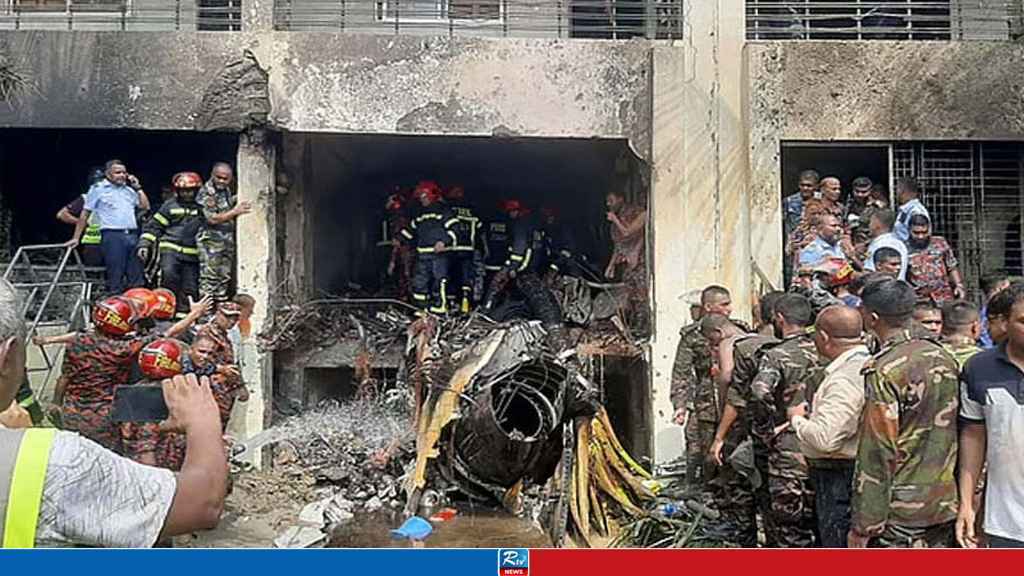
Tuesday, July 21, marks one year since the tragic fighter jet crash at the Milestone School and College campus in Diabari, Uttara, which claimed 36 lives. The horrifying memories of that fateful day continue to haunt the surviving students and their families, who still shudder at the sound of aircraft in the sky or the sight of fire. What Happened That DayThe incident occurred on Monday, July 21, 2025. At around 1:15 PM, a Bangladesh Air Force F-7BGI fighter jet crashed into the institution’s Haider Ali Building, instantly transforming the scene into a heart-wrenching catastrophe. The raging inferno severely burned the tender bodies of young children. The disaster left at least 36 people dead—including students, teachers, and guardians—and injured over a hundred others, the vast majority being children. The pilot, Flight Lieutenant Tauqir Islam, also lost his life in the crash. Grief Unabated, Parents OutragedFamilies who lost their children in the Milestone tragedy have failed to overcome their grief even after a full year. Alongside their sorrow runs deep anger, with parents expressing profound frustration that the official investigation report into the crash has still not seen the light of day. Rubel Mia, father of Tanvir Ahmed, a student killed in the crash, said, "In the morning, I dropped my child off at school with my own hands, and by afternoon, I received him back as a corpse." "I have two sons. Previously, I used to bring both of them to school every morning. Now I only bring the younger one. When I come to school, I search for my Tanvir among hundreds of students, but I find him nowhere. Only his smiling face and memories from his last day strike my heart. A year has passed today, and my elder son’s smile still floats before my eyes," he added. Minhaj Rahman, father of Mahtab Rahman, a seventh-grade student killed in the accident, shared, "My boy’s study table has remained untouched in the exact same way for a year. The books haven’t moved, the notebooks haven’t moved. Every day his mother wipes the books and organizes them. None of us are doing well without Mahtab. Our home used to be lively and cheerful. Now this house feels like a graveyard." Ayesha Akter, mother of deceased student Tasnim Afroz Aiman, said, "The government wanted to offer 20 lakh taka in compensation. We didn't touch a single penny. What would I do with money? Would Aiman come back even if the whole world was given to me? I said instead that I would pay money, just let me hold Aiman to my chest for one second." "I have no other demands left for the government, just one—let this school be relocated from here. Planes still fly right over the school. The runway was there first, the school came later. This is still dangerous. My Aiman is gone, but hundreds of other Aimans like her are still studying at that school. I do not want any other mother's heart to be emptied like this," she added. Flights Not Suspended, Panic Mounts When Jets Take to the SkyMeanwhile, parents and relatives harbor deep resentment over the continued operation of flights over the hazardous residential area. They complain that despite such a massive disaster, flight operations in the area have not been halted. According to Tanvir’s father, Rubel Mia, "Training aircraft are still conducting training according to their schedule. Now, flight drills are happening even more frequently than before. We live in constant panic and fear, worrying that another incident might happen again." College authorities, however, state that campus security has been reinforced following the accident. Repair work on the vulnerable sections of the building and necessary safety measures are progressing. Additionally, regular drills are planned to keep students and teachers prepared for any future emergency situations. To mark the one-year anniversary of the tragedy, college authorities have announced a two-day program. Events include commemorative gatherings, doa mahfils, recitation of the Holy Quran, and special munajats seeking eternal peace for the departed souls. College Principal Jahangir Alam Khan stated that as part of the program, the crash site will be open to everyone on Tuesday. He noted that scout and rover members will present a guard of honor at the site. Floral tributes will be paid to the victims, a one-minute silence will be observed, and a special prayer session will follow. Furthermore, remembrance events will be held alongside an exhibition featuring photographs of the deceased, memoirs written by friends, and various messages. Guardians are also expected to attend the program.
One Year Since Milestone Tragedy: Trauma Lingers, Many Families Left Destitute
Scholarly Journalist, Teacher Shahed Kamal Passes Away
Veteran journalist, former news editor of national news agency BSS and adjunct faculty of mass communication and journalism department of Dhaka University Shahed Kamal died of old-age complications at a private hospital here yesterday.  He was 86. Kamal, son of renowned poet Sufia Kamal, breathed his last at around 7:30pm at Sikder Medical College Hospital while undergoing treatment at the intensive care unit (ICU) of the facility, family sources said. He was admitted to the ICU on Saturday morning with pneumonia and diarrhea, just 20 days ahead of his 86th birthday on July 24. According to family members, Shahed Kamal's body will be kept tonight at "Sanjher Maya" residence in Dhanmondi to allow relatives, friends and well-wishers to have a last glimpse of him and pay their tributes. Her sister rights activist Sultana Kamal, currently staying abroad, said his namaz-e-janaza would be held after Zohr prayers tomorrow at Taqwa Mosque in Dhanmondi. Admirers, colleagues, relatives and well-wishers will be able to pay their last respects to Shahed Kamal from 9:00am to 10:45am on tomorrow at "Sanjher Maya", his Dhanmondi residence. The first namaz-e-janaza will be held at 11:00am at Taqwa Mosque in Dhanmondi. The body will then be taken to Dhaka University’s Mass Communication and Journalism department premises at 12:00 noon, where teachers, students, alumni and admirers will have an opportunity to pay their tributes.  A second namaz-e-janaza will be held at the university's Central Mosque after Zohr prayers. Later, the body will be taken to the National Press Club at 2:30pm to allow journalists and well-wishers to pay their final respects before he is laid to rest at Azimpur Graveyard at 4:00pm beside the grave of his mother, renowned poet Sufia Kamal.  Shahed Kamal made his debut in journalism career in 1957 and served in the then Associated Press of Pakistan (APP) and continued his job as it was renamed and restructured as Bangladesh Sangbad Sangstha (BSS) as the country’s national news agency. After the independence, he simultaneously joined as an adjunct teacher of the journalism department of the premier Dhaka University, from where he had secured his masters degree in journalism as well. Ahead of obtaining his master’s degree he received his bachelor’s degree from the university after his studies in Notre Dame College. A confirmed bachelor, Kamal, was active in Bangladesh’s scouting movement and known for his acumen in classical music, fine arts, literature and political and social history. During his decades’ long career both as a journalist and journalism teacher he taught a number of journalists who subsequently earned prominence in the profession.   His death has cast a pall of gloom over the country's journalism and academic communities, with colleagues, former students and admirers remembering him for his professionalism, integrity and lifelong dedication to journalism and education. Kamal was the eldest among his currently surviving two sisters and a brother. Sultana Kamal said they were six brothers and three sisters while the others passed away at different times. 
Scholarly Journalist, Teacher Shahed Kamal Passes Away
Read More
Affordable Housing Vital for Inclusive Development: President
'Super Intelligence': Is Trump Right to Rename AI?
PM Conveys Message of Bangladesh's Democratic Progress at the UN: Mahdi Amin
PMO to Hold Press Conference This Afternoon on New York Visit