UN Trade and Development (UNCTAD) has called for a fair, transparent and sustainable approach to the extraction and trade of critical minerals needed for the global energy transition, warning that the shift to clean energy should not reproduce the inequalities and environmental damage associated with the traditional extractive economy.
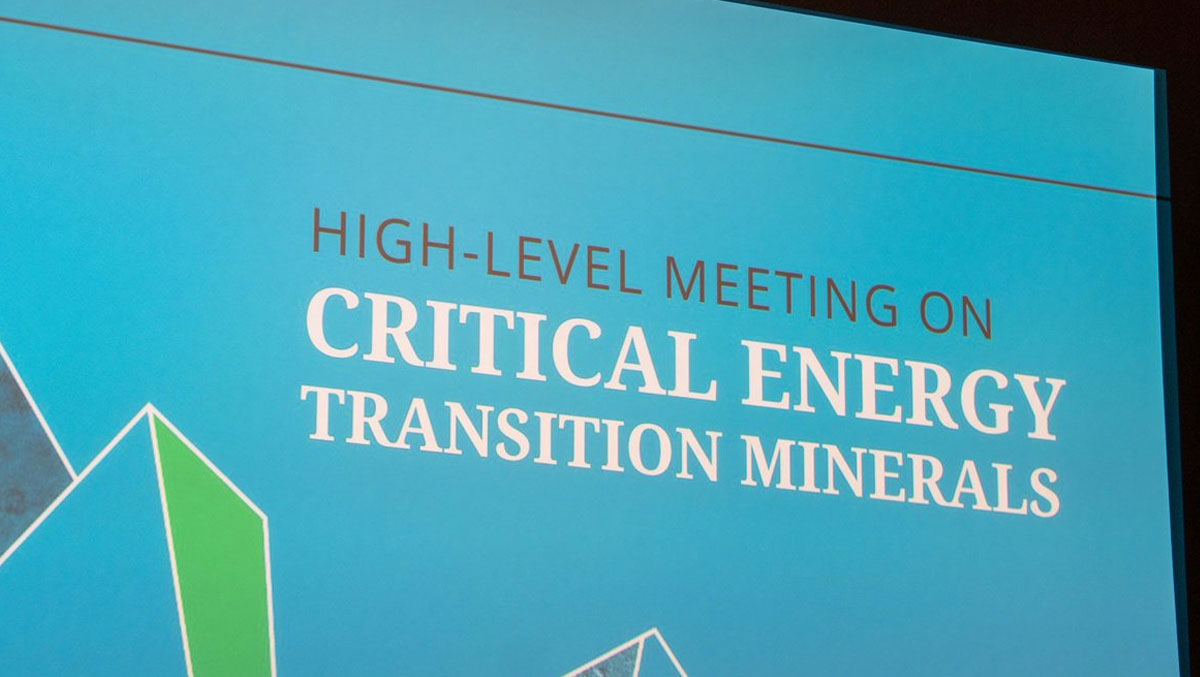
Speaking at the UN High-Level Meeting on Critical Energy Transition Minerals in New York on Tuesday (July 14), Pedro Manuel Moreno, Deputy Secretary-General and Acting Secretary-General of UNCTAD, said the growing demand for minerals such as copper, lithium, cobalt, nickel, graphite and rare earths would have major consequences for the communities, ecosystems and countries where those resources are found.
"Every wind turbine, every electric vehicle, every solar grid rests on something that was, until recently, in the ground," Pedro Manuel Moreno said.
He noted that the land from which these resources are extracted is 'held by a community', shaped by an ecosystem and governed by a country, stressing that the way those resources are managed will determine whether the energy transition establishes a new standard or simply replicates the patterns of the old extractive economy.
Pedro Moreno spoke on behalf of the co-chairs of the UN task force on Critical Energy Transition Minerals and outlined the seven principles established by the UN Secretary-General’s Panel to guide the task force’s work.
The principles include respect for human rights; environmental stewardship; justice and equity for communities and Indigenous Peoples; development through benefit sharing, value addition and diversification; responsible investment, finance and trade; transparency and accountability; and multilateral and international cooperation.
According to Moreno, the task force is working to turn these principles into practical policies and country-level action by bringing together existing UN capabilities around a common objective.
He said that the aim is to ensure that the energy transition strengthens the countries, communities and ecosystems that provide the necessary resources instead of depleting them.
Moreno also said the urgency of the task has increased as the world experiences one of the largest surges in energy investment in modern history. He attributed the investment boom both to the global energy transition and to the rapid expansion of artificial intelligence.
However, he warned that such a large increase in demand, combined with a highly concentrated mineral supply base, could generate significant volatility.
According to Pedro Manuel Moreno, the resulting pressures include fluctuating prices, the withdrawal of financing and the rapid development of rules that affected countries may struggle to understand and influence.
He said these pressures are ultimately felt at the local level, particularly by communities that bear the costs of extraction, ecosystems facing increasing strain and countries still dealing with unresolved legacies of commodity dependence.
Moreno added that the task force brings together economic, environmental, human and institutional considerations within a single multilateral agenda.
He said the work already being undertaken by the task force reflects the scale of its ambition, with five technical clusters currently operating.
The clusters are focused on value addition and diversification; traceability, transparency and accountability; mining legacies; artisanal and small-scale mining; and circularity and material efficiency.
Together, the five clusters have brought together nearly 350 experts from more than 25 countries to contribute to the work.
Pedro Manuel Moreno said two major knowledge products are scheduled to be released between now and the end of 2026.
One will provide a global assessment of trade policies affecting critical mineral value chains, while the other will examine approaches to circularity within critical mineral value chains.
At the same time, the Country Support Mechanism is moving from its design phase toward implementation with its first cohort of countries. The mechanism is intended to bring the critical minerals agenda directly to ministries, communities and companies on the ground.
Pedro Moreno said the high-level meeting provides an opportunity for governments, industry, civil society and Indigenous Peoples to work together and advance the agenda.
He said the discussions and outcomes of the meeting would feed back into the work of the task force and help shape its priorities for the year ahead.
"A transition should be to a better state, a better place," Moreno said.
He added that the success of the energy transition should ultimately be judged by the condition of ecosystems, the strength of institutions and the dignity, standing and prosperity of the communities whose land and resources make the transition possible.
"Our task is to make that a reality," he further added.






 Live TV
 RTV Plus