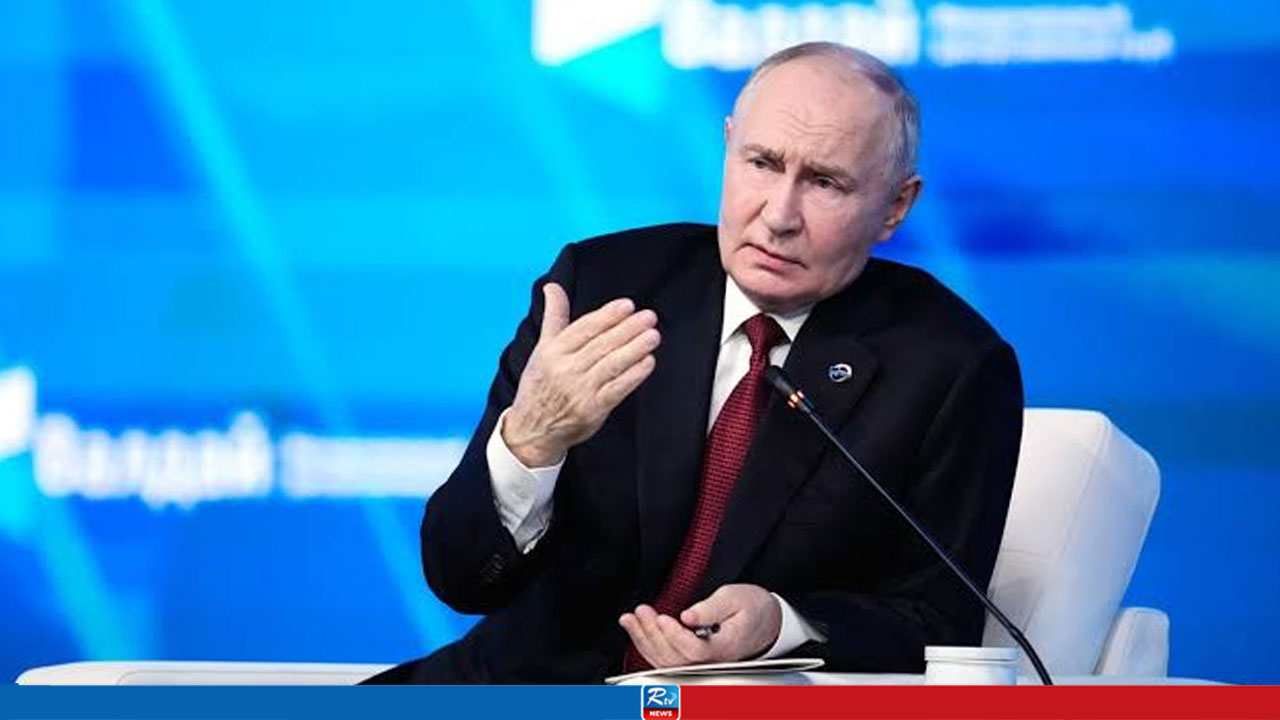
Russian President Vladimir Putin on Thursday reiterated that Moscow harbors no plans to attack European nations, while warning that Russia would respond to any external aggression utilizing "all weapons" at its disposal.
Addressing the Valdai Club foreign policy forum, Putin accused Western and European governments of escalating regional friction by debating preparations for a potential conflict with Russia in the coming years, conducting naval exercises across the Baltic Sea, and seizing Russian-flagged vessels.
His remarks followed explicit warnings issued by Moscow to NATO, stating that Russia would not rule out employing nuclear weapons to defend Kaliningrad should members of the Western military alliance attempt to sever the Russian exclave from the mainland.
Earlier in the week, multiple Russian embassies across Europe released statements asserting that Moscow possessed intelligence indicating NATO was preparing an “air and naval blockade” of Kaliningrad and its surrounding territory.
The diplomatic missions accused European leaders of “playing a dangerous game” by alleging that Russia might launch an invasion against another country or escalate destabilizing hybrid operations involving sabotage and drones—claims Moscow has dismissed as absurd.
“There should be no mistake — Russia would be ready to use all its arsenal, including nuclear weapons, to defend its territory if NATO countries try to isolate Kaliningrad region from the rest of the country,” the Russian Embassy in Ireland declared on Tuesday.
When asked at the forum whether Russia and NATO were edging toward direct military confrontation or merely engaged in mutual intimidation, Putin clarified that Moscow's posturing was a direct reaction to Western aggression.
“It’s not intimidation, it’s a response to an attempt to intimidate us,” he stated, confirming that the earlier warning communicated to NATO was entirely accurate.
“If it comes to a direct attack on the Russian Federation — in this case we mean Kaliningrad, or maybe some other territories — of course, inevitably and immediately the question of Russian Federation using all weapons at the disposal of our country will appear on the agenda,” he said.
While Putin refrained from explicitly specifying nuclear weapon deployment, he highlighted that Moscow retains advanced armaments that “no one else has” and would determine appropriate options if Russian territory comes under attack.
In response, NATO spokesperson Allison Hart confirmed Wednesday that Russia had delivered a written communication to the US-led alliance.
“We strongly denounce the threat of force, including any irresponsible nuclear rhetoric,” Hart stated, clarifying that NATO was not targeting Kaliningrad and emphasizing that “NATO is a defensive alliance and none of our activities or exercises pose a risk to any part of Russia.”
NATO Secretary-General Mark Rutte characterized the alliance’s response as “short and concise.” Speaking to Euronews, Rutte remarked, “Basically what we said is, ‘Hey, listen, we are defensive alliance, and stop the nuclear threat. This is absolutely not called for and not helpful.’”
NATO also urged Russia to immediately cease its “unprovoked war of aggression against Ukraine,” a conflict now in its fifth year.
Situated between NATO member states Poland and Lithuania, Kaliningrad serves as a vital Russian exclave housing Moscow’s primary Baltic naval base and significant military infrastructure, including nuclear-capable Iskander missile systems.
Western military strategists have noted that key installations in Kaliningrad would likely figure among the primary targets should Russia initiate hostilities against a NATO member.
In recent months, NATO allies have conducted multiple exercises throughout the Baltic region, with additional maneuvers slated for October.
The alliance also initiated Operation Baltic Sentry last year to protect critical undersea communications cables and energy pipelines.
On August 18, NATO executed an unannounced, large-scale exercise over northern Poland and the Baltic, featuring specialized aircraft such as the US Air Force EA-37B Compass Call—designed to disrupt enemy radar and electronic communications.
Defense analysts noted that the unannounced nature of the drill likely heightened Kremlin anxieties.
Concurrently, European leaders and intelligence services have warned that Russia could develop the capacity to strike another European nation within a few years, particularly if Moscow achieves its military objectives in Ukraine.
Rutte told Euronews that Russia’s belligerent statements are designed “to divide us and lose the focus” on aiding Kyiv.
“We will not,” Rutte asserted, maintaining that steadfast assistance to Ukraine remains the most effective countermeasure.
“That’s the message. Calm, carry on, keep the support for Ukraine going. That’s how we deal with it,” Rutte concluded.
Source: AP






 Live TV
 RTV Plus