Former United Nations human rights chief and International Court of Justice judge Navanethem 'Navi' Pillay was awarded the Nobel Peace Prize on Friday in recognition of her dedication to advancing global peace and international jurisprudence.
Announcing the distinction in Oslo, Norwegian Nobel Committee Chair Jørgen Watne Frydnes highlighted that the 85-year-old South African jurist has made pivotal contributions toward fostering international justice and peace.
Her lifelong work "is a source of hope and inspiration to all those who seek to bring about a more peaceful world," Frydnes noted, adding that the panel had not yet succeeded in reaching Pillay directly to convey news of the world's premier honor.
In an official statement, the committee emphasized that amid a surge in global conflicts and escalating political assaults on judicial bodies and international legal frameworks, upholding international law as a mechanism for peaceful dispute resolution has become paramount.
The panel stressed that a functional global legal framework—capable of holding war criminals accountable and delivering justice to victims of human rights violations—remains indispensable for securing enduring peace.
The committee evaluated 287 candidacies for this year's award, with over one-fourth originating from organizations.
According to analysts, the selection panel traditionally focuses on efforts aimed at establishing permanent peace, advancing international fraternity, and bolstering institutions dedicated to these causes.
The announcement comes a year after Venezuelan opposition leader María Corina Machado was bestowed the Nobel Peace Prize for her relentless campaign advocating a democratic transition in Venezuela, where she was commended as a figure who sustained democratic hope amid deepening authoritarianism.
Machado subsequently handed her Nobel medal over to US President Donald Trump following the removal of Venezuelan President Nicolás Maduro from power.
Nevertheless, the act remained purely symbolic, as the Nobel Committee formally affirmed that the accolade itself cannot be reassigned or transferred to another individual.
Submissions for the Nobel Peace Prize are restricted to designated nominators, including heads of state, national parliamentarians, university professors, foreign policy institute directors, previous laureates and active members of the Norwegian Nobel Committee.
The peace prize follows four earlier Nobel announcements this week.
The Physiology or Medicine prize was conferred upon three scientists whose research enabled light-based instruments to map cognitive functions.
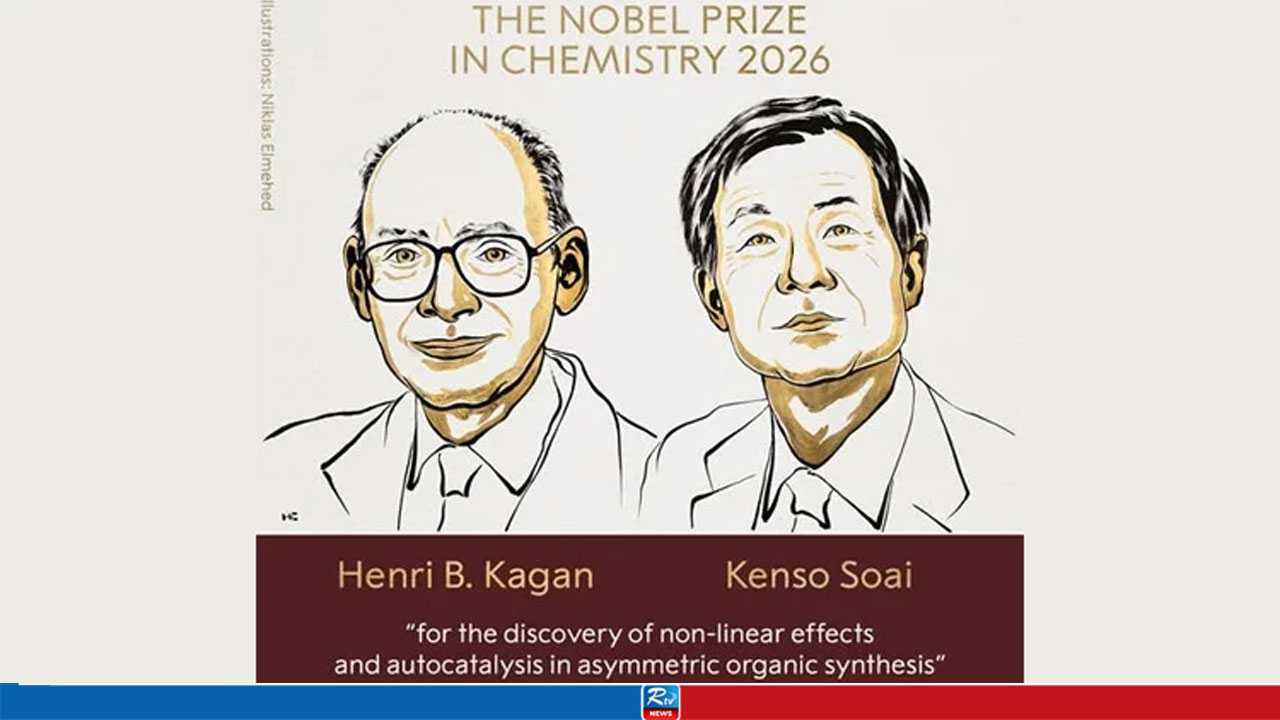
The Physics prize honored a researcher for elucidating the behavior of a rare category of neutrinos, while the Chemistry prize celebrated two scientists for discovering mechanisms governing mirror-image molecular structures, a breakthrough pivotal to modern drug development.
On Thursday, Canadian poet, essayist, and translator Anne Carson secured the Nobel Prize in Literature for works lauded as "bold and inventive" that seamlessly blend classical and contemporary forms while blurring the boundary between poetry and prose.
The Sveriges Riksbank Prize in Economic Sciences in Memory of Alfred Nobel is slated for release on Monday.
Each 2026 Nobel Prize carries a monetary reward of 12 million Swedish kronor (approximately USD 1.2 million), disbursed equally whether granted to a single recipient, shared among co-laureates, or conferred upon an organization.
This year's conferment coincides with the 125th anniversary of the Nobel Peace Prize, which was first awarded in 1901.
Over its history, the honor has been bestowed upon 112 individuals and 28 organizations, with the International Committee of the Red Cross receiving the award three times and the United Nations High Commissioner for Refugees winning it twice.
The prize was withheld during 19 instances, primarily during the two World Wars.
No award was conferred in 1948 following the assassination of Indian independence icon Mahatma Gandhi, who had been nominated 12 times throughout his life without receiving the prize.
Additionally, in 1939, a Swedish lawmaker submitted a satirical nomination for Adolf Hitler, which was subsequently rescinded after the proposer clarified it was never meant as a serious submission.



 Live TV
 RTV Plus