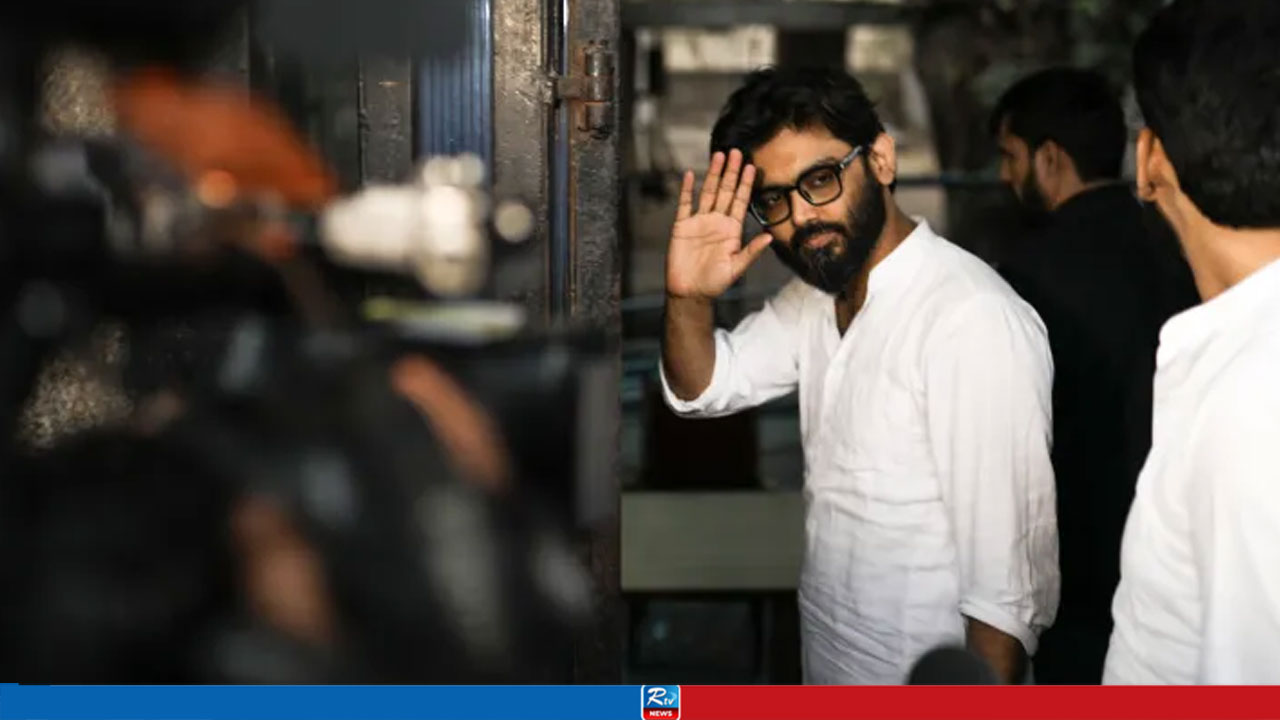
Al Jazeera published a report on Thursday (November 5) highlighting a fresh debate in India sparked by an interview with incarcerated Muslim researcher Sharjeel Imam.
In a lengthy interview given from a Delhi prison to the Indian media outlet The Quint on September 29, the 38-year-old questioned India's nationalism, secularism, and constitution.
Imam argued that despite India being home to nearly 210 million Muslims—accounting for about 14 percent of the population—their political influence and representation in the democratic system remain severely limited, with inadequate participation in state decision-making.
Imam claimed that the centralization of power in India’s constitution and the country's concept of secularism have failed to secure political rights for Muslims, asserting that decentralization and proportional representation are necessary.
Who is Sharjeel Imam?
A native of Jehanabad district in Bihar, Imam studied computer science at the Indian Institute of Technology (IIT) Bombay. After working as a software engineer, he returned to academics, pursuing research on the political history of Indian Muslims at Jawaharlal Nehru University (JNU) in New Delhi.
Following the enactment of the Citizenship Amendment Act (CAA) by the Narendra Modi government in 2019, protests erupted across the country. The long-standing sit-in protest led by Muslim women in Delhi's Shaheen Bagh became a focal point of the movement, and Imam was one of its key organizers.
He was arrested in January 2020 over speeches delivered during the protests and subsequently faced charges including incitement and conspiracy related to the Delhi communal violence, even though he was already in prison when the violence broke out. Human rights organizations have noted that he and several other Muslim student activists have been imprisoned for a prolonged period without trial.
Critique of Gandhian and Nehruvian Politics
In the interview, Imam also criticized the political philosophies of India's independence leader Mahatma Gandhi and first Prime Minister Jawaharlal Nehru. He claimed there are fundamental similarities between the secular politics of Congress and the Hindutva politics of the ruling Bharatiya Janata Party (BJP), asserting that both streams follow similar notions regarding the centralization of power and the reluctance to share political authority.
However, many analysts disagree with Imam’s views. Legal researcher Mohammad Zishan Ahmad noted that while Imam raised important historical and political questions, equating secularism with Hindutva is unreasonable. Ahmad added that internal differences within Muslim society—such as class, caste, women's rights, and ideological divergences—also warrant attention.
Meanwhile, Professor Irfan Ahmad of Ibn Haldun University in Turkey believes that the crisis of political representation among Indian Muslims is not tied to any single political party, but is instead rooted in the very concept of Indian nationalism.
Calls for Separate Political Representation
Imam advocated for the introduction of a proportional representation system in Indian elections, arguing that the current majoritarian electoral framework leaves Muslims politically sidelined over the long term. He also referenced the political thought of poet and philosopher Muhammad Iqbal.
Conversely, critics have opposed these proposals, arguing that Imam's suggestions could be contradictory to India's constitution and secular democratic framework.
The discussions have also brought renewed focus to Umar Khalid, a former student leader imprisoned in the same case. Unlike Imam, Khalid advocates for political mobilization from within the framework of the Indian Constitution and secularism. International figures and human rights organizations have repeatedly raised their voices demanding Khalid's release.
Some analysts point out that while liberals and leftists have been vocal regarding Khalid's detention, many remain silent on Imam—a stance attributed to Imam's emphasis on religious identity and the distinct political rights of Muslims.
Overall, Imam's interview has reignited intense debate surrounding the political representation, secularism, nationalism, and democratic rights of Muslims in India, once again bringing the question of minority standing to the forefront.
Source: Al Jazeera


 Live TV
 RTV Plus

