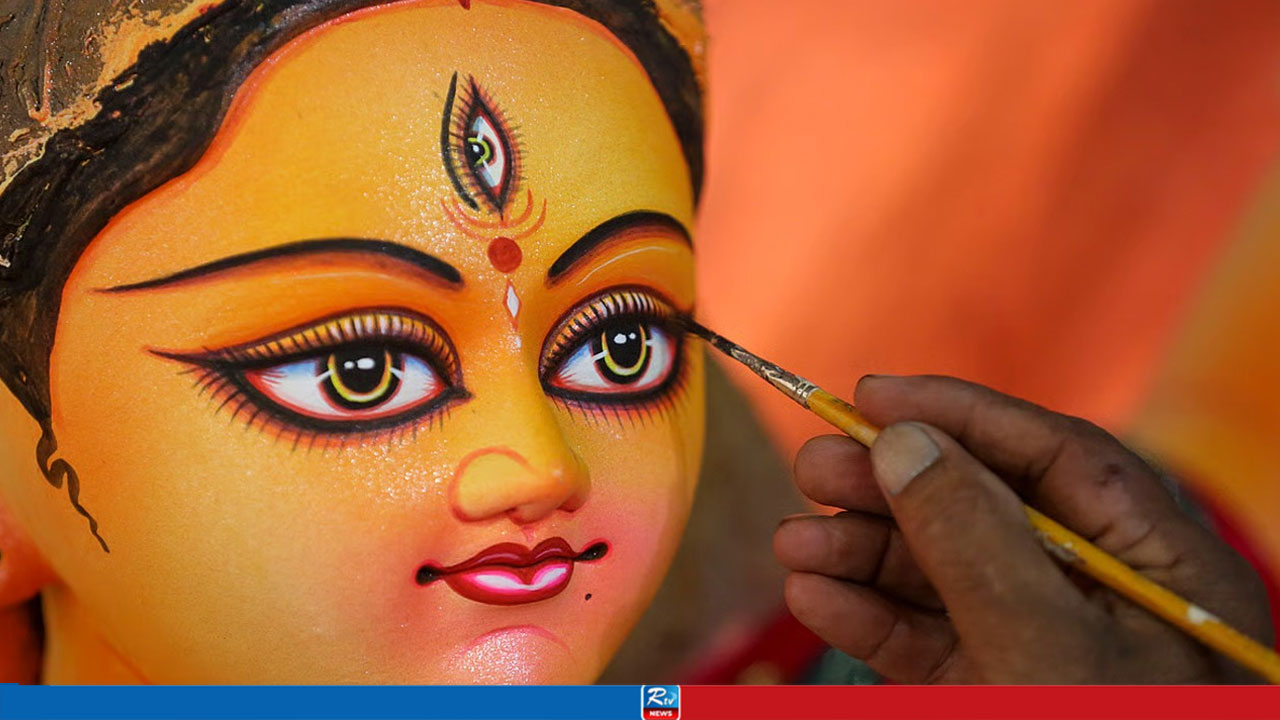
The countdown for Durga Puja, the largest religious festival of the Hindu community in Bangladesh, will officially commence on Friday with the nationwide celebration of Mahalaya.
Marking the auspicious occasion that heralds the arrival of Goddess Durga, an array of religious and cultural ceremonies has been organized across various temples, including key venues in the capital, Dhaka.
The Dhakeshwari National Temple is scheduled to host a series of dawn programs. Suvasish Kumar Biswas Sadhan, General Secretary of the Mahanagar Sarbajanin Puja Committee, noted that the Indian High Commissioner to Bangladesh is expected to attend the event.
Concurrently, Ramna Kali Mandir will host a large-scale celebration at dawn on Saturday, according to Mintu Basu, Joint Secretary of the temple management committee.
Mahalaya signifies the conclusion of Pitru Paksha—the fortnight dedicated to ancestor remembrance—and the start of Devi Paksha, the divine fortnight.
On this day, Hindu devotees pay homage to their deceased ancestors through rituals and by distributing robes to Brahmins.
The occasion also commemorates Goddess Durga beginning her journey from her celestial abode in Kailash to her paternal home on Earth.
Sadhan Chakrabarty, Chief Priest of the Dhaka University Jagannath Hall Upashanalaya, explained that Goddess Durga arrives on a horse (Ghotak) and departs on a boat (Nauka) this year.
As Bijaya Dashami falls on Wednesday, October 21, her departure by boat traditionally symbolizes a prosperous earth blessed with abundant rainfall and crops (shasyashyamala vasundhara).
Home Minister Salahuddin Ahmed announced that Durga Puja will be arranged at 33,851 puja mandaps nationwide this year, representing an increase of nearly 1,500 venues compared to last year.
Following instructions from Prime Minister Tarique Rahman, state financial assistance for the mandaps has been raised from BDT 4 crore to BDT 5 crore, he added.
In response to sustained requests from the Hindu community, the government issued an executive order extending the official Durga Puja holiday to three days.
When combined with the standard Friday-Saturday weekend, devotees will enjoy a continuous five-day holiday spanning October 20 to 24.
"It's truly a positive decision. We thank the prime minister for such decision," stated Basudeb Dhar, President of the Bangladesh Puja Udjapan Parishad, in an interview with a local media.
Echoing Dhar's sentiments, Mahanagar Sarbajanin Puja Committee General Secretary Suvasish Kumar Biswas Sadhan expressed gratitude to the government, emphasizing that the three-day holiday will enable the community to celebrate the festival with enhanced fervor.
He added that homebound travelers will experience fewer hassles due to the extended break. However, he advocated for permanently institutionalizing the three-day holiday in future years rather than relying on executive orders.
The Bangladesh Hindu Buddhist Christian Unity Council (BHBCUC) also welcomed the extended break.
"Through this, a long-standing demand of the minority communities has been fulfilled," remarked Manindra Kumar Natha, Joint Secretary General of BHBCUC.
Preparations for the grand festival are proceeding rapidly across Bangladesh and abroad, leading up to the official commencement of rituals with Maha Shashthi on October 16.
Temple committees and mandap organizers nationwide are finalizing pandal construction, illumination, idol installation, and security protocols to ensure seamless movement for visitors.
The five-day observance will progress through Maha Saptami, Maha Ashtami, and Maha Navami, culminating in Bijaya Dashami on October 21.
On the final day, devotees will bids farewell to Goddess Durga through ritual immersion (Bisarjan) of the idols in designated rivers and water bodies.
The festival carries immense spiritual and cultural importance, symbolizing the triumph of good over evil by commemorating Goddess Durga’s victory over the demon king Mahishasura.
According to Hindu mythology, when Mahishasura threatened the heavens after acquiring invulnerability against men, the gods unified their divine energy to create Goddess Durga, who vanquished the demon.
The primary rituals kick off on Maha Shashthi with Kalparambha and the ceremonial unveiling (Bodhan) of the idol.
Maha Saptami features the Nabapatrika or Kola Bou ritual, where nine symbolic plants representing divine forms are ceremonially bathed.
Maha Ashtami is marked by the crucial Sandhi Puja at the juncture of Ashtami and Navami, while Maha Navami involves concluding major worship procedures and bhog offerings.
Throughout Dhaka and other districts, mandaps are being decorated with elaborate artistic themes and vibrant illuminations.
The festival serves as a cornerstone of Bangladesh’s cultural heritage, fostering interfaith harmony and peaceful coexistence among people of all faiths.
To guarantee safety, authorities will deploy a specialized mobile application previously managed by the National Telecommunication Monitoring Center (NTMC).
The Home Minister explained that the application will enable rapid information sharing and quick responses to any untoward incidents during the festivities.
Furthermore, the Home Ministry has ordered uninterrupted power supplies at all venues, instructing organizers to keep backup generators running around the clock along with rechargeable lights as contingency measures.




 Live TV
 RTV Plus


