The United States has expressed hope that Bangladesh and India can collaborate to resolve the status of former Prime Minister Sheikh Hasina, acknowledging that the matter remains a primary point of friction in Dhaka-Delhi relations.
Addressing a query from a reporter regarding Hasina’s intention to return to Bangladesh by December and seeking the official position of Washington, a senior US Department of State official clarified to South Asian journalists during an on-background briefing in New York on Wednesday that no formal stance has been taken on the issue.
"We understand that it remains a major irritant in the India-Bangladesh relationship, and so we hope that they can work together to find a resolution," the official said.
The official further noted that Washington has not intervened specifically regarding Hasina's prospective disposition while reiterating support for improved bilateral ties between India and Bangladesh, stating, "But we have not weighed in specifically on what we think should happen with Hasina. But I will just say in general, we hope to see better – better – we encourage better relationships between both sides. And that’s what we support."
When questioned about lifting the ban on the political activities of the Awami League, the official asserted that the matter falls strictly within the domain of the local authorities, stating, "That’s for the Bangladeshi government to decide."
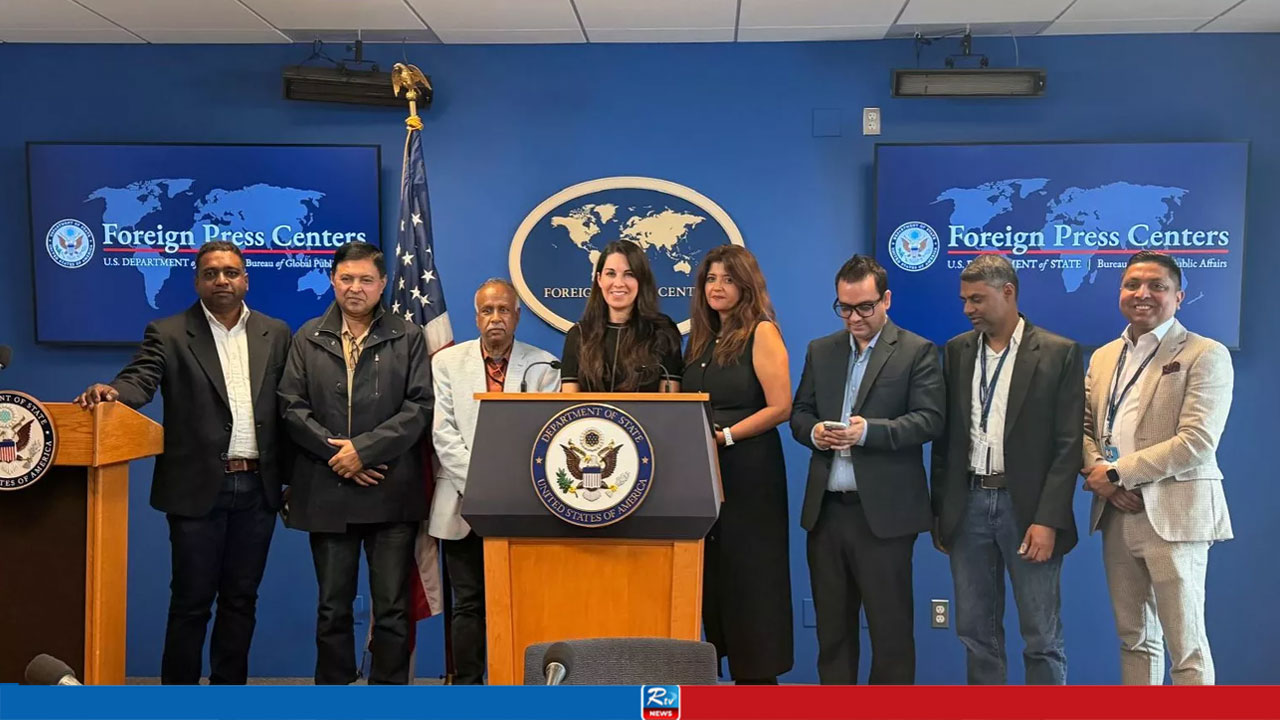
The position of the Trump administration was detailed at the New York Foreign Press Center during a session titled "US Policy in Support of a Stable, Prosperous and Sovereign South Asia," which was attended by press representatives from Bangladesh, India, Nepal, and Sri Lanka.
Describing the current state of Bangladesh-US relations as "very strong," the official emphasized that Washington remains focused on collaborating with the elected administration to advance objectives designed to make Bangladesh "stronger and more secure, and more prosperous."
Expanding on the domestic situation, the official stated, "We will not weigh in on for the domestic political ongoing discussions inside of Bangladesh, but I will say is that our relationship with Bangladesh, our relationship with the BNP, is in a very, very healthy place."
The official added, "We continue to work with the elected government, and that’s who we’re focusing on, advancing the goals that are going to make Bangladesh stronger and more secure, and more prosperous, as well as the United States. And so I think we’re not going to weigh in on political domestic ongoing discussions, but our relationship right now with the US and Bangladesh is very strong."
Regarding counterterrorism matters involving Bangladesh, the official confirmed that al-Qaida remains designated as a terrorist organization and affirmed Washington's readiness to assist any nation with security measures, though declining to comment on a recent UN Security Council sanctions monitoring report due to lack of direct review.
"I don’t know the details of that report, but I can just say in general al-Qaida is a terrorist organization, and we will work with any country to make sure we help them on counterterrorism," the official noted.
On broader strategic competition, the senior official clarified that the United States is not requesting Bangladesh to take sides among global powers but aims to offer viable alternatives, particularly regarding critical infrastructure and telecommunications.
"We’re not saying you have to pick this or that, but we want to be able to present them with alternatives that we think are safer and better for their resiliency and better for their sovereignty," the official said.
Observing that Bangladesh occupies a complex geopolitical position, the official acknowledged that nations cannot always be forced to choose between major powers.
"However, there are key areas that we do feel they need to make a choice, and those are things like critical infrastructure. These are things like telecom. These are sensitive parts of their system," the official stated, adding that Washington aims to safeguard Bangladesh's sovereignty by offering alternatives in sensitive domains.
Referring to state-backed foreign commercial enterprises, the official remarked, "That’s where we have resources, like the DFC and others, and working with our like-minded friends to make sure we can push alternatives."
Detailing expanding US-India security cooperation across the Indian Ocean, the official noted that Washington and New Delhi are pooling resources to collaborate in nations such as Sri Lanka, the Maldives, and Mauritius.
This joint framework focuses on maritime security, combating illegal fishing, human trafficking, narcotics interdiction, and developing strategic and digital infrastructure.
Pointing out that shared interests exist alongside their respective "America First" and "India first" doctrines, the official said, "We both have a strategic interest, and that’s where — and this is something the Secretary — I think you were at his press conference when we were in New Delhi. But America has an America First policy, India has an India first policy, but that doesn’t mean our interests do not align quite a lot."
The official added that both nations are also examining port infrastructure and next-generation digital standards, including 6G development.
In response to inquiries regarding potential future engagements between US President Donald Trump and Bangladesh Prime Minister Tarique Rahman, the official referred scheduling queries to the White House while highlighting prior recent contacts.
The official noted that President Trump had met briefly with Foreign Minister Rahman during the week, following an earlier meeting between US Secretary of State Marco Rubio and the foreign minister in Manila during an ASEAN-related gathering.
"Those touchpoints have been happening, and I can’t tell you what’s on the schedule coming up, but I imagine there’ll be more opportunities for them to meet," the official concluded.
With Inputs from UNB






 Live TV
 RTV Plus