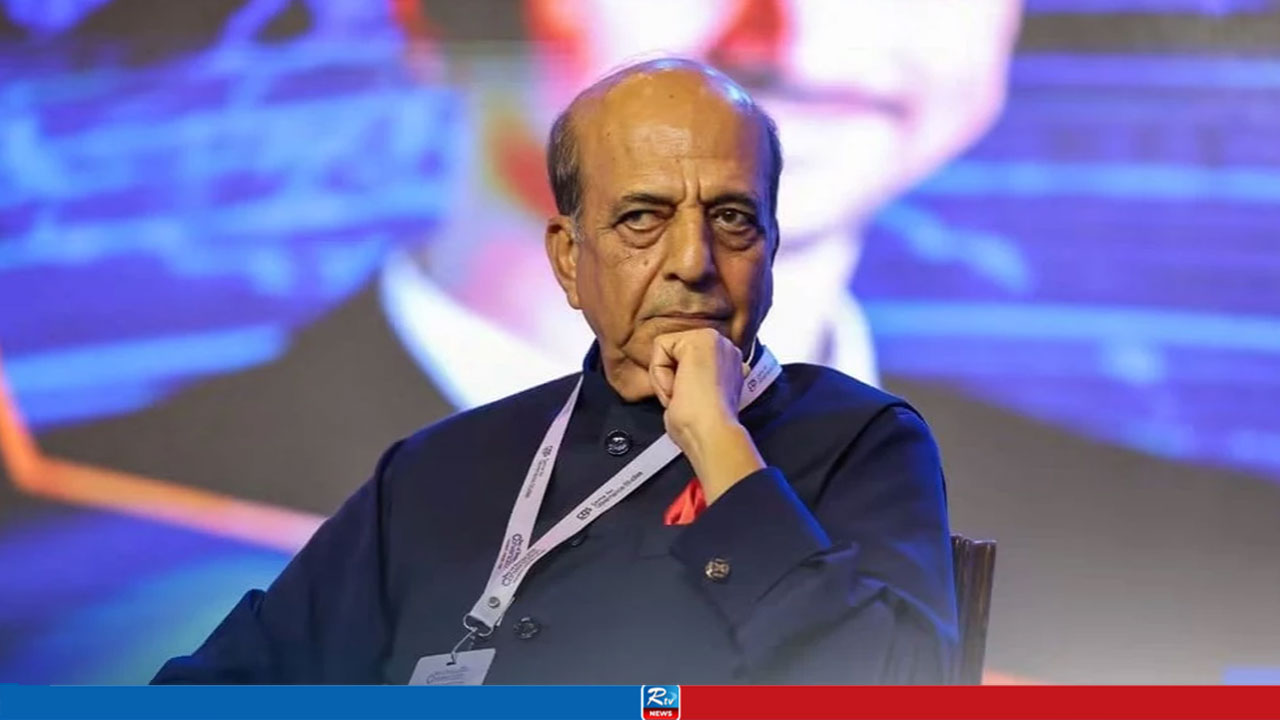
Indian High Commissioner to Bangladesh Dinesh Trivedi on Saturday stated that the legal evaluation regarding Bangladesh’s extradition request for former Prime Minister Sheikh Hasina remains active, clarifying that no specific timeline can be provided as the matter involves judicial processes.
He also emphasized that Sheikh Hasina was not transported to India by the Indian Air Force or Indian Army.
“Again and again, the government of India has replied to this that there is a process, and the process is legal, and it is well structured. So, as far as that is concerned, the process is on,” Dinesh Trivedi remarked while taking questions during a panel session entitled "Power and Prudence: Managing Great Power Competition without Conflict" at the Bay of Bengal Conversation in Dhaka.
Expanding on the legal aspects, he highlighted that because judicial bodies are involved, “nobody can give you a timeframe.”
Revisiting the events surrounding Hasina's arrival in India following her departure from Bangladesh in August 2024, Dinesh Trivedi noted that Indian authorities were caught unprepared by the sudden developments.
“Going back to history, Hasina was not brought to India by the Indian Air Force or Indian Army,” he clarified regarding her arrival.
He explained that the turn of events stemmed from “tragic circumstances” unfolding in Bangladesh at that time, stressing that such circumstances should never recur anywhere across the globe.
Dinesh Trivedi underscored that Hasina retained her position as the Prime Minister of Bangladesh upon her arrival, leaving New Delhi with no choice but to respond as a neighboring nation.
“I was watching on television, and the scroll was coming that she’s going somewhere else in some other country,” he recalled.
“At that point in time, Hasina was still the prime minister of Bangladesh. We had hardly any choice on that. It was our duty as a neighbour to accept the reality of life, because situations are such where at times you are not prepared for it,” the Indian envoy observed.
Reflecting on the critical juncture, he questioned what alternative India possessed.
“What was our choice? If you would have said that no, we are not going to accept, we don’t give landing permission. Things would have been I don’t know what,” Dinesh Trivedi stated.
Returning to current developments, he reiterated that India’s independent legal apparatus is handling the matter within established frameworks.
“The legal process is there in place, which you can be very sure,” he affirmed, remarking that India remains a “vibrant democracy”—much like Bangladesh—and that its legal institutions continue to handle the case appropriately.
Bangladesh has persistently sought the extradition of Hasina, who has remained in India since her departure in August 2024.
Prime Minister Tarique Rahman previously raised the matter directly during a meeting with Dinesh Trivedi in Dhaka in August.
In response, India’s Ministry of External Affairs confirmed that Bangladesh’s formal request was being scrutinized in accordance with prescribed legal protocols.
The panel discussion also featured contributions from President of the Bangladesh Institute of Peace and Security Studies Maj Gen (Retd) ANM Muniruzzaman, former Indian Army Commander Arun Kumar Sahni, Georgetown University Professor Carol Christine Fair, and Mustafa Osman Turan, foreign relations adviser to the mayor of Istanbul Metropolitan Municipality.
The session was moderated by Faris Hadrovic, Managing Director of Cnsltng-Bsnss-Dvlpmnt, Bosnia and Herzegovina.
With Inputs from UNB






 Live TV
 RTV Plus