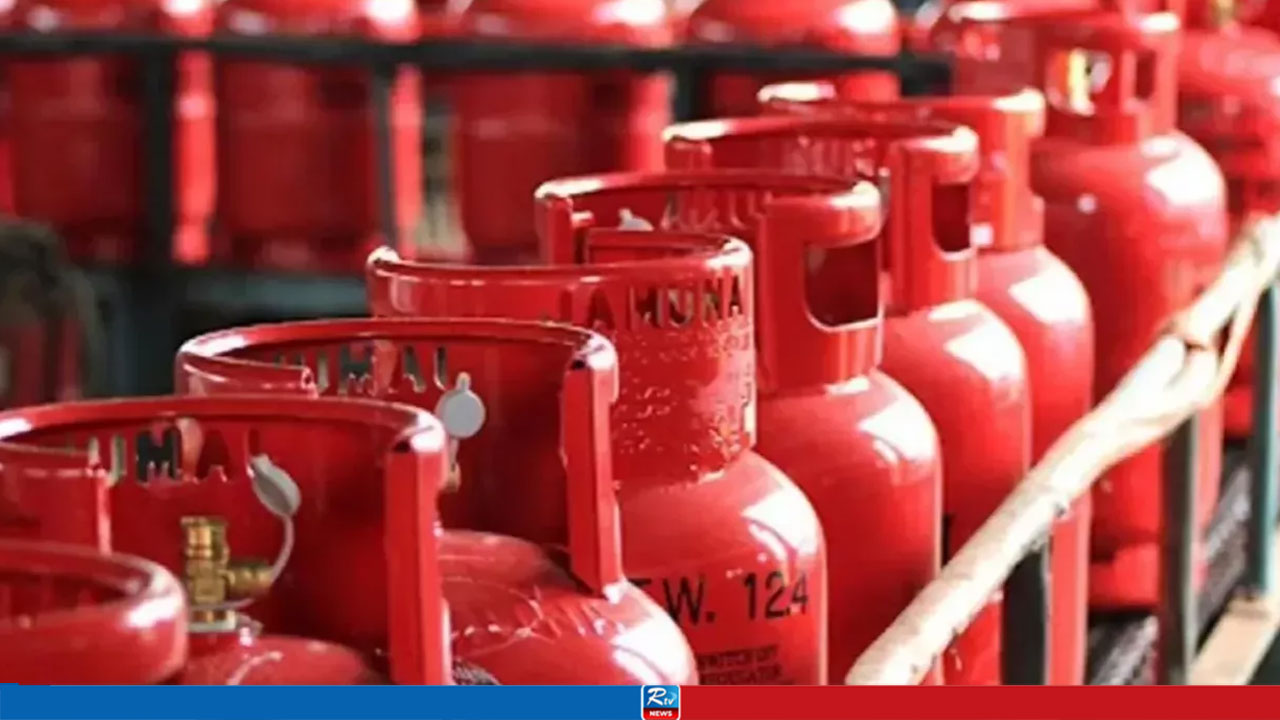
Consumers across the country are facing growing anxiety following the latest Liquefied Petroleum Gas (LPG) price hike, as severe supply shortages persist nationwide and 12-kg cylinders are being sold for BDT 2,200 to BDT 2,500 in areas where gas remains available—substantially exceeding the newly adjusted official rate of BDT 1,837.
The Bangladesh Energy Regulatory Commission (BERC) announced a fresh upward adjustment in LPG prices at the consumer level on Sunday, raising the price of a 12-kilogram cylinder by BDT 252 to BDT 1,837.
However, field reports reveal that consumers nationwide are trapped in an erratic retail market where 12-kg cylinders are fetching between BDT 2,200 and BDT 2,600—up to BDT 1,000 above government-mandated ceilings—while numerous retail points have exhausted their inventory entirely.
Although state-owned LP Gas Limited (LPGL) maintains a price of BDT 777 for its 12.5-kg cylinder, its negligible market share leaves over 98 percent of the country's bottled gas consumers wholly reliant on private distributors.
This latest price hike follows a high-level intervention held just a day prior, when Power, Energy and Mineral Resources Minister Iqbal Hassan Mahmood Tuku and Commerce Minister Khandaker Abdul Muktadir convened an urgent meeting with LPG importers at the Secretariat on Saturday to tackle the worsening market scenario.
The emergency meeting came in the wake of the Energy Minister's September 30 directive instructing Deputy Commissioners (DCs) to investigate whether market syndicates are manufacturing an artificial crisis and to execute strict legal measures against price gougers.
Industry analysts and energy specialists point to a severe deficit in national pipeline natural gas as the primary driver behind this unprecedented supply strain.
According to Petrobangla, against a nationwide demand approaching 4,000 million cubic feet per day (MMCFD), current domestic extraction alongside LNG regasification yields only around 2,600 MMCFD.
The resulting power disruptions and pipeline gas deficits have compelled thousands of households, commercial eateries, and light industries to transition to bottled LPG, generating a massive surge in demand that private distribution networks are ill-equipped to handle.
Compounding these domestic hurdles, private importers point to mounting international obstacles.
For September, Saudi Aramco raised its Contract Price (Saudi CP) to USD 625 per tonne for propane and USD 660 per tonne for butane.
More critically, global LPG availability has constrained as a result of Middle East geopolitical conflicts, pushing ocean freight rates to record highs.
Importers noted that while BERC calculated retail prices using a freight benchmark of USD 160 per tonne, actual international shipping costs have escalated to USD 400 per tonne, compelling several private operators to scale back import volumes to avert crippling financial losses.
The ongoing market crunch has simultaneously ignited internal friction within the LPG sector.
Official figures indicate that LPG imports fell from nearly 160,000 tonnes in August to approximately 120,000 tonnes in September.
However, a group of LPG operators submitted a formal letter to the Energy Division on October 1 asserting that import volumes remained consistent.
They alleged that certain major importers intentionally stalled the offloading and discharge of imported LPG shipments to engineer artificial market pressure and drive up retail rates, calling for an independent probe into the operational bottleneck.
With winter approaching—a period that routinely sees a seasonal rise in global heating fuel demand—consumers and industry actors warn that without stringent market enforcement and targeted import support, Bangladesh's LPG market risks sliding into even deeper instability in the months ahead.
Denouncing the price hike, Consumers Association of Bangladesh (CAB) Energy Adviser Prof. M. Shamsul Alam characterized BERC's decision as a "validation of illegal market manipulation."
He stated that raising official prices while failing to enforce retail compliance merely shields dishonest syndicates without ensuring gas access for ordinary citizens.
Energy expert and former BUET professor Dr. Ijaz Hossain underscored the policy oversight driving the crisis, emphasizing that shifting the nation's energy dependency from depleted domestic pipeline gas to imported LPG without expanding state buffer stocks or establishing a price stabilization fund leaves consumers vulnerable to private cartels and volatile global freight markets.
With Inputs from UNB



 Live TV
 RTV Plus