Dhaka 26 September, 2026

India’s Illegal Expulsions to Bangladesh Target Muslims: HRW

Mahima Kapoor, Deutsche Welle

Publish : 24 Jul 2025, 11:22 AM
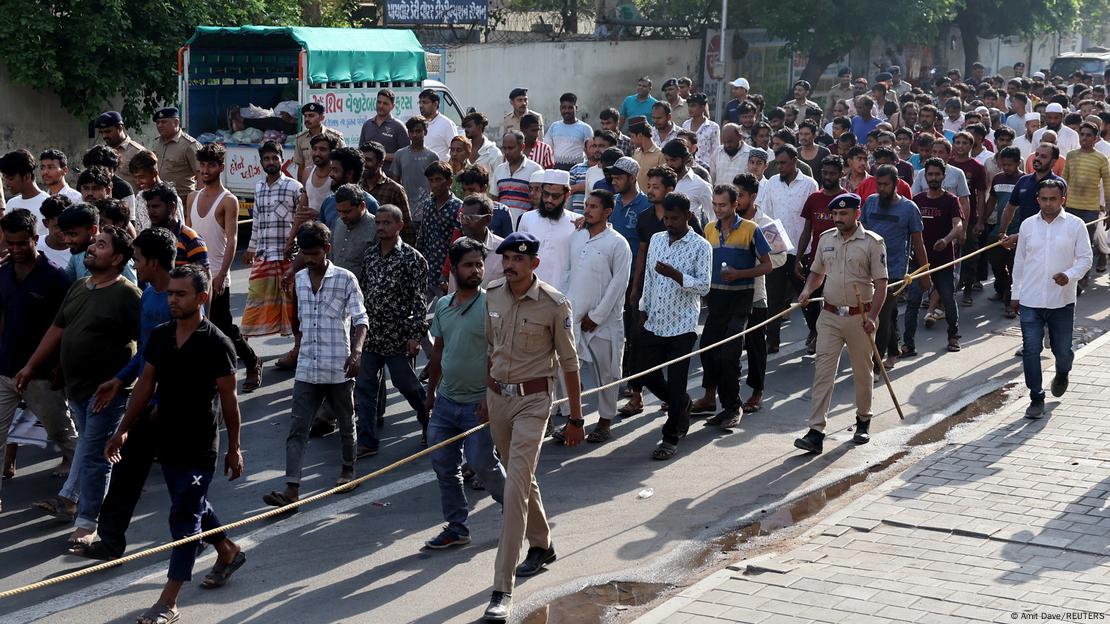
Several of those deported have been returned to India after they managed to prove their citizenship. Photo: Reuters

Indian authorities have unlawfully forced hundreds of Bengali-speaking Muslims into Bangladesh, the Human Rights Watch (HRW) said in its latest report on Thursday, accusing the Hindu-nationalist government of targeting Muslims for political gains.

At least 1,500 Muslim men, women and children were expelled across the border — some of whom were beaten up and their Indian identity papers destroyed — between May 7 and June 15, HRW said, citing Bangladeshi authorities. India's government has not released any statistics on how many people it has deported to Bangladesh as illegal immigrants.

"India's ruling BJP (Bharatiya Janata Party) is fuelling discrimination by arbitrarily expelling Bengali Muslims from the country, including Indian citizens," Elaine Pearson, Asia director at the NGO, said.

"The Indian government is putting thousands of vulnerable people at risk in apparent pursuit of unauthorized immigrants, but their actions reflect broader discriminatory policies against Muslims," she said.

Modi's quest against 'infiltrators'
Indian Prime Minister Narendra Modi's government has long taken a strong stance against irregular migration. In public speeches around elections, he has often focused on immigrants from Bangladesh, calling them "infiltrators."

The Ministry of Home Affairs gave states a 30-day deadline to round up undocumented Bangladeshi immigrants in May, soon after a deadly attack in Indian-administered Jammu and Kashmir in which Islamic extremists targeted Hindu tourists.

New Delhi claims all explusions were conducted to reverse irregular migration.

The report slammed the rushed operations, saying the government's reason was "unconvincing" as it disregarded "due process rights, domestic guarantees, and international human rights standards".

"The government is undercutting India's long history of providing refuge to the persecuted as it tries to generate political support," Pearson said.

In May, Indian media reported that authorities forcibly detained some 40 Rohingya refugees and dropped them into international waters using navy ships. While the Supreme Court has called it a "beautifully crafted story," the Modi government is yet to publically deny the allegations.

Muslim migrant workers targeted
New York-based HRW said that while some of those deported were Bangladeshi citizens, many Indian nationals who are Bengali-speaking Muslims from states neighboring Bangladesh.

This was possible because authorities carried out swift deportations without due process which includes verifying the person's citizenship before expulsion, the report said.

Of those expelled, 300 people come from the eastern state of Assam, which imposed a contentious citizenship verification process. Others were Bengali-speaking Muslims who had migrated from the eastern state of West Bengal to Gujarat, Maharashtra, Rajasthan, Uttar Pradesh, Odish and Delhi in search of work.

The targeting of Bengali-speaking Muslims is characteristic of the Hindu-nationalist movement in India led by Modi's BJP and related fringe groups. The issue of Bangladeshi immigrantion is likely to take center stage in West Bengal— one of the few states that the BJP has failed to win — where elections are due in 2026.
1
India's leaders have often targetted bangladeshi immigrants in their speeches, calling them 'infiltrators'

'I thought they would kill me'
HRW said it interviewed over a dozen affected people and their families, including those who were returned to India after being expelled to Bangladesh.

Nazimuddin Sheikh, a migrant worker from West Bengal who had been in India's financial capital Mumbai for five years, said the police raided his home, tore up his identity documents proving his Indian citizenship and flew him along with over 100 others to the Bangladesh border.

"If we spoke too much, they beat us. They hit me with sticks on my back and hands. They were beating us and telling us to say we are Bangladeshi," he said.

Another worker from Assam recalled his ordeal. "I walked into Bangladesh like a dead body. I thought they would kill me because they were holding guns and no one from my family would know."

Follow google news channel to get RTV news Google News
India Overtakes Japan as 4th-Largest Economy, Report Says
India has surpassed Japan to become the world's fourth-largest economy, according to calculations in the Indian government's end-of-year economic review. On current trends, India is expected to overtake Germany to become the world's third-largest economy within the next three years, the review said. How big is India's economy? The review said India's gross domestic product has already reached about $4.18 trillion (€3.55 trillion), and is projected to reach $7.3 trillion by 2030. On current trends, it said, India would trail only the United States and China in economic heft. India's real GDP grew 8.2% in the second quarter of the 2025–26 financial year, up from 7.8% in the previous quarter and marking a six-quarter high. Export performance has also strengthened, the review noted. Merchandise exports rose to $38.13 billion in November, up from $36.43 billion in January, supported by engineering goods, electronics, pharmaceuticals, and petroleum products. Official confirmation however depends on data due in 2026 when final annual GDP figures are released. The International Monetary Fund suggests India will surpass Japan next year. The Reserve Bank of India has revised its growth forecast for the 2025–26 financial year upward to 7.3%. Why might India's economy be booming? Growth was said to have been driven primarily by domestic demand, with particularly strong private consumption, despite continued global trade and policy uncertainty. The government described the current phase as a rare "Goldilocks" period of high growth and low inflation, saying strong corporate balance sheets, steady credit flows, and ongoing reforms have positioned India for sustained expansion. "India is among the world's fastest-growing major economies and is well-positioned to sustain this momentum." "With the ambition of attaining high middle-income status by 2047 — the centenary year of its independence — the country is building on strong foundations of economic growth, structural reforms, and social progress." What economic challenges does India face? In income terms, the gap with advanced economies remains wide. India's GDP per capita stood at $2,694 in 2024, according to the latest World Bank data—about 12 times lower than Japan's $32,487 and roughly 20 times below Germany's $56,103. By population, India overtook neighboring China in 2023 to become the world's most populous country. Government figures show that more than a quarter of India's 1.4 billion people are aged between 10 and 26. Creating enough well-paid jobs for millions of young graduates is an upcoming hurdle, but the report offered a rosy outlook. "As one of the world's youngest nations, India's growth story is being shaped by its ability to generate quality employment that productively absorbs its expanding workforce and delivers inclusive, sustainable growth," a note in the review said. Prime Minister Narendra Modi this year unveiled sweeping consumption tax cuts and pushed through labor law reforms after growth slowed to a four-year low in the 12 months ending March 31. Currency pressures have also mounted. The rupee hit a record low against the dollar in early December, after falling about 5% in 2025. That came amid concerns over the lack of a trade deal with Washington and the impact of higher levies on Indian goods. India became the world's fifth-largest economy in 2022, when its GDP overtook that of former colonial ruler Britain, according to IMF figures.
India Overtakes Japan as 4th-Largest Economy, Report Says
India's PM Modi Expresses Grief Over Khaleda Zia’s Death
Indian Prime Minister Narendra Modi has expressed deep condolences following the passing of BNP Chairperson and former Prime Minister Begum Khaleda Zia. In a message shared on social media on Tuesday (December 30), Prime Minister Modi stated that he was "deeply saddened" by the news of her demise. "Deeply saddened to learn about the passing away of former Prime Minister and BNP Chairperson Begum Khaleda Zia in Dhaka," he wrote. "Our sincerest condolences to her family and all the people of Bangladesh. May the Almighty grant her family the fortitude to bear this tragic loss." He further added, "As the first woman Prime Minister of Bangladesh, her important contributions towards the development of Bangladesh, as well as India-Bangladesh relations, will always be remembered." Read More CA Expresses Deep Grief Over the Death of Khaleda Zia The Indian Prime Minister also took a moment to reflect on their personal interactions: "I recall my warm meeting with her in Dhaka in 2015. We hope that her vision and legacy will continue to guide our partnership. May her soul rest in peace." Global Condolences Pour In Prime Minister Modi's message is part of a wave of international tributes following the death of the 80-year-old leader, who passed away at 6:00 AM today at Evercare Hospital in Dhaka. Earlier this morning, world leaders including Pakistan's Prime Minister Shehbaz Sharif and the United States Embassy in Dhaka also extended their deepest sympathies, acknowledging Khaleda Zia's pivotal role in shaping the modern history of Bangladesh.
India's PM Modi Expresses Grief Over Khaleda Zia’s Death
India's Space Agency Launches Its Heaviest Satellite Yet
The Indian space agency on Wednesday launched a LVM-3 rocket carrying its heaviest-ever satellite — BlueBird Block-2 — from the Satish Dhawan Space Centre in southern India. BlueBird Block-2 weighs 6,100 kilograms (over 6 tons), making the largest-ever commercial communications satellite to be deployed in low Earth orbit (LEO) and "the heaviest payload to be launched from Indian soil," according to the space agency. The LVM3-M6 rocket, built by the US-based company AST SpaceMobile, was launched at 8.55 a.m. local time (0330 GMT). The satellite was successfully injected into the intended orbit, ISRO said. India stepping up its space ambitions ISRO plans to use a modified version of the LVM-3 rocket for its future space missions, including the human spaceflight program, Gaganyaan mission. The milestone launch was lauded by the Indian Prime Minister Narendra Modi as "a significant stride" for the space sector. "It strengthens India's heavy-lift launch capability and reinforces our growing role in the global commercial launch market," he said in a statement. India is trying to secure its place in the commercial satellite business as its phone, internet and other companies seek to expand and improve communications. The country is also preparing an unmanned mission to the moon ahead of its fist human spaceflight, which set for 2027.
India's Space Agency Launches Its Heaviest Satellite Yet
Delhi Summons Bangladesh High Commissioner Following Dhaka’s Protest
In a continuing cycle of diplomatic friction, the Indian Ministry of External Affairs (MEA) summoned Bangladesh High Commissioner M. Riaz Hamidullah to New Delhi on Tuesday (December 23). The move came just hours after Dhaka summoned the Indian envoy to protest recent security breaches at its diplomatic missions in India. This marks the fourth time in 10 days that the two neighboring nations have summoned each other’s top diplomats to register formal protests and concerns. Escalating Tensions over Mission Security The day’s diplomatic maneuvers began in Dhaka, where the Bangladesh Ministry of Foreign Affairs summoned Indian High Commissioner Pranay Verma. During the meeting, Bangladesh expressed "deep concern" over several recent incidents in India: Protests in New Delhi: Demonstrations and alleged threats issued outside the Bangladesh High Commission and the High Commissioner's residence on December 20. Vandalism in Siliguri: An attack on the Bangladesh Visa Center in Siliguri on December 22, reportedly carried out by members of several Hindutva organizations. Delhi’s "Tea Invitation" Counter-Summons In a swift response, the Indian MEA summoned High Commissioner Hamidullah later that afternoon under the guise of an "invitation for tea." Diplomatic sources reveal that B. Shyam, Joint Secretary at the MEA, told the Bangladeshi envoy that Dhaka has recently been reacting to various issues in an "unreasonable and irrelevant" manner. High Commissioner Hamidullah reportedly refuted these allegations during the meeting, maintaining that Bangladesh’s positions are based strictly on "ground realities" and factual developments. Context of the Strained Ties Relations between the two countries have remained sensitive since the political transition in Bangladesh last August. The frequent summoning of diplomats highlights a period of significant mistrust, with both nations trading accusations regarding the safety of diplomatic personnel and the treatment of minorities.
Delhi Summons Bangladesh High Commissioner Following Dhaka’s Protest
India's Nuclear Sector to Expand, Draw Foreign Capital
Nuclear reform opens India's nuclear sector to foreign firms, but critics highlight safety and supply chain gaps. Last week, India's parliament approved legislation that opens nuclear power generation to private and foreign companies. The landmark Atomic Energy Act marks a significant government shift as India moves towards increased nuclear energy and reduced dependence on fossil fuels in order to meet climate targets. India is seeking to boost its nuclear power capacity tenfold to 100 gigawatts by 2047, which would be enough to power nearly 60 million Indian homes annually and is essential to achieving carbon neutrality by 2070. Reaching this target requires around 20 trillion Indian rupees ($226 billion, or €193 billion) in investment that the new legislation aims to unlock from private sources. Indian Prime Minister Narendra Modi said it "marks a transformational moment for our technology landscape" and also opens "numerous opportunities" for the private sector. Major Indian conglomerates, including Tata Power, Adani Power and Reliance Industries, have already signaled their interest in entering the country's tightly controlled civil nuclear power sector. Nuclear reform spurs safety concerns Alongside the government optimism, many experts warn of potential challenges, ranging from liability caps and regulatory oversight to safety standards, which could complicate India's nuclear power ambitions. Ajay Bisaria, a former Indian envoy to Pakistan, said the legislation removes the legal barriers that kept US and French companies out since 2010, enabling India to diversify beyond Russia. "This reform moves India-US nuclear cooperation from political signaling to commercial reality. Joint statements on large reactors and SMRs [small modular reactors] can now translate into actual projects, with improved Indo-US relations expected in 2026 providing further momentum," Bisaria told DW. "Licensing timelines, localization requirements, nuclear material safeguards for imported fuel, financing constraints and questions about regulatory capacity are issues." US interest questioned in India's nuclear shift Opposition parties have alleged India's new legislation — dubbed "SHANTI" (meaning "peace" in Hindi), an acronym for Sustainable Harnessing of Advancement of Nuclear Energy for Transforming India — was expedited to meet US demands. The Indian reform coincides with US President Donald Trump signing the National Defense Authorization Act (NDAA) on December 18. The NDAA, a sweeping defense policy bill, includes provisions mandating a joint US-India consultative mechanism to align New Delhi's domestic nuclear liability rules with international norms. India balances safety with investment push Jairam Ramesh, a senior member of India's main opposition Indian National Congress party, claimed that recent changes to the country's nuclear liability framework were pushed through Parliament to align domestic law with US interests. The Indian government maintains that the country's energy security needs and clean energy commitments are driving the nuclear reform. Sameer Patil, director of the security, strategy and technology center at the Observer Research Foundation, a think tank, said that the policy shift is a necessary structural reform to unlock private investment for India's nuclear ambitions. "However, there are several challenges, such as the lack of indigenous supply of fuel supplies being a chief concern. This makes the sector and country vulnerable to vagaries of geopolitics," Patil told DW. "The question of safety and oversight, frankly, in my opinion, is a trade-off between incentivizing commercial participation and imposing reasonable safeguards." Patil noted the nuclear legislation's current provisions may seem inadequate given the possible damage from a nuclear accident, but they are sufficient to keep private companies interested in India's nuclear expansion plans. Skepticism over private sector role However, a government official familiar with the nuclear sector, speaking on condition of anonymity, expressed skepticism. "India's nuclear industry has consistently missed targets, and the private sector's track record of abandoning high-risk ventures like gas and hydro raises questions about sustaining capital-intensive nuclear commitments with weakened liability protections," the official told DW. Anil Wadhwa, a former diplomat with extensive experience in nuclear and disarmament issues, told DW that India faces implementation challenges to realize its ambitious goal. "Supply-side issues include poor domestic uranium quality, the need for skilled workforce development, and insufficient manufacturing capacity for reactor components," said Wadhwa. Safety caps and supply gaps under fire Wadhwa said that debates were continuing around critical issues. "Whether liability caps of 15 billion Indian rupees ($168 million, €143 million) are adequate for major accidents, whether the regulatory body, Atomic Energy Regulatory Board, has sufficient independence from government, and how to properly balance commercial incentives with safety standards," queried Wadhwa. Japan's Fukushima disaster in 2011 cost over $200 billion in cleanup and compensation, more than 1,200 times India's proposed liability cap. The Chernobyl accident's total economic impact exceeded $700 billion when accounting for long-term health costs, evacuations, and contaminated land loss. For foreign companies, Wadhwa said, India's earlier Civil Liability for Nuclear Damage Act (CLNDA) of 2010 allowed operators to sue suppliers for equipment defects, unlike global norms where only operators bear liability. "This law fundamentally reforms this by aligning closer to international standards," said Wadhwa. "Foreign ownership is capped at 49% with operational and licensing requirements, but the bill creates participation pathways that did not exist before, which marks significant progress from the previous restrictive regime."
India's Nuclear Sector to Expand, Draw Foreign Capital
Read More
Human Rights Groups Urge Chief Adviser to Ensure Accountability and Reform
Bangladesh Still Polarized a Year After Hasina's Ouster
HRW: Sheikh Hasina, Top Officials Linked to Enforced Disappearances
Sheikh Hasina Personally Ordered Abductions and Killings
