Prime Minister Tarique Rahman on Tuesday issued a clarion call for Bangladesh’s universities to pivot away from traditional, certificate-based teaching toward a future defined by research and innovation.
Speaking at the inaugural session of a workshop at Dhaka University, the Prime Minister warned that the country must adapt to remain viable in an increasingly competitive global landscape.
“If universities do not focus on research and innovation alongside textbook education, it will be difficult for us to survive in a competitive world,” the Prime Minister stated.
He noted with concern that Bangladesh’s higher education institutions have yet to reach expected heights in global rankings, which heavily weigh research output and citations.
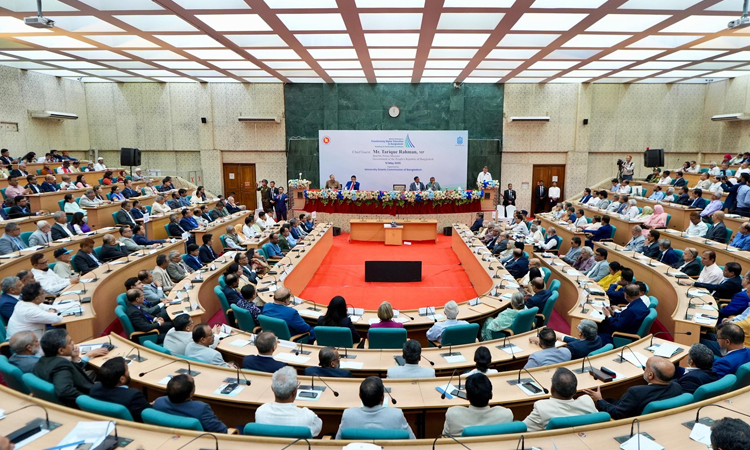
“Global university rankings usually place greater importance on research publications, citations and innovation. Our academics should think more deeply about where we stand in these areas,” he added.
The daylong workshop, titled ‘Transforming Higher Education in Bangladesh: Roadmap to Sustainable Excellence,’ was organized by the University Grants Commission (UGC) at the Nawab Ali Chowdhury Senate Bhaban.
Addressing the impact of the Fourth Industrial Revolution, the Prime Minister highlighted how technologies like artificial intelligence, robotics, biotechnology, and big data are fundamentally altering the labor market.
While acknowledging that automation may reduce traditional roles, he emphasized that it simultaneously creates new opportunities for those with the right skill sets.
“To face the challenges of the Fourth Industrial Revolution and enter new employment markets, we must move away from a memorisation- and certificate-based education system,” he said, stressing the urgency of redesigning the national curriculum to meet modern technological demands.
To bridge the gap between graduation and employment, the Prime Minister advocated for stronger industry-academia collaboration, suggesting that industrial needs must be integrated directly into university curricula.
He revealed that the government has already begun modernizing the curriculum from the primary to the tertiary level to focus on practical, employment-oriented learning.
Addressing the issue of graduate unemployment, the Prime Minister remarked that many youths remain jobless because they lack practical experience despite their academic credentials.
To combat this, the government is expanding apprenticeship and internship programs, initially linking universities in divisional cities with local business institutions. He also detailed plans for seed funding and innovation grants intended to commercialize student business ideas.
“The aim is to create entrepreneurs from campuses,” he said, noting that skilled students should aim to be "job creators instead of job seekers."
Furthermore, the government plans to establish innovation and entrepreneurship development institutes and science parks within higher educational institutions.
Drawing parallels to global giants like Uber, Facebook, and Alibaba, he illustrated how innovative ideas are reshaping the world economy.
He also encouraged universities to engage their alumni networks more effectively, stating, “Students are the life of a university, while alumni are its backbone.”
Concluding his address, the Prime Minister envisioned a merit-based society where creativity and competence are prioritized, ensuring every student has the chance to reach their full potential.
However, he also cautioned that technological progress must not come at the expense of the nation’s religious, social, and moral values.
The event, chaired by UGC Chairman Prof Mamun Ahmed, also featured speeches from Education Minister Dr. A N M Ehsanul Haque Milon, the Prime Minister’s Education Adviser Dr. Mahdi Amin, Education Secretary Abdul Khaleq and UGC Secretary Fakhrul Islam.
Following the session, Prof Mamun Ahmed presented a commemorative crest to the Prime Minister.




 Live TV
 RTV Plus