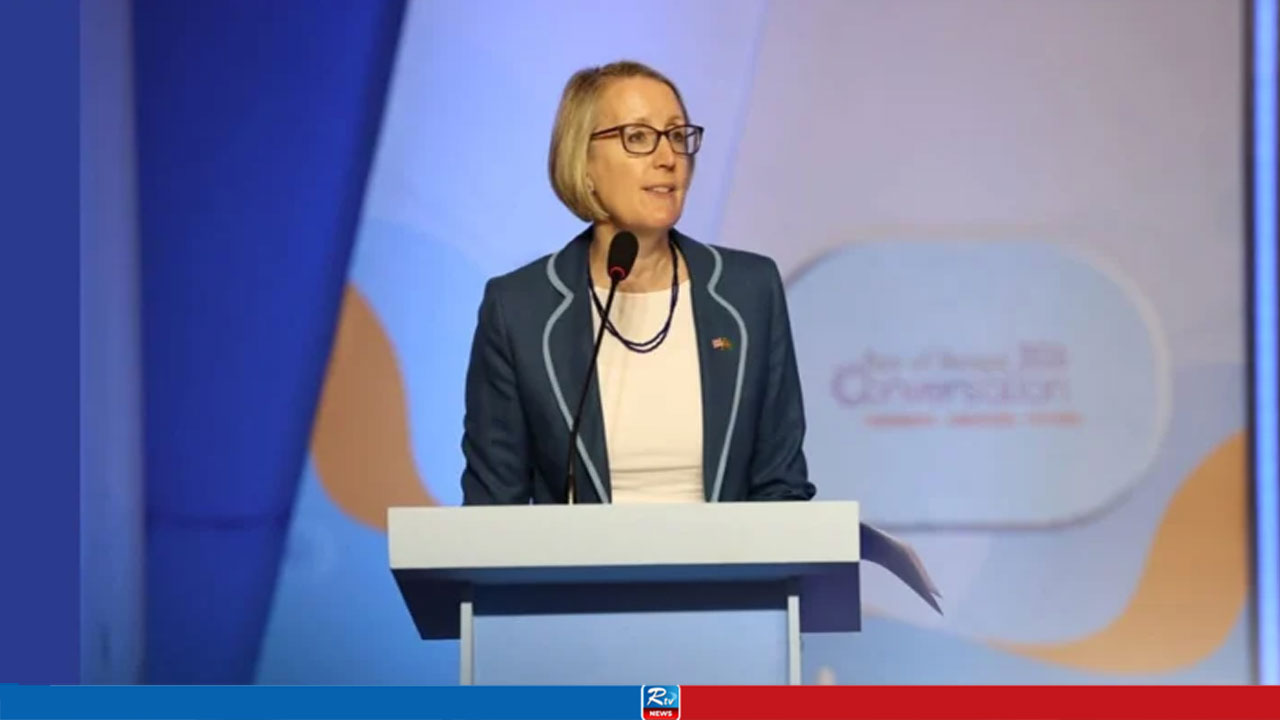
British High Commissioner to Bangladesh Sarah Cooke stated that 92 percent of Bangladeshi goods, including ready-made garments, will maintain duty-free entry into the UK market following a three-year transitional window after Bangladesh officially graduates from the least developed country (LDC) category.
She delivered these remarks while addressing the second day of the Bay of Bengal Conversation 2026 at a hotel in the capital on Sunday afternoon.
Cooke noted that Bangladesh presently benefits from duty-free access across 99.8 percent of its exported product lines entering the UK market.
These existing trade privileges will remain intact for three years post-LDC graduation, after which duty-free access will continue to apply to 92 percent of products, including the ready-made garment sector, she explained.
The high commissioner emphasized that the UK's primary objective is supporting Bangladesh in navigating a smooth, resilient, and sustainable transition out of LDC status.
She characterized the UK's Developing Countries Trading Scheme as among the most straightforward and liberal trade preference frameworks globally.
Cooke highlighted Bangladesh as a strategic and trusted partner for the UK, observing that bilateral ties are steadily maturing into a modern, strategic alliance that reflects Bangladesh's expanding influence on the global stage.
She added that deep-rooted, people-to-people connections continue to serve as a cornerstone of this dynamic partnership.
Underscoring robust economic ties, she pointed out that the UK remains one of Bangladesh's premier foreign investors.
British enterprises operating in finance, apparel, education, and energy continue to drive Bangladesh's economic transformation while generating widespread employment opportunities, she noted.
Regarding security cooperation, Cooke affirmed that mutual collaboration is grounded in shared goals and trust, including a joint commitment to maintaining a free and open Indo-Pacific.
The UK acknowledges Bangladesh's pivotal role and regional responsibilities in the Bay of Bengal, an area of rapidly increasing strategic significance, she stated.
Furthermore, both nations recognize the imperative of mounting coordinated responses to mitigate cyber threats, economic security risks, and climate-related challenges, she added.
On the Rohingya humanitarian crisis, Cooke reaffirmed the UK's commitment to sustaining international focus while working toward the voluntary, safe, and dignified repatriation of displaced Rohingya to Myanmar once conditions permit.
She described a sustainable return to their homeland as the sole long-term resolution to the displacement crisis.
Addressing climate change, the high commissioner stressed that Bangladesh and the UK share aligned priorities in countering environmental vulnerabilities.
Few nations possess a deeper understanding of climate risks than Bangladesh, where rising sea levels, shifting atmospheric patterns, and severe weather events are actively impacting communities—a trajectory likely to persist across generations, she observed.
The three-day international conference was hosted by the Centre for Governance Studies (CGS).






 Live TV
 RTV Plus