Dhaka 18 October, 2026

Protests Against Hijab Ban in Azerbaijan: Why are Children Involved?

Ismi Aghayev; Mark Scheider, Deutsche Welle

Publish : 17 Oct 2026, 10:27 AM
Azerbaijan is a majority Muslim country (file photo from 2016). Photo: IMAGO

A dispute over Islamic headscarves in Azerbaijani schools has triggered protests at home and an unusual exchange of criticism between politicians in Azerbaijan and Turkey, two countries whose leaders routinely describe their relationship as that of "one nation, two states". The row has raised questions about religious freedom, sovereignty and the limits of Turkish and Iranian influence in the south Caucasian country.

The unprecedented protests have been taking place across Azerbaijan for a nearly week. Children have demonstrated against the headscarf ban introduced at schools. Among those rallying outside of schools are girls who wear Islamic headscarves; others, including boys, have joined classmates in solidarity.

Rallies in general are rare in a country where police routinely disperse any public protests. But demonstrations involving children are unprecedented in Azerbaijan. As the videos showing the protests started spreading on social media, access to Instagram and TikTok was disrupted in the country, indicating how seriously the authorities are taking the issue. Internet monitors documented blocks; the authorities have not explained their cause.

School rules interpreted as a hijab ban
The dispute follows a series of legal changes. On July 7, Azerbaijan amended its general education law, reinforcing the principle of secular education and requiring pupils and teachers to comply with dress codes. On September 21, the government adopted Resolution No. 309, tightening school uniform rules.

The resolution prohibits additional clothing that disrupts the standard uniform or conflicts with secular education. It does not explicitly mention the hijab ― a Muslim headscarf covering the hair and neck ― or instruct schools to exclude pupils wearing one. But some school administrators have interpreted the rule as applying to hijabs and turned girls covering their heads away. The regulation gives each school's pedagogical council responsibility for resolving compliance issues.

A separate decision on October 6 set dress requirements for teachers. Reports followed of women wearing headscarves being prevented from teaching.
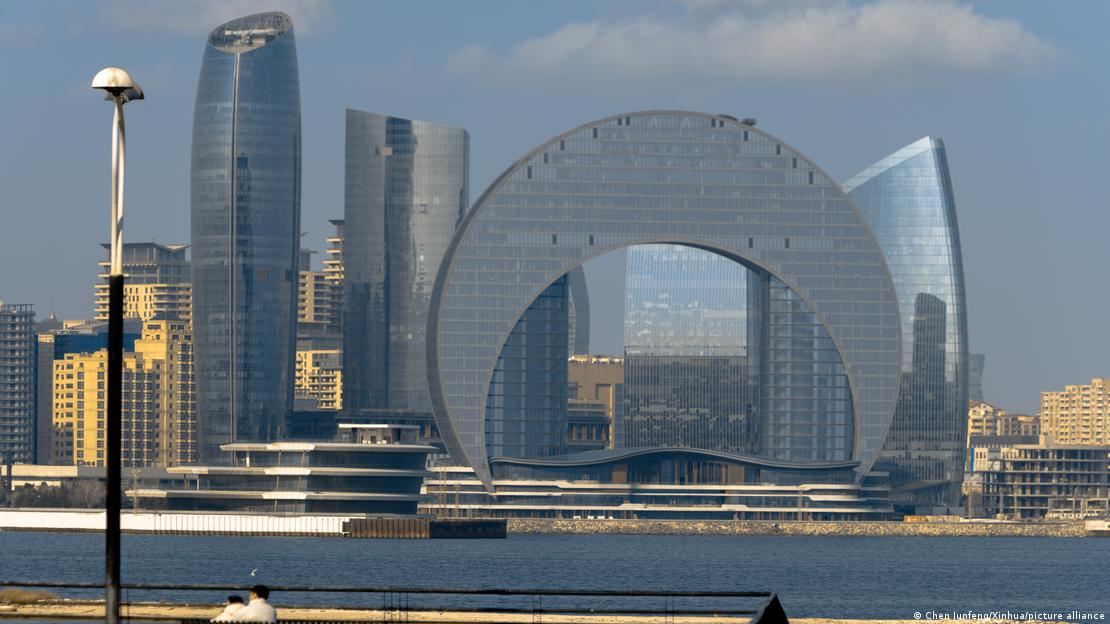
A view of Azerbaijan's capital Baku

Secular education and religious freedom
Azerbaijan is a predominantly Muslim country, but Article 18 of its constitution separates religion from the state and requires state education to be secular. Articles 42 and 48 protect the right to education and freedom of conscience.

Supporters of the schools' actions say the same dress rules should apply to all pupils. Critics argue that excluding girls because of religious clothing violates their rights. The dispute cuts across conventional political divisions: some government critics support the restrictions, while some non-religious Azerbaijanis oppose them. School headscarf restrictions also prompted protests in 2010 and subsequent years.

Families and teachers describe the impact
A Baku literature teacher with 40 years of experience, said that girls wearing headscarves were not admitted to classes at the teacher's school. Some removed their scarves; others went home or wanted to study at home. The teacher, who didn't want to be identified by name and provided only the initials M.C., supported enforcing the uniform rules, arguing that children were too young to make decisions about religious dress.

A parent identified as D.A. told DW this was not a nationwide hijab ban, but a matter of school uniforms. Another parent who opposed the restrictions withdrew an interview before publication.

Facebook user Sarraf Cabbarov from Baku posted on his social media account that his daughter Sevil, a primary school teacher in Azerbaijan's capital, was dismissed for refusing to remove her headscarf. He also published a school order issuing her a written warning under the new dress regulations.

Detentions and reactions in Azerbaijan
On October 12, the Interior Ministry said 37 people had been detained in connection with the protests. According to the ministry's statement, the group had confronted school staff, damaged property and attempted to obstruct school activities and traffic. A criminal case was opened under Article 233, concerning disruption of public order. The ministry did not identify those detained or say whether they included children.

Artist and activist Ilkin Huseynov went missing after launching a project linking volunteer tutors with pupils affected by the restrictions. Local media later reported, citing people close to him, that he had been given 30 days of administrative detention for allegedly disobeying police orders.
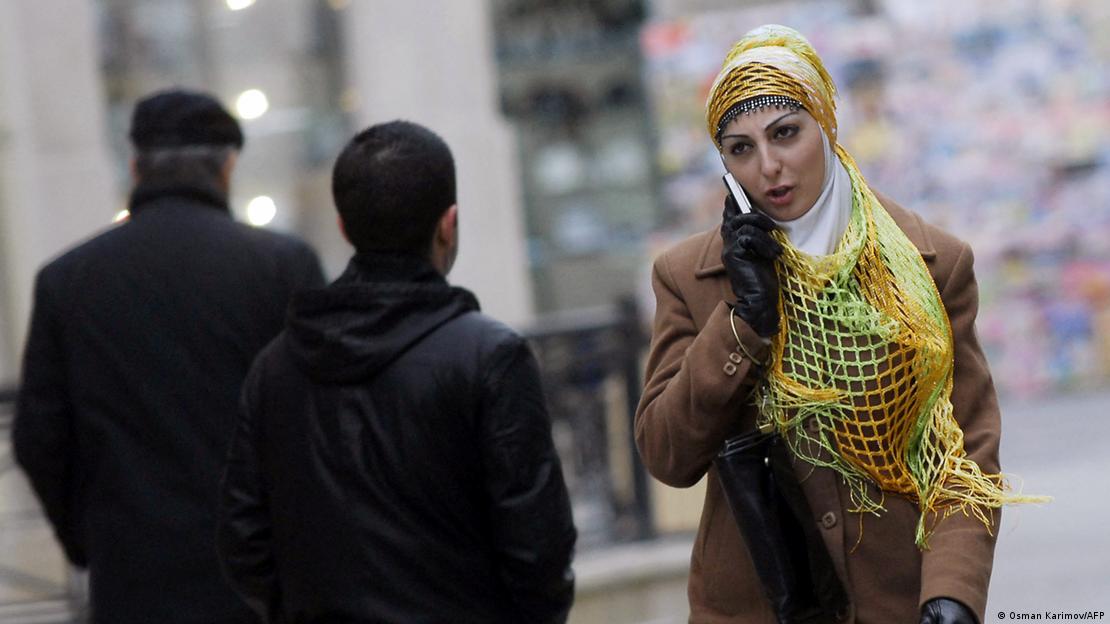
A woman wearing a hijab in Baku

Some observers linked the introduction of the new rules for school uniform to the attempts by the Azerbaijani government to counter the influence of neighboring Iran and the growing strength of religious groups within the country. This interpretation is, in essence, echoed by government officials as well, although they stop short of explicitly naming Iran.

Fazil Mustafa, who chairs the Committee for Public Associations and Religious Institutions at Azerbaijan's parliament, said the authorities were concerned about religious groups influenced from abroad and defended the school rules. Allahshukur Pashazade, head of the Caucasus Muslims Office, also warned of outside interference but called for a peaceful solution. The alleged foreign involvement has not been independently established.

Amnesty International condemned the exclusion of girls wearing hijabs and called for the release of anyone detained solely for protesting peacefully.

Dispute reaches Turkey
The controversy has also drawn criticism in Turkey, Azerbaijan's close ally. Protesters gathered outside Azerbaijan's consulate in Istanbul on October 3. Oktay Saral, an adviser to Turkish President Recep Tayyip Erdogan, criticized the restrictions, saying it's unacceptable to deny education to students wearing headscarves. Azerbaijan's ruling New Azerbaijan Party replied that close relations did not justify interference in its internal affairs.

For affected families, the immediate question remains whether children can attend school without removing their headscarves.

Follow google news channel to get RTV news Google News
India: Can 'Cockroaches' Threaten Modi's Political Grip?
Thousands detained, leaders arrested on arrival, and a capital under lockdown: The youth-led protests against the election chief have the attention of the Indian government. But experts say toppling it is another matter.
India: Can 'Cockroaches' Threaten Modi's Political Grip?
French Students Decry Failures of Education System
For weeks, schoolchildren in France have been protesting the failing education system. Compared to many other countries, France invests heavily in education but critics say that the funds are not distributed fairly. Rats in the toilets, leaking roofs, broken heating systems: Cellphone videos filmed by French schoolchildren and circulating on social media bear witness to the dilapidated infrastructure in many educational institutions across France. At the Lycee Paul Eluard in the Parisian suburb of Saint-Denis, a center of the current protests, young people have reported that there are vermin in the building, and say burst pipes are a regular occurrence. In nearby Pantin, pupils complained that windows couldn't be opened, even when temperatures soared to 40 degrees Celsius (over 104 degrees Fahrenheit) in summer. Pupils also complain of overcrowded classrooms and frequently cancelled lessons. The protests, which have erupted all over the country, show no sign of coming to an end.  Problems of centralization Yet, by EU standards, France invests a substantial amount in its education system — 6.7% of its GDP. The fact that this investment has not translated into a better learning environment may be partly attributable to the way responsibilities are divided. The central government in Paris mainly deals with paying teachers, and setting national curricula. But the responsibility for maintaining school buildings lies with France's various levels of local government. For elementary schools, the administration responsible is the municipality; for "colleges" (lower secondary schools, ages 11–15) it is the wider department, and for lycees (upper secondary schools, ages 15–18) it is the region. Depending on the region, the local authorities have different financial possibilities at their disposal, and must plan renovation projects themselves. Progress on making improvements is often very slow as a result. In addition, more than two-thirds of their budget is already allocated to staffing costs and pension payments, leaving relatively little room for investment. Dilapidated infrastructure Over 80% of elementary school buildings in France are more than 50 years old. An estimated 10 to 20% of all school buildings are considered to be in serious need of renovation. In many instances, politicians have been trying to address the problem. Ile-de-France, which covers Paris and the region surrounding it, approved a 10-year program of renovation and expansion for the period 2017 to 2027 at a cost of €6.6 billion ($7.4 billion). According to the local authorities, two-thirds of upper secondary pupils now attend a new school, or one that has been renovated. But even after mold has been removed and roofs repaired, it is still rare for buildings to have effective protection against the summer heat. It is also a bitter irony that some buildings newly constructed at considerable expense, or renovated just a few years earlier, have been damaged in the recent protests. Macron tried in vain to address problem Imbalances are also evident in ongoing education expenditure. While France invests a comparatively large amount in upper secondary education, according to OECD calculations Paris spends less per primary school pupil than the average for industrialized countries. Education researchers emphasize that it is precisely these early years that lay the foundation for subsequent academic success. The governments put in place by French President Emmanuel Macron have attempted to address this imbalance. Since 2017, class sizes in the first years of primary school have been halved in socially disadvantaged areas, and around 16,000 additional teaching posts created.  Amid the ongoing protests, the government has said it now intends to recruit more than 3,000 supply teachers at short notice. French Education Minister Edouard Geffray  announced that software would be used to identify schools that are in a particularly difficult situation. These announcements are the government's first concrete response to the demands of the students, who have been demonstrating for almost two weeks now, calling for better facilities in secondary schools, more supply teachers and greater investment in the education system generally. Increasing deficiencies The latest scores for the Organization for Economic Cooperation and Development’s (OECD) program for international student assessment (Pisa), which were published in September, illustrate the scale of the problems in the education system. According to the results, more than one in three 15-year-olds in France no longer achieve a basic level of competence in mathematics, for example. Macron's reform of the upper secondary education system has also been criticized. The abolition of academic streaming in favor of specialist subjects selected by the individual was meant to give pupils greater freedom of choice. However, the large number of possible subject combinations make it difficult to timetable lessons. Students complain that they have too many free periods and longer school days. The problems also extend to universities. A lecturer at a Paris university described a seminar attended by 50 students — so many that they have to fetch chairs from other rooms or sit on the floor. So far, she said, the university administration had done nothing about it. Cancelled lessons Compared with pupils in other EU countries, French schoolchildren have a high number of teaching hours per school year — on paper, at least. But the French Court of Accounts recorded that 9% of lessons at state colleges were cancelled in the 2023–24 school year. A study from the school year 2024–25 suggests that only around 12% of lessons cancelled at short notice are covered by other teachers. The relatively low salaries of French teachers compared to those in neighboring countries are also a problem. OECD data shows that after 15 years in the profession teachers at lower secondary schools in France only earn about half as much as their German counterparts. Broken promises of equality France takes pride in its republican model of education, which is supposed to provide all children with equal opportunities, irrespective of their background. In reality, academic success in France is much more dependent on parents' socioeconomic circumstances than in many other countries. This is also apparent in that children from poorer families are far more likely to be affected by the cancellation of lessons. The government's financial room for maneuver is currently restricted by the country's precarious budgetary situation. Although the draft budget for 2027 includes an additional €1.2 billion for the Ministry of Education, there are also plans to cut teaching posts, on the grounds that pupil numbers are falling. Protests in the run-up to the presidential election It's not just videos of dilapidated school buildings that are circulating on social media. As the discontent has spread, there is also footage of demonstrations where people carry placards with political slogans that have little to do with education policy. Some videos show burning barricades and clashes with the police, which faces accusations of using disproportionate force. Some members of the far-left France Unbowed (LFI) party have associated themselves with the protesting students. Lawmakers have appeared at school blockades and shared related videos. The government has accused LFI of deliberately exploiting young people's anger for political purposes, an allegation that the party rejects. With the French presidential election just six months away, the protests over the crisis in education are evolving into a power struggle.
French Students Decry Failures of Education System
Is Bangladesh Backtracking on Post-Hasina Reforms?
Two years after a student-led uprising toppled PM Sheikh Hasina, critics say Bangladesh's reform momentum is fading as political divisions deepen and key changes stall. Just two years after a student-led uprising ended the nearly 16-year rule of Sheikh Hasina, many fear Bangladesh is slipping backward. With Hasina, now in exile in India, planning a return in December and critics accusing the current government of failing to deliver on its promises, the country's political future is once again in doubt. "At the end of the day, we did not see the elimination of discrimination, the creation of an inclusive society, or the new political order that was promised," Mohammad Tanzimuddin Khan, a professor of international relations at Dhaka University, told DW. "It seems we are forgetting the very reasons behind the uprising of last July, especially those who came to power." The protest movement began in 2018 over a controversial quota system for government jobs. In 2024, a court-backed move to reinstate parts of the system sparked fresh demonstrations that grew into a wider anti-government uprising. In August 2024, after more than 1,000 people were killed in the unrest, then Prime Minister Hasina fled to India. Rebuilding Bangladesh's institutionsBangladesh's interim government, which was led by Nobel Peace Prize winner Muhammad Yunus and backed by the military and key figures from the uprising, facilitated the signing of a reform roadmap. It was named the "July Charter" after the month when the uprising that toppled Hasina began.  In a February 2026 referendum, around 70% of voters approved the charter, which proposed term limits for prime ministers, the creation of an upper house of parliament, stronger presidential powers and greater judicial independence. The Bangladesh Nationalist Party (BNP) won a decisive majority in a general election that took place alongside the referendum. Critics say the BNP has since failed to implement several pre-election reform commitments. Ali Riaz, who led the interim government's Constitution Reform Commission, said there had been "time-bound commitments," including the creation of a constitutional reform council and steps to implement reforms within 180 working days. "That was not done," he said, adding that it was "deeply regrettable." Is Bangladesh moving in the wrong direction?The interim government introduced 133 ordinances as part of its reform agenda, but after the BNP came to power, it refused to adopt 20 of them — including measures concerning the National Human Rights Commission (NHRC), the Anti-Corruption Commission, enforced disappearances and referendums. The BNP argues that constitutional and institutional changes should be enacted through proper legislative procedures in Parliament. The BNP and the opposition Jamaat-e-Islami-led alliance have clashed over the July Charter, including proposals for a constituent assembly to oversee constitutional reforms. Salahuddin Ahmed, who led the BNP's representatives in the National Consensus Commission, now serves as Bangladesh's Home Minister. Speaking in Parliament in March, Ahmed described the charter's implementation order as "a document of endless deception" by the interim government. Asif Mahmud, spokesperson for the student-led National Citizen Party (NCP), accused the BNP of "betraying the public" on its reform promises and cast doubt on "whether voters would trust the party again if a similar political moment were to arise." Mahmud, a leading figure in the uprising who later served as an adviser in the interim government before resigning ahead of the national election, told DW: "The BNP is taking the country backward by revoking the very ordinances and reforms that the interim government had implemented."  However, Khan believes the opposition party also bears responsibility for this. "It is not just the ruling party; there is no sign of the opposition breaking free from this tendency either." While he sees some change in the way prime ministerial power is exercised, he believes "politicization has returned to major institutions, including educational ones." Have public aspirations been realized?Mahmud said "political parties were eager to secure power" through early elections, forcing student leaders of the uprising to "make compromises on key reform demands." Alleged enforced disappearances were among the most serious accusations against Hasina's government. A commission set up by the interim administration reported that, of 1,913 complaints received, 1,569 were verified and classified as cases of enforced disappearance. Among those who later returned alive, about 75% were linked to the Islamist party Jamaat-e-Islami and 22% to the BNP, the main political rivals of Hasina's Awami League party. In an effort to prevent future abuses, Bangladesh signed the UN Convention against Enforced Disappearances in August 2024. The interim government later introduced an ordinance to criminalize the practice. "We wanted to ensure permanence by incorporating this into the constitution and making the necessary legal changes," Asif Mahmud said. However, rather than seeking parliamentary approval for the ordinance, the BNP-led government published a new draft bill in July 2026. Critics say the proposal weakened safeguards by assigning investigations into alleged enforced disappearances from the National Human Rights Commission (NHRC) to the police. Human Rights Watch (HRW)  warned that "allowing the police to investigate enforced disappearances will not ensure accountability and will not create the deterrence necessary to bring this practice to an end." HRW also cited the April 21 alleged abduction of Miraj Sheikh by men allegedly posing as Coast Guard personnel as the first reported enforced disappearance since the 2024 uprising. More than three months later, his whereabouts remain unknown. "We see signs of a return to those old times," Khan said. "Naturally, this is alarming." The 'Hasina Factor' persists in Bangladesh politicsThe Awami League and its affiliated organizations remain banned under an executive order and were excluded from February's elections. Hasina, meanwhile, has been sentenced to death by Bangladesh's International Crimes Tribunal over crimes against humanity committed during the 2024 uprising and remains self-exiled in India. Yet despite her fall from power, Hasina and her Awami League continue to loom large over Bangladesh's political landscape. In a Reuters interview last month, Hasina said she plans to return to Bangladesh in December and surrender to the authorities. The authorities in Dhaka "want to take me back, they are repeatedly sending letters to India seeking to have me sent back," she said. "I will go myself." "I believe in justice and I feel that once proceedings start, it will be ​clear to the people how farcical the court is," Hasina added, "and that I want to prove it." The announcement of her planned return has fueled fresh debate. NCP spokesperson Asif Mahmud argued that "even India no longer wishes to host Hasina" and suggested her remarks reflect growing uncertainty about her future there. Mahmud added that sheltering Hasina now provides India with little political benefit and complicates relations with Bangladesh's current government. Bangladesh's attorney general has declared that Hasina would be arrested immediately upon her return and stand trial. Ali Riaz, however, warned that Hasina's return could create new challenges. "During the trial proceedings, she and her followers might attempt to destabilize the law-and-order situation in Bangladesh for political gain," he said, calling on the government to guard against any resulting instability. Others, however, see a different possibility. Khan said the tensions surrounding Hasina's return could instead help "forge broader political unity in a deeply divided country."
Is Bangladesh Backtracking on Post-Hasina Reforms?
Reclaiming Our Legacy in a Fractured World
A land etched by the rivers of time, Bangladesh stands today at a moral crossroads. Our history books, our folk songs, and our national identity are built upon a profound legacy of communal harmony, resilience, and collective compassion.  This is the soil that gave birth to the spirit of Ekattor, where religion, ethnicity, and creed blurred into a singular, unstoppable force for liberation.  This is the culture that venerates Lalon Shah, whose verses transcended the artificial walls of faith, asking the most human of questions: “What form does the soul take?” Yet, scrolling through today’s news feeds or hearing whispers in our neighborhoods, we are confronted with a jarring, painful contradiction.  A rising tide of barbaric incidents—communal violence, brutal attacks on minorities, venomous speech, and acts of shocking cruelty—threatens to tear the very fabric of our society. How did we, a nation born from a symphony of unity, find ourselves listening to this dissonant cacophony of hate? In the months following the political upheaval of August 2024, Bangladesh witnessed a disturbing surge in violence against religious minorities. According to the Bangladesh Hindu Buddhist Christian Unity Council (BHBCUC), more than 2,010 incidents of communal violence occurred between August 4 and 20, 2024, alone—including attacks on 69 temples, damage to over 1,000 homes and businesses, and the loss of innocent lives.  In the first half of 2025, the Council documented another 258 incidents, including 27 murders, 59 attacks on places of worship, and 20 cases of violence against women. Odhikar and Human Rights Watch have also recorded the continued targeting of Hindu, Buddhist, Christian and Ahmadiyya communities, as well as indigenous groups. These numbers are not abstract statistics. They represent shattered homes, desecrated temples, and families living in fear. One harrowing case that shocked the nation was the lynching of 25-year-old Hindu garment worker Dipu Chandra Das in December 2025—beaten, hanged, and set ablaze over an alleged blasphemy accusation.  Such acts of barbarity stand in stark, heartbreaking contrast to the compassionate Bangladesh we know ourselves to be. The gap between our historical self-image and our present reality is not just alarming; it is an existential warning. We must confront this contradiction not with denial, but with fierce, collective introspection. The barbarity we witness is not an alien invasion; it is a corrosion from within.  Read More The Turbulent History of US-Cuban Relations It is the fruit of cultivated prejudice, of political and social narratives that have, for years, quietly exchanged our rich, complex identity for a narrow, monolithic one. It is the result of an empathy deficit, where the “other”—be they of a different faith, ethnic community, or social standing—is slowly dehumanized, turned from a neighbor into a caricature, and then into a target. This dehumanization is the bedrock of all barbarism. When we strip a person of their individual story, their dreams, and their capacity for pain and joy—reducing them to a mere label of “they” or “them”—we grant ourselves unconscious permission for cruelty.  The assailant does not see a humble shopkeeper, a devout worshipper, or a diligent student; he sees only an abstract symbol he has been taught to fear or despise. This is where our collective failure lies. We have allowed the space for shared stories to shrink.  We have forgotten the profound Bengali tradition of ‘mohamaya’—the divine illusion that separates us—and instead of seeking the underlying unity, we have begun to believe the illusion is real. Therefore, the antidote to this barbarity is not merely stricter laws or louder condemnation, though both are necessary. The fundamental antidote is a conscious, deliberate, and massive reawakening of compassion—not as a soft, passive feeling, but as the most robust and revolutionary human quality.  Compassion is not mere pity; it is the courageous recognition of oneself in another. It is the active force that propelled hundreds of Muslim villagers to form protective rings around Hindu puja mandaps in times of tension and Hindu families to shelter their Muslim neighbors.  These are not fairy tales; they are living, breathing examples from our own recent past, proving that our better nature is not extinct, only dormant. Reclaiming this compassion requires a personal and public revolution. First, we must practice Radical Empathy in our daily orbits. This starts in our homes—in what we tolerate and what we challenge. It means correcting a prejudiced joke at the family meal, intervening when a colleague is unfairly maligned for their background, and choosing kindness in traffic and in queues.  It means visiting the neighborhoods and houses of worship of communities different from our own, not as tourists, but as learners and guests.  We must consciously consume media that humanizes rather than demonizes, sharing stories of inter-community friendship, collaborative business ventures, and the countless mixed neighborhoods where life continues in peaceful synergy. These narratives are our true national news. Second, we must demand and cultivate responsible speech from our leaders, influencers, and ourselves. Words are the architects of reality. The venom that flows from political platforms, social media pulpits, and even some pulpits of faith is not “just talk”; it is the kindling for the fire of violence.  Collected Photo We must collectively shift our moral compass to honor those who build bridges with their words and withdraw our attention—and our votes—from those who trade in division. Silence in the face of hateful rhetoric is complicity. Our public discourse must be re-sanctified by the values of liberty and equality that our forebears died for. Finally, we must actively rebuild our civic friendship. The strength of Bangladesh has always been in its samajik bonds—the community organizations, cultural groups, and relief committees that form spontaneously in crises.  We need to revive and reinvent these spaces as integrated, inclusive forums. Let our literary festivals, football tournaments, flood relief efforts, and cultural jatra be deliberately pluralistic. Let our children study together, play together, and work on community projects together, so their friendships become an unbreakable barrier against future bigotry. Our harmony was never the absence of diversity, but its celebration. Bangladesh is not, and must never become, a nation defined by the barbarism of a few. It is defined by the quiet compassion of millions—the farmer who shares his harvest, the rickshaw puller who returns a lost wallet, and the strangers who pull together during a cyclone. This is our true character. This is the soul of this land, waiting to be reaffirmed. The rivers of Bangladesh do not compete—they merge before flowing into the sea. Let our diverse streams of humanity do the same. Let compassion become the mighty current that sweeps away the debris of hatred. In a world full of conflict, only humanity can stop this.  Our history commands it. Our future depends on it. Every day, in every conversation and every act, let us choose to be healers, not hurters. Let us rebuild, together, the Bangladesh that was always meant to be—a sanctuary for the human heart.
Reclaiming Our Legacy in a Fractured World
The Turbulent History of US-Cuban Relations
Donald Trump is not the first US president to have expansionist ambitions for Cuba. The US has a long history of trying to control the island — and of antagonistic relations with its government. "I think I could do anything I want with it": That's what Donald Trump said about Cuba mid-March. Yet he is hardly the first US president with such expansionist desires, notes historian Michael Zeuske, a professor at the Center for Dependency and Slavery Studies at the University of Bonn. Zeuske says the US had already set its sights on the island as early as the mid-19th century. Cuba is not for saleBack then, Cuba was still a Spanish colony. In 1820, Thomas Jefferson, who had served as the third president of the nascent United States from 1801-09, declared that his country should seize the first opportunity to annex Cuba. Three years later, then-Secretary of State John Quincy Adams remarked: "There are laws of political as well as of physical gravitation; and if an apple severed by the tempest from its native tree cannot choose but fall to the ground, Cuba, forcibly disjoined from its own unnatural connection with Spain, and incapable of self support, can gravitate only towards the North American Union, which by the same law of nature cannot cast her off from its bosom." In 1848, the 11th US president, James K. Polk, offered the Spanish $100 million for Cuba, only for the European colonial power to reportedly reply that it would rather sink the island into the sea. Spain desperately wanted to keep hold of the colony, one of the few still in its possession. But just six years later the US was at it again: Its diplomats drafted a secret document in which they claimed the right to take Cuba by force should Spain continue to refuse their demand to sell the island. Nothing would come of it, however. The 'apple' is ripeAll these plans were a result of the Monroe Doctrine, a foreign policy direction rooted in then-President James Monroe's 1823 message to the European colonial powers that "America [is] for the Americans." On the surface, this message concerned the sovereignty of the young nation in North and South America. However, the US itself had already long ago embarked on a course of expansion. So wouldn't it be logical to finally pick that apple lying just 160 km (99 miles) off the south coast of Florida? It was practically on their doorstep. Finally, in 1898, the US found a pretext to take over the island. The Cubans had been fighting bitterly for years to rid themselves of Spanish rule, and Washington established a strong military presence on the island, on the pretext that it was protecting its citizens there. As part of this, the USS Maine, a navy battleship, was anchored in Havana Harbor for weeks. On February 15, 1898, a massive explosion tore open the ship's hull, sinking the vessel almost immediately. Was it caused by a smoldering fire that reached the ammunition? Or had the Spanish torpedoed the ship, as the US claimed? According to Zeuske, the accusation has never been substantiated; there is no proof it was an attack. The US nonetheless declared war on Spain. 'Remember the Maine! To hell with Spain!' became the rallying cry of soldiers in the Spanish-American war Cuba becomes a de facto protectorateThe war lasted just four months and ended with Spain losing its last major colonies: Puerto Rico, Guam, the Philippines and Cuba. The United States finally took control of the Caribbean island — but it didn't become a state. This is due in large part to US Senator Henry M. Teller, who opposed Cuba's annexation, supposedly to protect the sugar industry in his home state of Colorado from Cuban competition. Yet Cuba also wasn't given full independence. The United States refused to withdraw its troops unless the new government accepted the conditions of the "Platt Amendment." Cuban leaders had to include it in the constitution, Zeuske explains. The amendment would define future relations between the two countries, effectively allowing the US to have a say in foreign policy, national debt and health policy, as well as to intervene militarily and build naval bases. The base at Guantanamo still exists today. On May 20, 1902, US military rule ended and the Republic of Cuba installed its first president. But even then, Cuba remained a quasi-protectorate of its powerful northern neighbor. The US was driven largely by economic interests: By 1926, US companies controlled about 60% of Cuba's sugar industry. American investors also poured large amounts of money into hotels, bars and casinos in Havana. The mafia's long reachIn 1920 the US banned alcohol, and tourists began flocking to Cuba. Organized crime groups followed soon after. Cuba was close enough to the US to be easily reached but far enough away to avoid its law enforcement. Havana became a major hub for gambling, drug and arms trafficking, money laundering and prostitution. US crime groups and the circle around Cuba's dictatorial leader Fulgencio Batista made millions in profits. Batista maintained close ties with mob boss Meyer Lansky, who became a key business partner and informal adviser. The Cuban Revolution and its aftermathWhile the elites were growing wealthier, much of the population was struggling in poverty. In 1953 Fidel Castro led an initial insurrection that government forces crushed. His "26th of July Movement" subsequently waged a guerrilla war that ended in 1959 with Batista fleeing the country. "Castro initially tried to maintain a good relationship with the United States," Zeuske says, but US officials showed little interest in negotiating with a socialist revolutionary. What's more, Castro ordered the expropriation of US-owned refineries and sugar plantations and grew closer to the Soviet Union. In 1960, President Dwight D. Eisenhower imposed a trade embargo on Cuba. In 1961, Cuban exiles, covertly supported by the CIA, attempted to land at the Bay of Pigs, on Cuba's southern coast, and overthrow the Castro government. The operation failed miserably and became a public embarrassment for the United States. Cubans celebrated Castro as he made further overtures toward Moscow, turning Cuba into a Soviet-aligned state in the Western Hemisphere. In 1962, the Soviet Union deployed nuclear missiles to Cuba, bringing the world to the brink of nuclear war. The crisis ended when the Soviets withdrew the weapons in exchange for a US pledge not to invade Cuba. But US efforts to eliminate Castro continued, first through assassination plots and later through schemes involving poisoned cigars, a contaminated diving suit and an explosive device disguised as a seashell. These attempts caused Cubans to rally even more closely around their leader. Is Cuba 'ready to fall'?In the decades that followed, relations between the countries improved twice, under Presidents Jimmy Carter in the late 70s and Barack Obama in the 2010s. President Donald Trump later reversed that course. In early January, Trump claimed Cuba was "ready to fall" and increased pressure on the island by blocking its foreign oil supplies, including those from Cuba-friendly Venezuela, where the US had taken military action. In March, Trump added on camera: "I think I will have the honor of taking Cuba." The Cuban response was swift: Deputy Foreign Minister Carlos Fernandez de Cossío told NBC News that the country was sovereign and would not accept being controlled by another state. Conditions in Cuba remain strained. Its energy supply has faltered, and blackouts have become common. Tourism has declined, garbage has piled up in the streets, and food has spoiled during power outages. "When it comes to leadership, the military and territorial control, Cuba is extremely resilient," Zeuske says. "At the same time, people are deeply dissatisfied with their government, especially with the power cuts. Conditions continue to deteriorate. Many young people want to leave."
The Turbulent History of US-Cuban Relations
Read More
Messi's Retirement: 'You are the GOAT, and Always will Be'
Trump Welcomes Saudi-Turkish-Pakistani Defense Pact
Pori Moni Surpasses Shakib to Claim Top Spot on Facebook
Trump Rages at EU Over Fines on US Tech Companies, Threatens Major Tariffs